
EW JOURNAL
by Elveander Welfendorff
Essay

ALFRED NOBEL REWROTE HIS WILL
Memento Mori in the Portfolio
No. LVI
4 November 2026
ALFRED NOBEL REWROTE HIS WILL
Essay · 4 November 2026
Written by Elveander Welfendorff
Published by EW Journal · ewbyew.com
© 2026 Elveander Welfendorff. All rights reserved.
No part of this publication may be reproduced, stored in a retrieval system or transmitted in any form or by any means without the prior written permission of the author and publisher, except for brief quotations with attribution.
This publication is for general information and cultural reflection only. It is not financial, investment, legal or tax advice.
ALFRED NOBEL REWROTE HIS WILL
Memento Mori in the Portfolio
In 1898 a French lawyer named Paul Coulet stood before a court and told the judges that the man whose estate he defended had lived, in law, in Sweden. The man had died in Italy. He had lived in Paris for years until an accusation of treason, for selling an explosive to the Italians, sent him in 1891 to a villa and a laboratory at San Remo, and his money lay in banks scattered across Europe like seed. Coulet offered a stable as evidence. At Björkborn, in the Swedish parish of Karlskoga, stood the valuable Russian Orlov trotters that Alfred Nobel had owned when he died, and a man, said Coulet, lives where he keeps his horses. Of all the evidence a lawyer might call, I prefer the horses. The court accepted the argument. The suit brought by French claimants was dismissed, and a fortune that existed on paper in banks all over the continent was found, for the purposes of the law, in a stable.
The fortune had been left by a document that few lawyers would have been proud of. On 27 November 1895, at the Swedish-Norwegian Club in Paris, Nobel put his name to his third and last will, which he had drafted without any help from a lawyer and which the Library of Congress describes, in a kind understatement, as leaving much to be desired as a legal document.
It ran to four pages.
Yellowed now, the pages are covered in a curling hand in black ink, smudged in places, with additions running up and down the margins. His capital, converted by the executors into safe securities, was to form a fund, and the interest was to be paid each year as prizes to those who had conferred the greatest benefit on humankind, in five equal parts, for physics, chemistry, medicine, literature and the promotion of peace, and with no consideration given to nationality. After taxes and small bequests, 31 million Swedish kronor, about 94 per cent of his assets, went to the fund, a very large sum for 1896, left by a man who held 355 patents and had never married. He once wrote of himself that his greatest virtues were “keeping his nails clean and never being a burden to anyone”, and his greatest weaknesses “having neither wife and kids nor sunny disposition nor hearty appetite”. The will named bodies to choose the winners and none to hold the money or run the fund, so the executors had to invent one. They did, in fact, ask a lawyer for help.
Relatives were less than delighted. A Swedish newspaper called the affair the Great Comedy of the Will. Some of the family wanted it set aside, and King Oscar II, according to one account, took their part at first, on the ground that an aging man’s fanciful ideas could not override a family’s claims. Conservatives called the scheme unpatriotic, since the prizes were to go to the best candidate whether Scandinavian or not. There is also the story of an obituary printed by mistake in 1888, when his brother Ludvig died at Cannes, which called Alfred a merchant of death and is supposed to have decided him to rewrite his legacy. Accounts disagree about it. One gives the text of a notice in Le Figaro, withdrawn the next day, saying that a man who could with difficulty be called a benefactor of mankind had died at Cannes, while another says that no copy of the famous headline has ever been found. I include the tale because it makes so good a hinge, and the document stands without it.
Carrying out the will fell to two young engineers. Ragnar Sohlman, born in Stockholm in 1870, had been Nobel’s assistant at San Remo since 1893, and Rudolf Lilljequist shared the executorship. The will promised Sohlman, who was expected to do most of the work, 100,000 kronor for his trouble and Lilljequist 50,000, so that the man doing the work was paid twice as much as the man who shared the title. Nobel died at San Remo on 10 December 1896, and within weeks the two men faced a problem that no financial plan would have anticipated. The money lay in banks in several countries, mostly as shares and bonds, and the French authorities might, they feared, block its removal while the relatives disputed where Nobel had really lived. Sohlman and his colleague therefore went round the Paris banks with a horse and carriage, collected the securities, packed them in crates and sent them from the Gare du Nord to Sweden as registered luggage. The Library of Congress adds that Sohlman reportedly guarded the bonds with a pistol on his lap.
So a great fortune left France as crates of paper in the luggage van.
By one account the Swedish consul general lent a hand, and the removal was complete before any court had registered the will. The district court at Karlskoga approved it in February.
Next came the institutions. Norway’s parliament agreed on 26 April 1897 to appoint the committee for the peace prize, though nobody can say for certain why Nobel chose a Norwegian committee. The Swedish academies hesitated, and Sohlman won them round by setting aside part of the money for special Nobel institutes to carry the work of evaluation, and they fell into line in June. The relatives settled for much more than Nobel had meant them to have, and gave up their claims for good, which brought the Great Comedy to a close the family could applaud. The Nobel Foundation was established in 1900, and King Oscar approved its statutes on 29 June of that year. Sohlman, who had begun as a young assistant in a laboratory at San Remo, went on to run the Foundation as its executive director from 1929 to 1946.
Five years to the day after Nobel died, the first prizes were awarded, on 10 December 1901, in Stockholm and in Oslo. Economics, the subject best placed to advise him, is not among them. The Bank of Sweden added it in 1969.
There remained the question of tax. The Swedish Supreme Court held in 1899 that the French property of the estate could be taxed in France and again in Sweden, and the executors were allowed to deduct the foreign duty as a debt. The Foundation went on paying Swedish tax on its income for decades,.
Then there was the matter of what “safe securities” meant. In 1896 it meant government bonds, preferably with a gold clause that let the holder demand payment in gold, and it excluded shares and property as too risky and speculative. Over the next fifty years inflation and tax wore the capital down, and the prizes with it. Equities were allowed only in 1953, and the first prize of 1901, which was about 150,000 kronor, was not restored in real terms until about 1991, when the prize reached six million. The rule guarded the capital against default and left it open to inflation, a danger the will does not mention.
Nobel also wrote a tragedy, Nemesis, which was printed while he lay dying. Nearly every copy was destroyed after his death, and three survive. The play takes up Beatrice Cenci, an Italian noblewoman executed in 1599 for her part in her father’s murder, and it reached a stage in Stockholm only in 2005. The four pages of the will have had better luck with posterity.
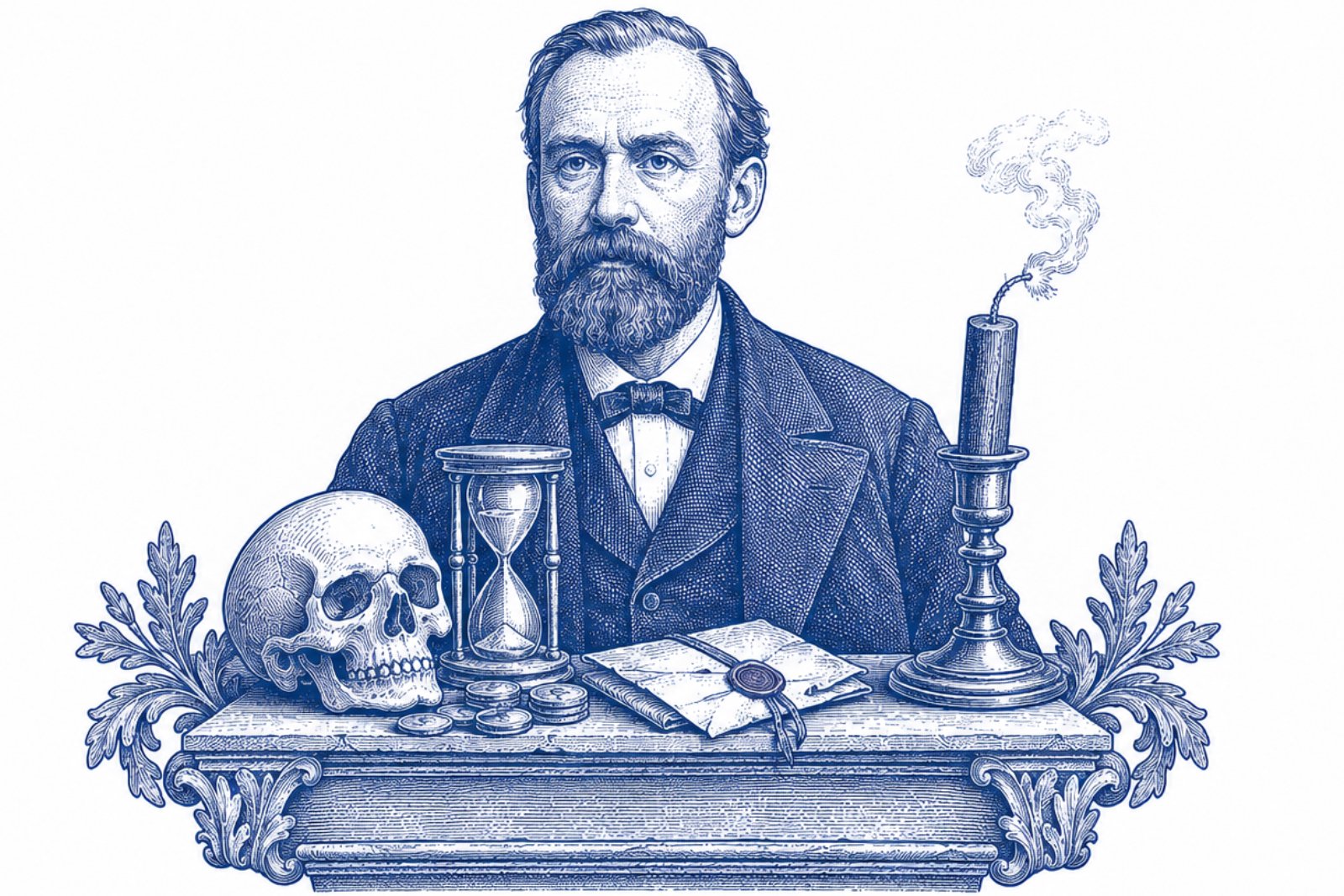
Nothing in the will told the executors what they then had to do. They had to find assets scattered across several jurisdictions, learn where the owner was deemed to live, because a court would ask, build an institution to receive the bequest where none existed, and find cash for the tax and patience for the family. A will answers the questions its author thought of, and the executors answer the rest, because the owner can no longer be asked. The last clause of the will is exact about the body: once competent doctors have confirmed death, his arteries are to be severed and his remains incinerated in a crematorium. Dutch painters of the seventeenth century set a skull beside the coins and papers in their still lives, and moralists read the skull as a sermon on vanity. Nobel’s still life has its skull in that clause, with the crates and the trotters for the coins and papers.
Coulet needed no more evidence than the stable. A man lives where he keeps his horses, he told the court. The judges of 1898 found nothing wrong with the sentence, and the prizes have been awarded in most years since.