


THE URINAL IN THE MUSEUM
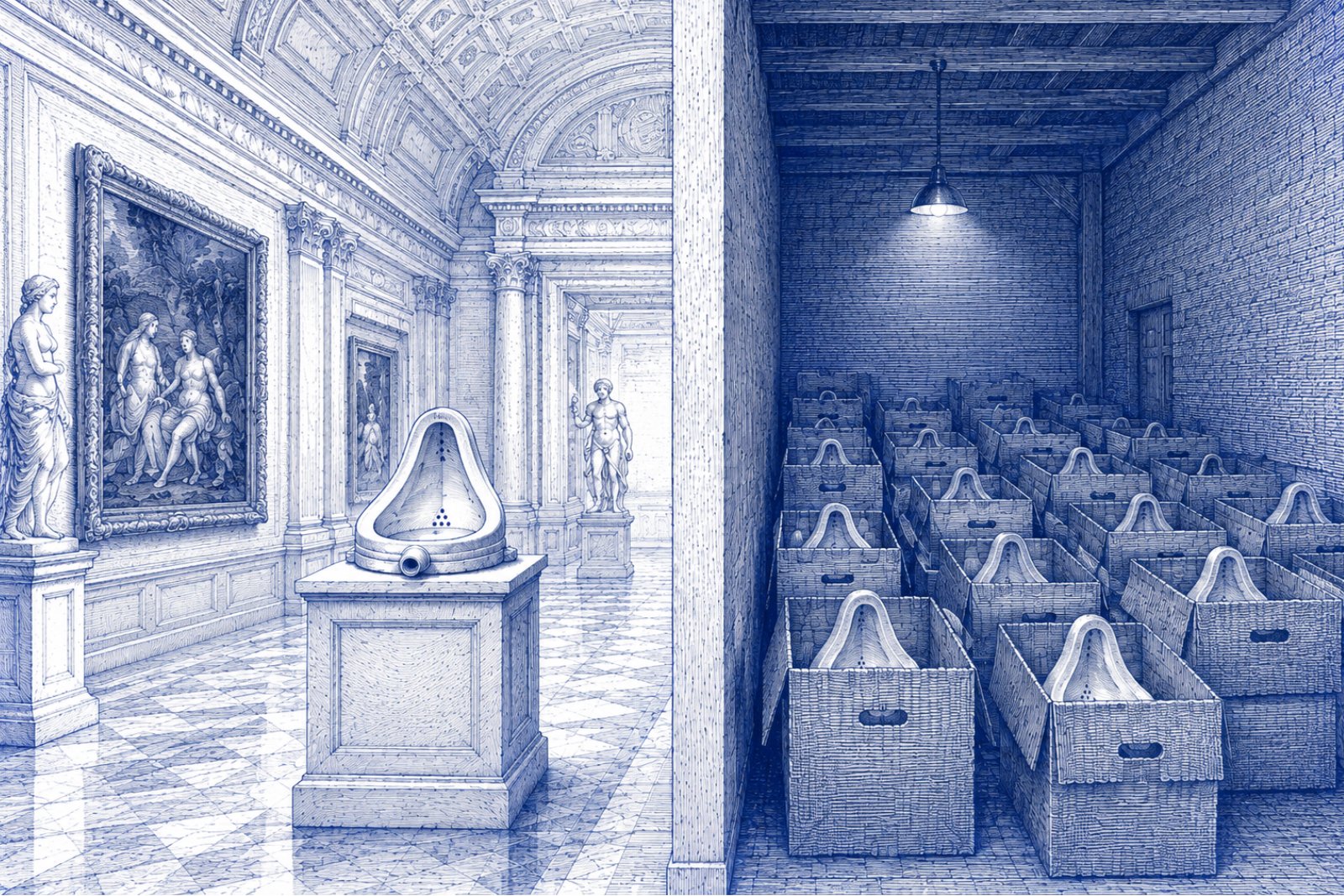
A plumber’s merchant on Fifth Avenue, the J. L. Mott Iron Works, kept a showroom of sanitary ware in the spring of 1917: basins, traps, cisterns, and along one wall the flat-back urinals that a builder ordered by the dozen for a hotel or a barracks. A customer came in and bought one. He did not haggle, and there was nothing to haggle over, since the object was catalogue stock of a type installed in thousands of buildings across the eastern United States that decade. He carried it away, laid it on its back so that the drainage holes faced the room, wrote a name on the rim in black paint, and had it delivered to the very exhibition that had promised to refuse nobody.
The exhibition was the first annual show of the Society of Independent Artists, opening that April in the vast rented hall of the Grand Central Palace, and its arrangements are what make the episode worth describing. The society had been founded that year on a rule borrowed from the French Indépendants: no jury, no prizes, six dollars from anyone who wished to hang, and works displayed in alphabetical order so that no committee could confer prominence by placement. The founders had split from an older, juried tradition precisely over this point, and the new rule was the whole selling point. It was printed on the announcements. A painter rejected everywhere else could, for the price of a modest dinner, hang beside anyone in New York, and some two thousand works arrived on that understanding.
It arrived on that understanding too, signed R. Mutt, with the fee paid.
What the board did next it did without much appetite for a record. The directors met on the eve of the opening, argued, and the object never reached the floor; it was placed behind a partition, and when the show opened the public saw the alphabetical hang exactly as promised, minus one item. The society’s own president, who had proposed the no-jury rule, resigned over the decision. The board never had to say outright that it had rejected the piece, since rejecting was the one thing the constitution did not permit it to do. The actual verdict, that the object was not a work of art, is a different sentence, and a much more expensive one. A society that had promised to jury nothing had discovered, in practice, a second kind of jury: the one that meets behind a partition and calls itself an editorial judgment.
Alfred Stieglitz, a photographer with a gallery of his own a few blocks away, took a picture of the object before it disappeared, and a small magazine called The Blind Man printed that photograph alongside an unsigned defence arguing that whether Mr Mutt made the fountain with his own hands was of no importance, since he had chosen it. The original then vanished. Every version standing in a museum today is a later replica, authorised and editioned in the nineteen-fifties and sixties, which means that the object taught in art history is a reproduction of a photograph of a missing piece of sanitary ware. The argument is still being had, more than a century on. The original porcelain failed to last even a decade before it disappeared entirely.
Consider by contrast the thousand siblings from the same production run. They were fitted into washrooms, used for forty or fifty years, and scrapped, and no ledger anywhere recorded their passing because there was nothing to record: a fixture depreciates to zero on a schedule a bookkeeper can write down in advance. The chair, the hammer, the length of pipe in the wall, the bracket holding up a shelf somewhere. Their worth follows from what they do, it declines as they do it less well, and the whole affair is settled without an audience. Economics handles this case beautifully and has done since before anyone thought to call it economics. Depreciation schedules do not argue. Nobody has ever convened a committee to decide whether a drainpipe still deserves its listed value.
Behind the partition sat an item that obeyed no such schedule.
Its worth lived inside a dispute over who had standing to make the call, and the dispute supplied the value directly: it functioned as the asset itself, with the object no more than the peg the argument hung on. Every month the argument continued, the position appreciated. One is tempted to call this reflexive, and the word fits, though it flatters the mechanism somewhat, since what looks like a market anomaly is, on inspection, the ordinary condition of anything whose price rests on continuing agreement and gets nothing at all from measurable output. A brand runs on exactly this fuel. So does a founder’s reputation, so does the premium paid for a company with no earnings and a persuasive account of why earnings will arrive, and so, if one is honest about it, does the credit of a solvent state.
We say premium, which sounds pleasantly technical, and the word does real work in a model. What it names is a shared willingness to keep believing, renewed daily, priced by the minute, revocable without notice and without anybody’s permission. The valuation arithmetic arrives afterwards to lend the belief a respectable surface, in the order such things always arrive: the conviction first, the spreadsheet second, the justification third and at some length. Accountants have their own name for the same fact, and keep it on the balance sheet under goodwill, an asset with no shape and no weight, checked every year by an auditor watching for signs that the believing has stopped.
And yet the two cases are not opposites, which is where the comfortable version of this story goes wrong. The hammer’s price also rests on an agreement, only one so old and so widely held that nobody experiences it as an opinion. Utility is simply belief that has stopped being contested. What the object on Fifth Avenue did was expose the gap between a price that has stopped being argued about and a price that never will be, and then, by an accident of the board’s cowardice, stand in that gap for a century.
Those men who voted that evening were not fools and they were not philistines. They were officers of a young society with a landlord, a printer’s bill, and a constitution they had written themselves in a hurry, and they discovered that a rule admitting everybody admits everybody. That is a discovery anyone who has ever drafted an open mandate will recognise with some sympathy. They had promised to refuse nobody. Somebody took the promise at face value, and the promise was, in the event, worth about as much as most promises made in a founding document by people who cannot imagine who will one day invoke it.
By now, what a urinal was worth in 1917 has a tidy answer, and the answer stopped being interesting decades ago. The harder question sits underneath it: how much of everything else in the room is priced on the same unaudited agreement to keep believing, and whose name would actually be on the file the day somebody finally asked to see it?
Leave a thought