


THE RHINO AT THE END OF THE TABLE
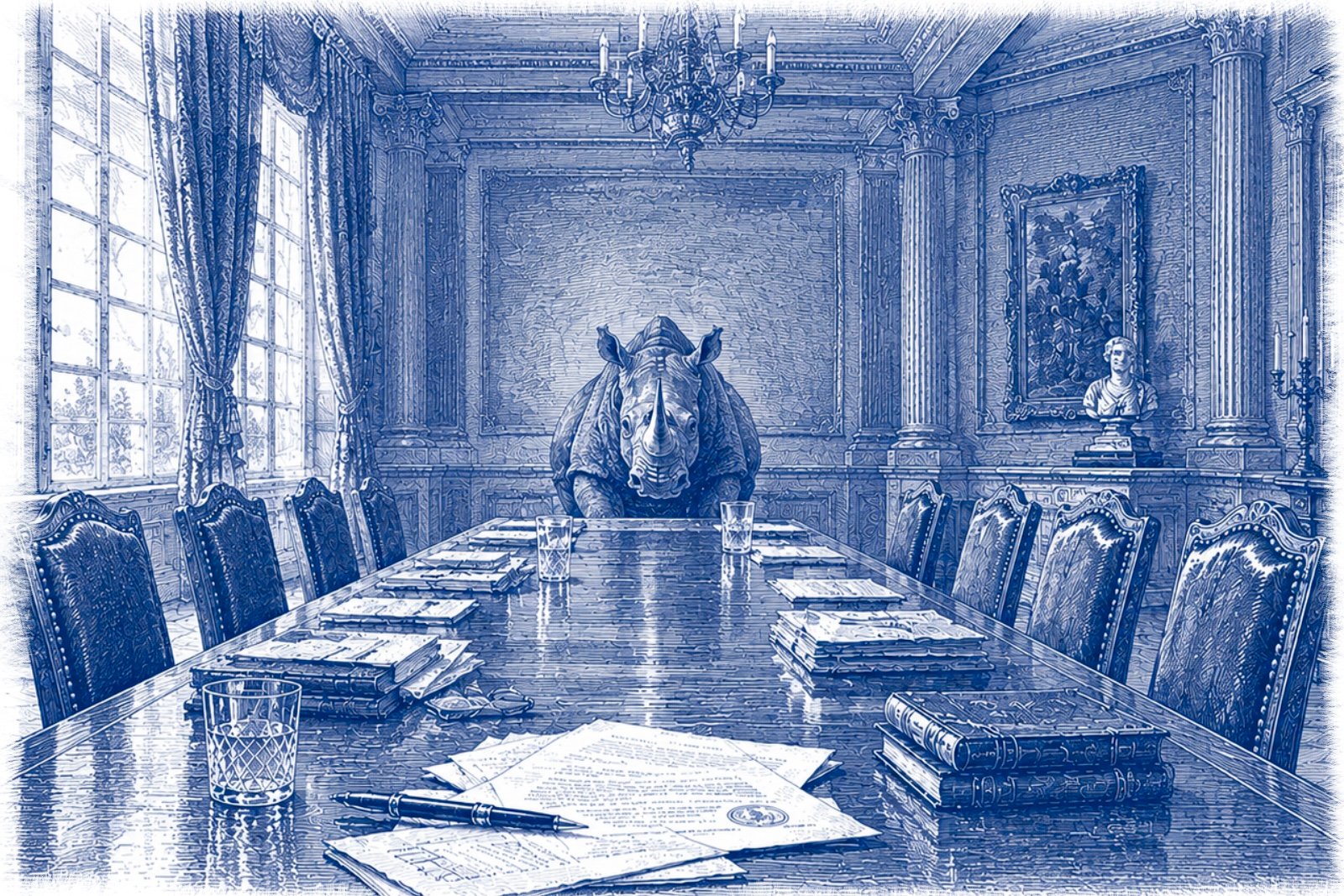
A rhinoceros is a difficult animal to miss. It is grey, it weighs more than two tonnes, and for years before it finally charges it simply stands exactly where it has always stood, in full view from across the room. A rhino left alone is, by the standards of a two-tonne animal, remarkably placid; it only charges when something finally forces the question, and by then the distance that made it look avoidable has already closed. Michele Wucker coined the term grey rhino at a Davos panel in 2013 and developed the idea at length in a 2016 book, deliberately set against a more fashionable idea that had dominated risk thinking for a decade: the black swan, Nassim Taleb’s name for the disaster nobody could have seen coming. Most institutional disasters, Wucker’s book argued, are simply rhinos: large, grey, and already seen by everybody in the room long before anything actually charges.
Wucker’s distinction matters more than the animal metaphor might suggest. Frank Knight separated risk, which can be priced because its odds are knowable, from uncertainty, which cannot be priced because its odds are not even in principle calculable; a true black swan lives in Knight’s uncertainty, genuinely outside the model, genuinely unknowable in advance. A grey rhino lives in perfectly ordinary territory. Its odds are entirely knowable, because somebody has usually already calculated them and written the result down in a memo that is sitting, unread by the people who most need to read it, in a file marked low priority. Confusing the two categories lets an institution borrow the humility owed to a genuine black swan and spend it excusing a failure that was never actually a surprise to anyone close to the numbers.
Nothing about eyesight explains the difference. Psychologists have a name for the relevant habit, normalcy bias, which amounts to little more than trusting that tomorrow will resemble today because every yesterday so far has, a belief that gets reinforced daily for exactly as long as it holds and is shattered without notice on the one day it finally does not. Acting on an obvious threat costs something now, in money, in effort, in the standing of whoever has to walk into a room and tell colleagues their favourite number is wrong, against a loss that remains, for the moment, comfortably hypothetical. The delay is best understood as a rational reading of whichever incentives are actually on the table that quarter.
Silicon Valley Bank gave the pattern a recent and expensive demonstration. By the end of 2022 the bank had built an enormous portfolio of long-duration government and mortgage bonds, bought back when interest rates were close to zero, and every basic fact needed to see the danger in that position was already sitting in its own public filings. Bond prices fall as interest rates rise, further for a longer-dated bond than a shorter one, and 2022 delivered the fastest rate increases the Federal Reserve had produced in four decades. By the bank’s own disclosures, the unrealised losses sitting inside that bond book ran into the billions: large enough, measured against the bank’s capital, to raise a real question of solvency, well beyond ordinary accounting noise, for anybody who gave the actual numbers more attention than the quarter’s headline profit.
This was a judgement available well before any hindsight was needed. Federal Reserve supervisors had flagged the bank’s interest rate exposure directly to its management more than once in the two years before it failed, in exactly the kind of internal finding meant to be acted on before a crisis arrives, well ahead of whatever filing and citing happens afterward. Acting meant selling part of the bond portfolio at a loss, raising fresh capital at a worse price than the bank would have liked, or both, publicly, in front of shareholders who were not going to enjoy watching either. Not acting meant a number that stayed comfortably inside the “unrealised” column for one more quarter. Every individual incentive inside the building pointed toward the second option, for exactly as long as the depositors did not notice.
The run on the bank itself came in March 2023. Social media and mobile banking compressed it into about thirty-six hours. A sufficient number of the bank’s own depositors, many of them technology companies holding balances well above the insured limit, had read the same numbers everyone else could have read for a year. Now they acted on them, before their neighbours did. Withdrawal requests on the single worst day are reported to have run on the order of forty billion dollars, a sum no bank, however well run, keeps in cash against one afternoon. Regulators closed the bank on a Friday. It was, by assets, the second-largest bank failure in American history to that point, and every fact that produced it had been sitting in a public filing for months.
Aftermath mostly extended the pattern, doing very little to interrupt it. Regulators, worried about contagion to other regional banks holding similar portfolios, took the unusual step of guaranteeing deposits above the normal insured limit, funded through a special assessment levied specifically on the banking industry, a distinction that mattered more to accountants than to anyone else. The specific people who had chosen, year after year, not to hedge the interest rate exposure or raise capital earlier did not personally bear the cost of that choice in anything like the proportion they would have borne the cost of acting early and turning out to be wrong. Most individual rescues, including this one, were probably necessary on their own terms: the downside of waiting is routinely socialised, and the downside of moving early and being premature is not.
SVB turns out to be a common specimen of the type, not a rare one. The Boeing 737 Max’s flight control software drew internal concern, including from the company’s own engineers and test pilots, well before it was linked to two crashes that killed three hundred and forty-six people between them. Subprime mortgage risk was flagged, in writing, by analysts inside and outside the banks that went on to collapse in 2008, years before most of them did. The register existed each time. The warning existed each time. What was missing, every time, was somebody senior enough to accept a certain, bounded cost today against an uncertain, unbounded one tomorrow, while accepting it could still matter.
None of this makes for an interesting account of surprise, which is exactly the point. The forecast, such as it needed to be, was adequate: a rate-sensitive bond book loses value when rates rise, which is pure arithmetic, the kind every first-year finance student is taught. The arithmetic held up fine; the hierarchy sitting above it did not. Nobody senior enough to matter was willing to trade a quiet, survivable loss today for the chance of a much larger, louder one later, on somebody else’s watch if the dice happened to fall that way. None of that shows up in a risk model, because a risk model does not know who is due for a bonus review in the spring, and has no line item for what a room decides it would rather not discuss this afternoon.
An individual balance sheet keeps rhinos too, generally easier to spot than SVB’s was, which does not make them any easier to act on. A mortgage at a floating rate nobody has checked against what a further two points of increase would actually do to the monthly payment. A household income concentrated in a single employer whose own balance sheet nobody in the family has ever actually read, or a life carried for a decade without disability cover, past the point where going without it quietly stopped making sense. None of these needs a forecaster. Each one is already sitting in a drawer somewhere, in plain view, exactly like the animal standing at the far side of the boardroom, waiting for whoever owns it to find a Tuesday inconvenient enough to finally look.
Return to the room itself, because the decision was never abstract. A board sits around a table, reviewing a risk register that lists the interest rate exposure in its correct place, probably has done for two years running. Somebody has noticed a small, manageable, comfortably quantifiable problem elsewhere on the agenda, a stain on the tablecloth, and the discussion runs long on that instead, because the stain is solvable this afternoon and the rhino is not. The rhino stands in plain view at the far end of the boardroom, for exactly as long as everyone finds it more convenient to discuss something else, and then, without any particular warning beyond the two years everybody already had, it moves.
Leave a thought