


THE EMPIRE WITH NO TERRITORY
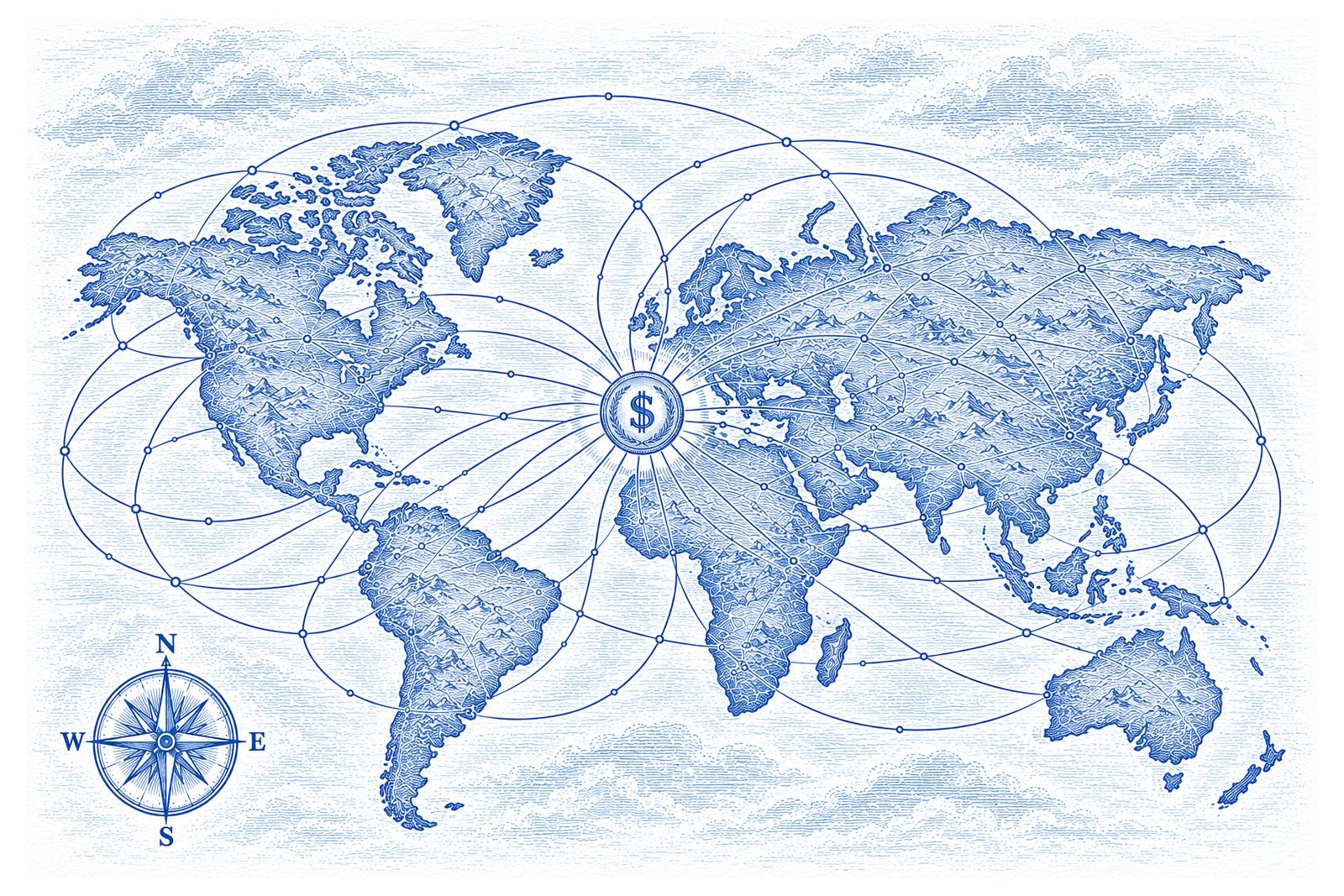
Where, exactly, is a dollar created? The textbook answer involves a printing press in Washington and a ledger at the Federal Reserve, and for most dollars that will ever exist, the textbook answer is the true one. A very large and largely invisible fraction of them are created somewhere else entirely: on a trading floor in London, or Tokyo, or the Cayman Islands, where a bank that answers to no American regulator takes a dollar deposit from one customer and lends dollars to another, manufacturing, in the lending, dollars that the United States Treasury never printed and the Federal Reserve never counted. No fractional reserve requirement from Washington reaches that loan, no deposit insurance from Washington backs it, and the dollar created this way is, for every ordinary purpose, exactly as real and exactly as spendable as one drawn from a cash machine in Ohio.
This is the eurodollar market, and the name is almost entirely misleading: it describes neither the euro, which did not exist for the market’s first four decades, nor Europe especially, since identical mechanics now run through Singapore and the Cayman Islands as readily as London. A eurodollar is simply a dollar-denominated deposit held at a bank outside the United States, and the market in such deposits, and in the loans made against them, has grown into one of the largest pools of credit on the planet. The Bank for International Settlements, which tracks as much of this as anyone does, has put the stock of dollar credit extended to borrowers outside the United States at several trillion dollars in recent years, a figure its own staff describe as a floor rather than a ceiling, since large parts of the market are simply not captured by anybody’s reporting requirements. It is invisible on any map precisely because it was never drawn on one.
None of this requires anything exotic in the way of banking technology. A bank accepts a dollar deposit and makes a dollar loan, the same two sides of the same ledger entry every bank everywhere has always run, and the only thing that has changed is which government’s rulebook happens to apply to the transaction, which turns out to matter a great deal more than the mechanics themselves do. The 2008 financial crisis showed what this arrangement actually costs the country whose currency it borrows. Foreign banks had built up enormous short-term dollar funding needs through the eurodollar market, lending long in dollars while borrowing short, and when the crisis froze interbank lending everywhere, those banks found themselves needing dollars with no domestic central bank able to print them. The Federal Reserve ended up extending currency swap lines, which peaked at a little over half a trillion dollars outstanding at any one time, to more than a dozen foreign central banks. The mechanism itself was simple enough to describe, however unusual the amounts involved. The Fed lent dollars directly to a foreign central bank, which then re-lent those same dollars to banks inside its own jurisdiction that had run short. The foreign central bank bore the credit risk; the Fed faced only the risk of a sovereign counterparty, a safer exposure by a wide margin than a single struggling commercial bank would have been. The choice was not really a choice. A eurodollar funding freeze abroad would have come home to American markets within days, through channels the Fed could already see but had never had the authority to govern directly.
That same machinery was dusted off again in March 2020, when a dash for dollar cash at the start of the pandemic produced funding strains that regulators recognised immediately, because they had seen the shape of it once before. The swap lines were reopened within days, to many of the same central banks, for substantially the same reason: a market the United States does not run had seized up, and only the United States had the one thing capable of unseizing it.
Ordinary savers feel this system’s reach most sharply when a crisis somewhere else in the world turns out to be a dollar crisis wearing a local name. A government or company in Jakarta or Buenos Aires that borrowed in dollars, because dollar borrowing was cheaper and deeper than borrowing in its own currency, discovers whenever the Federal Reserve tightens policy at home that its debts have just become more expensive in a currency it does not issue and cannot create more of to meet them. The event gets reported as an emerging-market currency crisis, a local failure of local policy. Underneath that it is usually also a dollar shortage, born of the same offshore borrowing, arriving in a country that had no vote in the decision that caused it.
By the 1980s the market had grown large enough to spawn its own derivatives and its own reference rate. The Chicago Mercantile Exchange launched eurodollar futures in 1981, contracts that let a trader bet on where the interest rate attached to these offshore dollar deposits would sit months or years in advance, and for a long stretch the contract became the most actively traded interest rate futures product in the world. The underlying rate itself acquired a name, the London Interbank Offered Rate, LIBOR, which went on to become the reference written into trillions of dollars of mortgages, corporate loans and derivatives contracts worldwide, a number set each morning by a panel of private banks estimating what they believed they would pay, for a market that, again, no single regulator actually ran.
The often-told story credits Soviet state banks, worried that dollar deposits held in New York could be frozen by Washington for political reasons amid the Cold War, with moving their dollar balances to London and Paris in the 1950s to place them beyond American jurisdiction’s reach. It is a good story, and it may even be true in part, though nobody has produced archival proof precise enough to settle it. The better-documented driver is less colourful. In 1957, facing a sterling crisis, Britain restricted the use of sterling to finance trade between other countries, and British clearing banks, Midland prominent among the first, simply began financing that same trade in dollars, booked in London, outside any American rule because the transaction never touched American soil. A workaround for a currency crisis in one country created, almost by accident, a dollar market no country was actually running.
Growth from there was fast by any historical standard. Paul Einzig, a Financial Times correspondent who had been tracking the new market since its earliest days, published the first systematic study of it in 1964, by which point it was already too large for any single institution to claim it had planned. Within two decades, on the rough estimates available from the period, the market had gone from a standing start to several hundred billion dollars, expanding every time some other government tightened its own capital controls at home and pushed its banks to look for dollars offshore, each new control adding liquidity to the very market the controls were supposedly working against.
An arrangement of this kind amounts to something like an empire that owns no territory: a loan covenant standing in for a border, a correspondent banking relationship standing in for a garrison, a liquidity line standing in for a treaty. Nobody files a map of it anywhere, because what is actually being governed is a set of promises between institutions, a currency of commitments where an ordinary empire would measure acres, and a promise changes jurisdiction every time somebody rolls the loan over.
For the sovereign whose name is stamped on every note involved, this is a strange kind of authority to hold. The dollar keeps multiplying through the night in rooms no American examiner has a key to, in transactions nobody in Washington actually sees until long after they have already settled, and when the arrangement comes under strain, as it did in 2008 and again in 2020, the country discovers the size of its own exposure at the exact moment it is forced to backstop a system it never agreed to run.
A political map still shows tidy, defended borders, and underneath it a second map, denominated purely in money, has been drawn for seventy years by banks answering to nobody in particular, in a currency that belongs to a government increasingly unable to say where all of it sits on a given night. Every other kind of empire in history eventually had to station someone on the ground to keep its provinces in line. This one manages without, because a loan is self-enforcing in a way a border garrison never was: break the covenant, and the credit simply stops arriving next time, no soldiers required. If a sovereign must repeatedly rescue a system every time that system’s private expansion of his own currency comes under strain, which one of the two is in charge: the government whose name sits on the banknote, or the ledger it can no longer fully see?
Leave a thought