


THE BOOK IN WHICH GENTLEMEN COULD NOT RETREAT
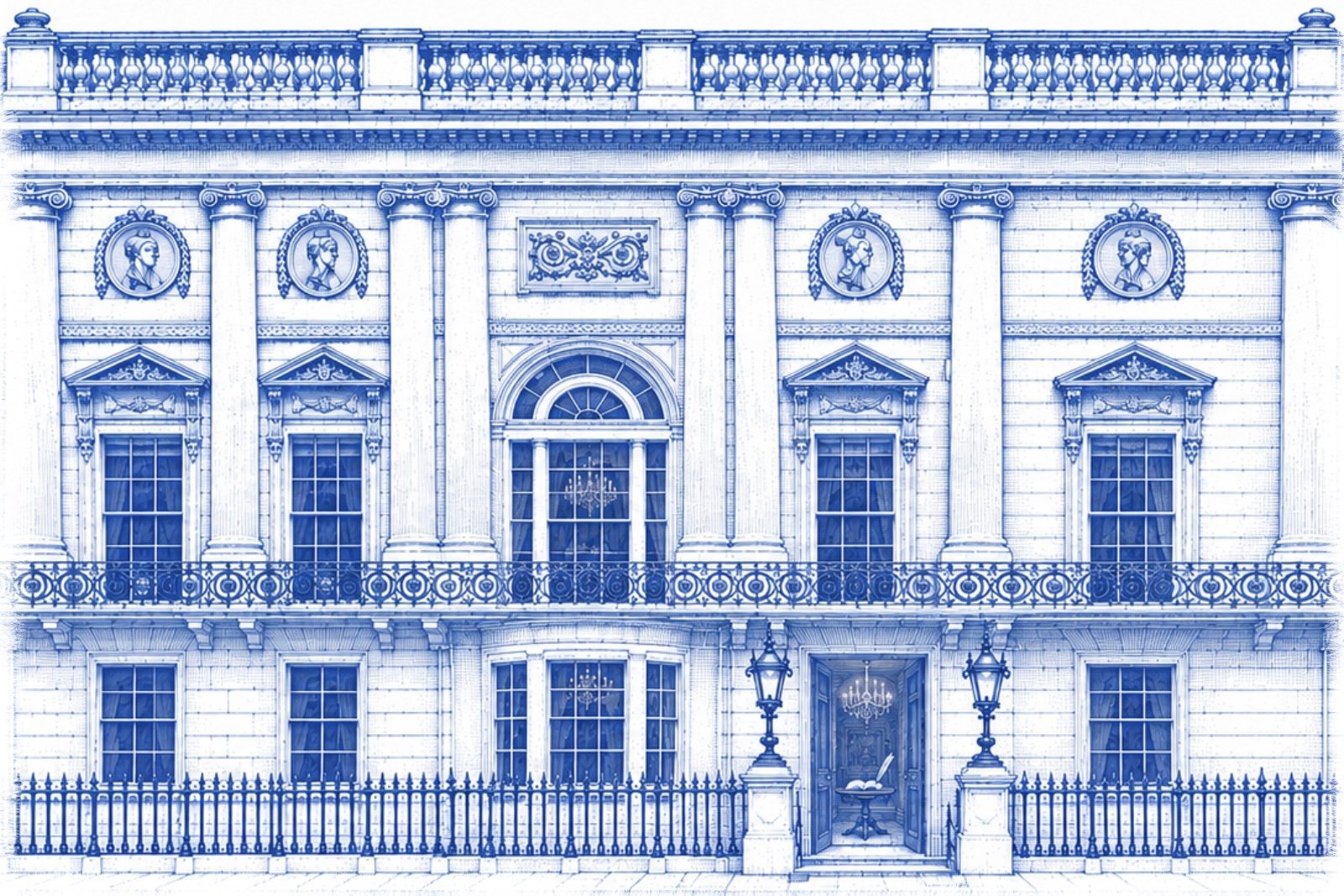
St James’s Street, in 1693, gained a new chocolate house, one of dozens that opened in London that decade and, on the face of it, no different from the rest. Within a century the business had shed the chocolate entirely and become White’s, the oldest and most exclusive gentlemen’s club in London, a club younger than the City’s livery companies but, by one standard comparison, a year older than the Bank of England itself. By 1778 it had settled into the building at numbers 37 and 38 St James’s Street that it still occupies today, its membership drawn from precisely the circle of men whose good word mattered most to one another and least to anybody outside the room.
The chocolate house’s founder, an Italian immigrant who had anglicised his name from Francesco Bianco to Francis White, would scarcely have recognised what his shop became. One object in that room mattered more than anything else inside it: a bound ledger where members set down each wager by hand, naming the stake, the parties and the date. Algernon Bourke’s history of the club, published in 1892, reproduces entries running from 1743 to 1878, naming the men involved and the day the ink went down; one surviving example, dated 12 December 1758, records a wager between a Mr Fanshawe and a Captain Rodney, the stake itself now lost to a torn page but the two names and the date fixed forever regardless. A century and more of this sits in Bourke’s pages, entry after entry: trivial wagers, kept with a formality gossip never earns.
Much of what went into the book was, by any sober measure, trivial. Members wagered on an election result, on the likelihood of a marriage, on how long a hard winter would run, on almost anything that could be stated as a proposition and settled later by the plain fact of what happened. Read purely as entertainment, the book looks like exactly what a certain kind of history prefers: a harmless eccentricity of wealthy men with time to spare and no better use for a quill. That reading survives for exactly as long as nobody asks what the ink itself was actually doing.
An opinion spoken aloud at a card table belongs to the man who spoke it, and to nobody else; he can qualify it an hour later, or abandon it outright, at no cost beyond a little embarrassment among friends who will have forgotten the whole business within the month. An opinion written into the club’s own book, under his own name, witnessed by men he will see again at dinner for the next thirty years, acquires a second owner that a spoken opinion never had: his own standing among exactly the people whose good opinion he has spent a lifetime cultivating. Withdrawing the bet risks that standing directly, not the handful of coins staked on it.
Psychology eventually gave this a name, though not for another two and a half centuries. In 1976 the organisational researcher Barry Staw ran an experiment, since treated as the founding study of what the field now calls escalation of commitment. Business students were asked to allocate research funding across a company’s divisions, told how each division subsequently performed, and then asked to allocate a second round of funding; those who had personally chosen the division in the first round, and then been told it was failing, went on to invest substantially more of the second round into that same losing division than students who had simply been handed somebody else’s earlier choice to continue. The finding was narrower than the folklore built on top of it since. Staw’s original design isolated personal responsibility for the choice; whether the choice had also been made in public was a separate question, one his own later work took up directly, arguing that a decision taken in front of others recruits a motive a private decision never has to answer to, the need to be seen by those others to have been right all along.
That second motive is easy to confuse with an ordinary sunk cost, though the two are not the same. A sunk cost is simply money already spent, irrelevant to any rational decision about what to do next, and people overweight it even sitting entirely alone with nobody watching at all, filling in a tax return, say, with nobody else in the house. White’s book added something a sunk cost alone never supplies: an audience. A private miscalculation does not require one; a reputation absolutely does. White’s own betting book had reached this conclusion a touch under two centuries before Staw’s experiment confirmed it, simply by building that audience into its furniture.
Martin Shubik, an economist who later held an endowed chair in mathematical institutional economics at Yale, demonstrated how far this can run, in a short 1971 paper for the Journal of Conflict Resolution bearing the dry title “The Dollar Auction Game: A Paradox in Noncooperative Behavior and Escalation.” The game it describes is simple to set up and hard to watch without wincing. A dollar bill is offered to the highest bidder in the usual way, with one deliberate alteration: the second-highest bidder also pays their own final bid, and receives nothing at all for it. Shubik’s point was simple. A rival bidder changes what the dollar is actually being fought over: each side is now bidding to avoid being the one who pays for nothing, and that particular fear has no natural ceiling. Classroom audiences given the game to play have been recorded, repeatedly, paying considerably more than a dollar in total to win a single one, for the same reason a member of White’s found it cheaper to raise his own stake again than to be the man who struck out an entry under his own name.
None of this requires a betting book specifically. A live auction today runs on an almost identical mechanism, quite deliberately: a raised paddle is a visible, witnessed act performed in front of a room of people who will remember who bid and who stopped, which is exactly why auction houses still run their bidding in the open, long after sealed bidding became trivially easy to arrange by post or by telephone. The room is the point, at Christie’s as much as it ever was at White’s.
Precisely this logic produced, in the final quarter of 1988, the largest leveraged buyout then on record, later chronicled at length in Bryan Burrough and John Helyar’s Barbarians at the Gate. Ross Johnson, the chief executive of RJR Nabisco, opened a management-led bid for his own company at seventy-five dollars a share on 20 October, backed by Shearson Lehman Hutton. Kohlberg Kravis Roberts, the buyout firm led by Henry Kravis and George Roberts, entered the contest six days later at around ninety dollars a share. The two sides spent a month raising paddles at each other in public, in front of a board, a press corps and a cast of bankers who were themselves being paid handsomely to keep the bidding alive, until the final figures stood at a hundred and twelve dollars a share from management against a hundred and nine from Kohlberg Kravis Roberts, a contest by then worth some twenty-five billion dollars to whichever side actually won it. Every one of those bids had been placed in front of journalists who would print the next one by morning, which is as public a room as a gentleman’s club ever was. The board took the lower number. Management’s higher bid rested on financing the board judged less certain to close in practice, and a smaller, firmer figure beat a larger, shakier one, a rare moment in which somebody in the room was finally paid to value certainty over ego, arrived at only once the bidding itself had made the distinction unavoidable.
A room run on this logic always settles two separate accounts, though only one of them is ever itemised. The money changes hands in the ordinary way, recoverable the moment the object is resold at whatever it genuinely turns out to be worth. The standing a man spent defending his own bid changes hands as well, and no market has ever been found willing to buy it back, in St James’s Street or on Park Avenue. White’s kept no column for that second account, and neither, as it happens, did Wall Street in the final weeks of 1988. A signature collected in front of witnesses works less on whoever reads it afterward and more on the man holding the pen at the time: it closes, permanently and on the spot, his own easiest route back out, which is precisely what it was always for.
Leave a thought