


NAPOLEON’S 130 DÉPARTEMENTS
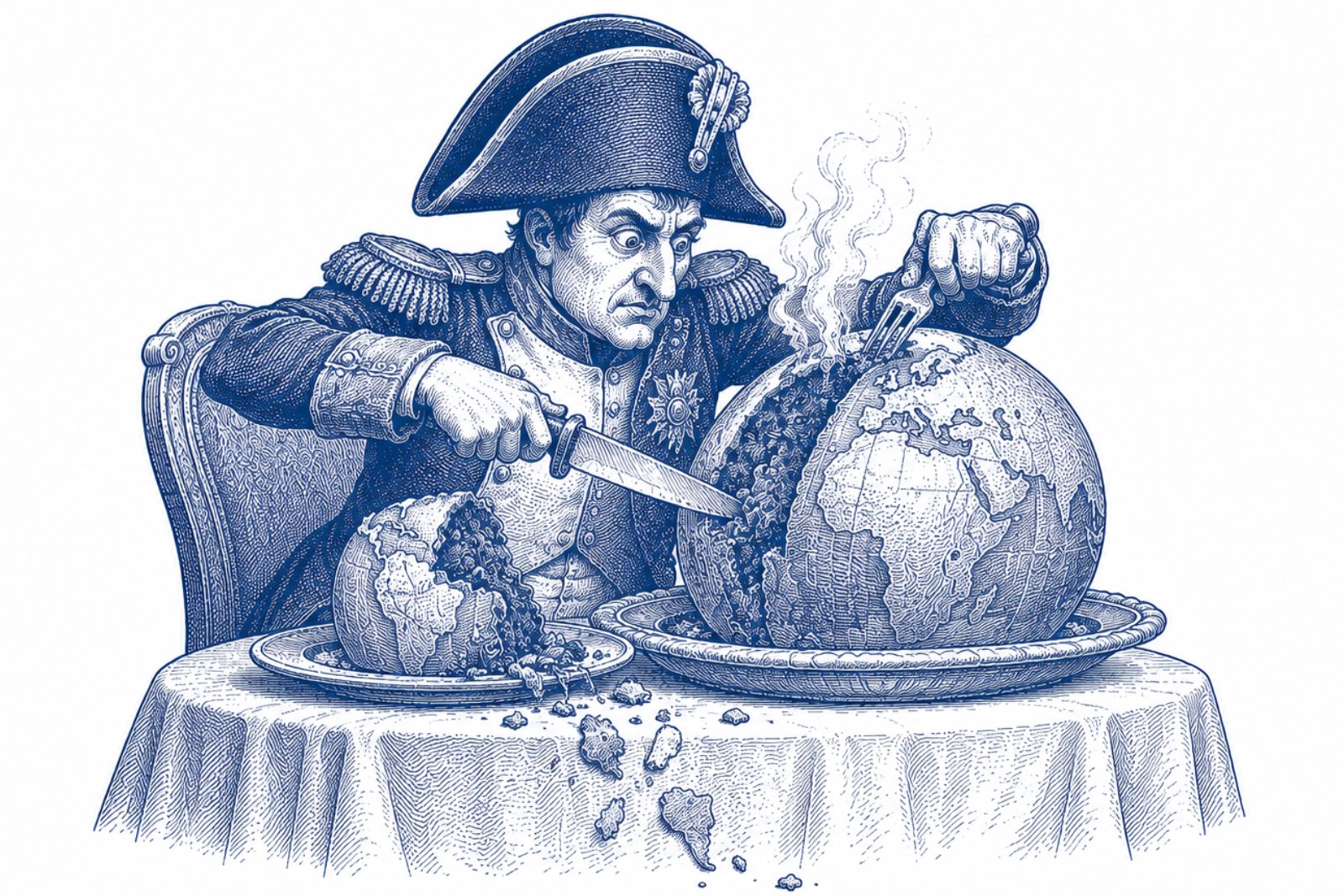
On 26 February 1805 Hannah Humphrey published at 27 St James’s Street a print that, for about five shillings, a passer-by could take home hand-coloured. James Gillray’s prints were shown in her shop window, where eager crowds examined them. Napoleon had just sent King George an offer of peace while threatening invasion from Boulogne, and Gillray thought the offer funny. He had drawn two men in uniform at a dining table with a plum pudding between them, and the pudding was the world. He called it The Plumb-pudding in Danger, or State Epicures taking un Petit Souper.
William Pitt, tall, thin and in red, steadied the globe with a trident for a fork and sliced off the ocean and the West Indies. Napoleon, shorter, stockier and in blue, drove a sword into Europe, and his fork stood planted over Hanover. Pitt eyed his fellow guest warily, and Napoleon stared fiercely at the pudding. Each had a small plate of his own, Pitt’s with the royal arms and Napoleon’s with an imperial crown. The caption borrowed from The Tempest to say that the great globe itself was too small for such appetites. It remains, by the National Portrait Gallery’s reckoning, probably Gillray’s most famous print, and the joke has lasted because every guest at the table believes he is carving a slice. Gillray gave the sea to the Englishman and the land to the Frenchman, and the Frenchman’s slice was much the smaller. Land, as events proved, needed far more administration than water.
Pitt did not last long at the table, for he died in January 1806. After the news of Austerlitz he is reported to have said, of the map of Europe, “Roll up that map; it will not be wanted these ten years.”
A slice is easy to draw, and on Napoleon’s map the slices were départements. At its height, around 1811, the empire counted 130 of them, each with a prefect, a capital and the same laws as the others. The map had been coloured in by decree. Take Rome first. The Papal States were annexed on 17 May 1809, the Pope was arrested soon afterwards, and in September a young prefect named Camille de Tournon was appointed to govern the Eternal City as a provincial capital. A prefect with broad powers and no money of his own to command, he dug out the Colosseum and the Baths of Titus, and an imperial commission set about beautifying Rome and draining the Pomptine Marshes, until storms broke the dykes at the end of 1813 and the funds dried up. The Minister of the Interior had called him, in 1811, the youngest and the best of the prefects. When Joachim Murat took Rome in January 1814 the prefect left the next day, a promptness I cannot fault.
The marshes had to wait for Mussolini.
Holland followed in 1810. Louis Bonaparte, whom his brother had made King of Holland, had worked hard at his Dutch and is said to have opened his reign by announcing himself as the Konijn van Holland, the Rabbit of Holland, for the Koning. He abdicated on 1 July 1810 with Napoleon threatening to put an army into Amsterdam, and Holland was annexed by decree on 9 July. From 1 January 1811 it was divided into seven départements, one of them named Zuyderzée after the sea that had made Amsterdam rich. The Dutch navy ceased to exist on the same day, absorbed into the imperial one, and between 1810 and 1813 about 35,000 Dutchmen were conscripted into the army or the fleet, some 25,000 of them marching to Russia. Napoleon visited his third capital in October 1811 and stayed a fortnight in the royal palace, touring wharves, barracks and the fortifications on Pampus, and discussing the Continental System with the Dutch merchants who were to live under it. In 1811 his officials closed the universities of Harderwijk and Franeker.
British goods leaked through the blockade at every port, and Napoleon’s remedy was to annex the port. The largest leak was the north German coast, and Hamburg and Bremen, annexed in December 1810, had lived on exactly the trade the blockade forbade. Caspar Voght, a Hamburg merchant and its most active philanthropist, had predicted in 1803 that war would end the city’s neutrality. When he came home in September 1812 he described it as empty and desolate, and said that the work of his life had been destroyed. He had been right, and it had helped nobody.
Marshal Davout governed Hamburg as Governor-General of the Hanseatic cities, and when the war turned against France in 1813 he shut his garrison up inside the walls. In November the French seized the contents of the Hamburg Bank, 7,489,343 marks banco, and melted the bullion into coin for wages and the army. Davout was accused afterwards by some of keeping part of it for himself. In December he sent 15,360 people out of the city in three days to save the food. A city that had just lost its bank now lost its people, for the sake of the food. He held 42,000 men, of whom 8,000 lay in hospital. The province added to the map for its customs duties was now being eaten by the troops who held it.
By 1814 the départements beyond the old frontiers were gone, Rome among them. The colour that had gone on at the stroke of a pen came off in a season. Davout gave up Hamburg only on the order of Louis XVIII, the king who had replaced his emperor. A prefect in Hamburg could report the bank’s balance and the price of sugar and still be unable to say whether the city would hold. The centre sent orders to places it had never visited, and the places sent back bills.
General Electric made the same journey over a longer calendar. It was among the twelve companies of the first Dow Jones Industrial Average in 1896 and had stood in it without interruption since 1907. The journalist David Gelles has called Jack Welch an imperial executive, and the balance sheet bears him out. When Welch took charge in 1981 the company was worth under 15 billion dollars, and by 2000 its market value reached 594 billion. Its lending arm, GE Capital, grew until it held more than 600 billion dollars of assets, and when the financial crisis came in 2008 GE needed 139 billion dollars of government guarantees and an emergency share sale of 15 billion, a fifth of it from Warren Buffett. By March 2009 the shares stood below 7 dollars, against 42 in October 2007, and the company had lost its AAA rating.
Sales of the provinces filled the next decade. GE sold its remaining 49 per cent of NBC to Comcast in 2013 and its appliance business to Haier in 2016. In 2014 it had announced the largest acquisition in its history, a bid of 17.1 billion dollars for the energy business of Alstom, and four years later it took a goodwill writedown of 23 billion dollars that Bloomberg attributed mainly to overpaying for it. On 19 June 2018 the Dow announced that it would replace GE with Walgreens, and the shares fell as low as 12.67 dollars, which would have been their lowest close since 2009. It was the last of the original twelve to go. A company that had stood in the index since 1907 gave its place to a chain of chemists.
Napoleon had prefects and GE had divisional chiefs, and each did well by the standards of his own province. Every purchase had a sponsor who could explain it. The sum of the purchases was seen by no one, because no meeting was convened to look at it, and the question of whether the centre still grasped the whole went unasked until the answer arrived as a loss.
Larry Culp, an outsider and the first in the company’s history, was brought in as chief executive in 2018 and spent the next six years dividing the inheritance. The company announced in November 2021 that it would split into three. GE HealthCare began trading in January 2023, and on 2 April 2024 the other two, GE Aerospace and GE Vernova, set up on their own. Of Welch’s conglomerate nothing remained under one roof except the name, and the name went to the jet engines. The ticker GE belongs now to a company that builds aircraft engines and does little else.
In Gillray’s print the slice on Napoleon’s side is labelled Europe, and the sword is already in it. Nobody drew what followed, when a slice has to be fed, governed and paid for, and I never see a plum pudding now without counting the forks.
Leave a thought