


JAKOB FUGGER PAID FOR AN EMPEROR
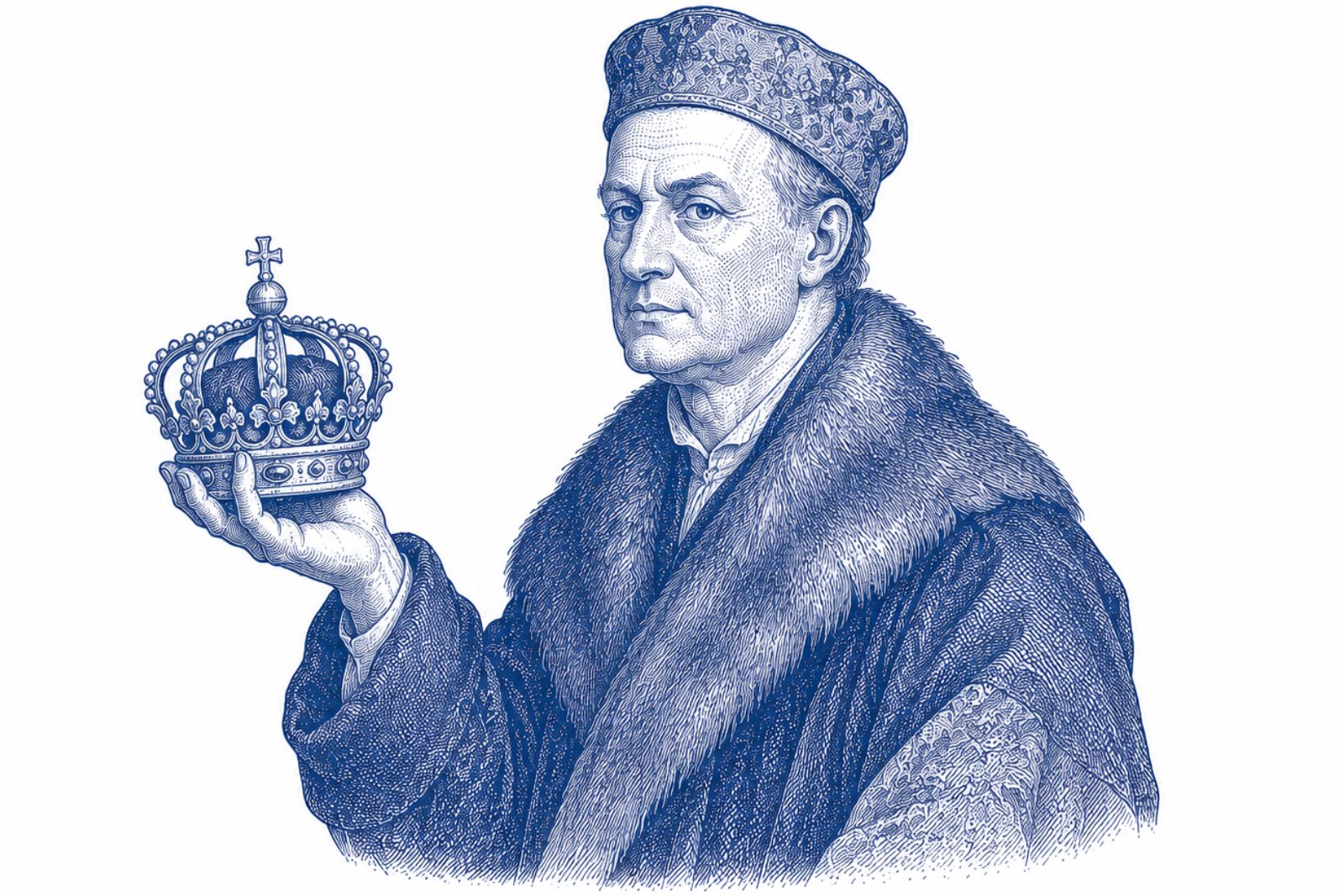
In 1518 Albrecht Dürer painted a man of fifty-nine in a close golden cap, clean-shaven and level-eyed, with the expression of a clerk who has just found that the figures agree. The sitter was Jakob Fugger of Augsburg, the richest merchant in Europe. The following year he financed most of an emperor’s election.
The figures, it seems, did agree.
Maximilian I died in January 1519 and left the crown of the Holy Roman Empire to be disposed of. Seven electors held the vote, and they were open to persuasion. The contest came down to the young Charles of Spain and Francis I of France, who had already bought the Elector of Trier. The persuading cost about 852,000 guilders in all. Jakob Fugger supplied about 543,000 of that sum, and the Welser house of Augsburg and some Italian bankers found the rest. Frederick the Wise of Saxony, whom some of the electors would have preferred, reportedly refused the crown. Charles was elected unanimously at Frankfurt on 28 June 1519. Historians still argue about how much the money decided. The Fuggers needed no debate to settle the point. By 1521 the debts of their candidate had passed 600,000 guilders, and repayment came partly as rights to mines, among them the Spanish quicksilver that the firm worked for decades.
By the spring of 1523 Jakob Fugger was writing to remind Charles that His Imperial Majesty could not have claimed the Roman crown without his help. It was an invoice, delivered in the form of a reminder.
Dictated to a scribe that spring, his collection notice ended in the voice of a clerk, with the demand that “the money which I have paid out, together with the interest upon it, shall be reckoned up and paid without further delay.” Charles held eighty-one titles, among them king of Naples, king of Jerusalem and lord of Asia and Africa, and not one of them had settled the account.
Whoever finances a candidate becomes the creditor of an emperor, which is a better position than lending to one already crowned.
For such a customer Jakob had prepared all his life. Born in 1459 into a family of Augsburg cloth merchants, he made his fortune lending to the Habsburgs against the silver and copper of the Tyrol. In 1507 Maximilian sold him the lordships of Kirchberg and Weissenhorn for 50,000 guilders, and by the end of his reign the emperor owed so much that he had every reason to keep his creditor in good health. The family fortune stood at about 200,000 guilders in 1511 and had passed two million by the time Jakob died, around two per cent of the economy of Europe by one modern biographer’s reckoning. The firm worked through a web of permanent trading houses in the great commercial cities, staffed by loyal employees, and it held rights over mines, manors and villages in more than two hundred places. It ran like a miniature state, with envoys, agents and a foreign policy that consisted mostly of arithmetic.
Jakob had no children. When he died on 30 December 1525 his nephew Anton, whom he had named as successor eight years before, took over a firm with assets of 2,032,652 guilders.
Seven weeks after the funeral Jakob’s widow, Sybille Arzt, married one of her late husband’s business partners and became a Protestant. The widow, at least, settled her affairs with admirable speed.
Anton ran the business with his brother Raymund and his cousin Hieronymus, and the question that every rich house puts to itself had begun to be answered: what becomes of a fortune made by one man when it passes to people who did not make it. Mixed is the fairest word for the answer. Anton moved the business towards Spain, bought land, and saw the firm’s assets reach their peak in 1546. He married Anna Rehlinger in 1527, fathered four sons and six daughters and married the children into the nobility, which prepared the next generation for everything except the counting house. He lent to Charles V, to his brother Ferdinand I and later to Philip II, and he gave up the Neusohl mines in 1547.
When he took an inventory in 1560 his assets stood at 5.6 million guilders against liabilities of 5.4 million, a margin that a modern risk manager would call thin, with a large share of the business in Spain. He died in September of that year, aged sixty-seven.
His sons and nephews showed little interest in trade. Hans Jakob Fugger became a partner in 1543 and later went bankrupt on his own account, and Markus Fugger ran what remained on a smaller scale. Britannica counts three family lines from the middle of the century that survive, so the name has outlived the firm.
Augsburg’s Fuggerei lasted longer still. Jakob began building its houses in 1516, founded it formally in 1521 and had fifty-two standing by 1523. It was a settlement for the poor of Augsburg, open only to needy Catholics, and the tenants say three prayers a day for the founder and his family and are asked for small services to the common good, as night watchman, sexton or gardener. The rent was one Rhenish guilder a year, and five centuries on it is still one guilder, reckoned at 88 cents, while roughly 150 people live in sixty-seven houses. The five gates are locked at ten each evening, and a tenant who comes home late pays the night watchman fifty cents, or one euro after midnight, and that euro is more than a year of rent. A mason named Franz Mozart, great-grandfather of Wolfgang Amadeus, lived there from 1681 to 1694 and is commemorated by a stone plaque. The Swiss National Museum reports that new tenants are given a portrait of Jakob, and that most of them hang it in the corridor. The family’s foundations run the estate, and I find it hard to quarrel with a landlord of such constancy.
John D. Rockefeller took the same question to an office, in another century. He opened it for his family’s affairs in 1882, and from 1933 it filled a whole floor of 30 Rockefeller Plaza, known inside the family simply as Room 5600. In 2015, after more than eighty years, the family moved one block south to One Rockefeller Plaza, having decided that it needed less space. The office has changed address five times and has never been wound up. A family office is a room before it is a legal form, and a family of that size has to decide something every year, such as which cousin sits on the investment committee, how the trusts are to be funded, who explains the taxes and who settles the quarrels. A family office exists to take those decisions before they reach a court.
Lawmakers have taken an interest in the arrangement. Under the Dodd-Frank Act Congress told the Securities and Exchange Commission to define the family office, and on 22 June 2011 the commission did so. An office is excluded from regulation if it advises only family clients, is wholly owned and controlled by the family, and does not present itself to the public as an investment adviser. The rule is patient about what counts as a family, since it takes in the lineal descendants of a common ancestor up to ten generations removed from the youngest. A rule that counts ten generations has a sense of time that Jakob Fugger would have recognised.
Family-office lore has a favourite statistic, that seventy per cent of family fortunes are lost by the second generation and ninety per cent by the third. The figure traces to a consultants’ study of which little is shown, and it deserves the scepticism due to any number that has been repeated more often than checked. The Fuggers offer a better test, because their record can be read in the archive. The firm that financed an emperor stood, by 1560, a mere two hundred thousand guilders ahead of its creditors. The housing estate has lasted five centuries on a rent of one guilder. The two investments were never compared, since the second paid its returns in prayers.
A tenant on the way to the door passes the portrait of a calm man who bought an election. The guilder falls due once a year, as it has since 1521.
Leave a thought