


CASSANDRA’S CURSE, REVERSED
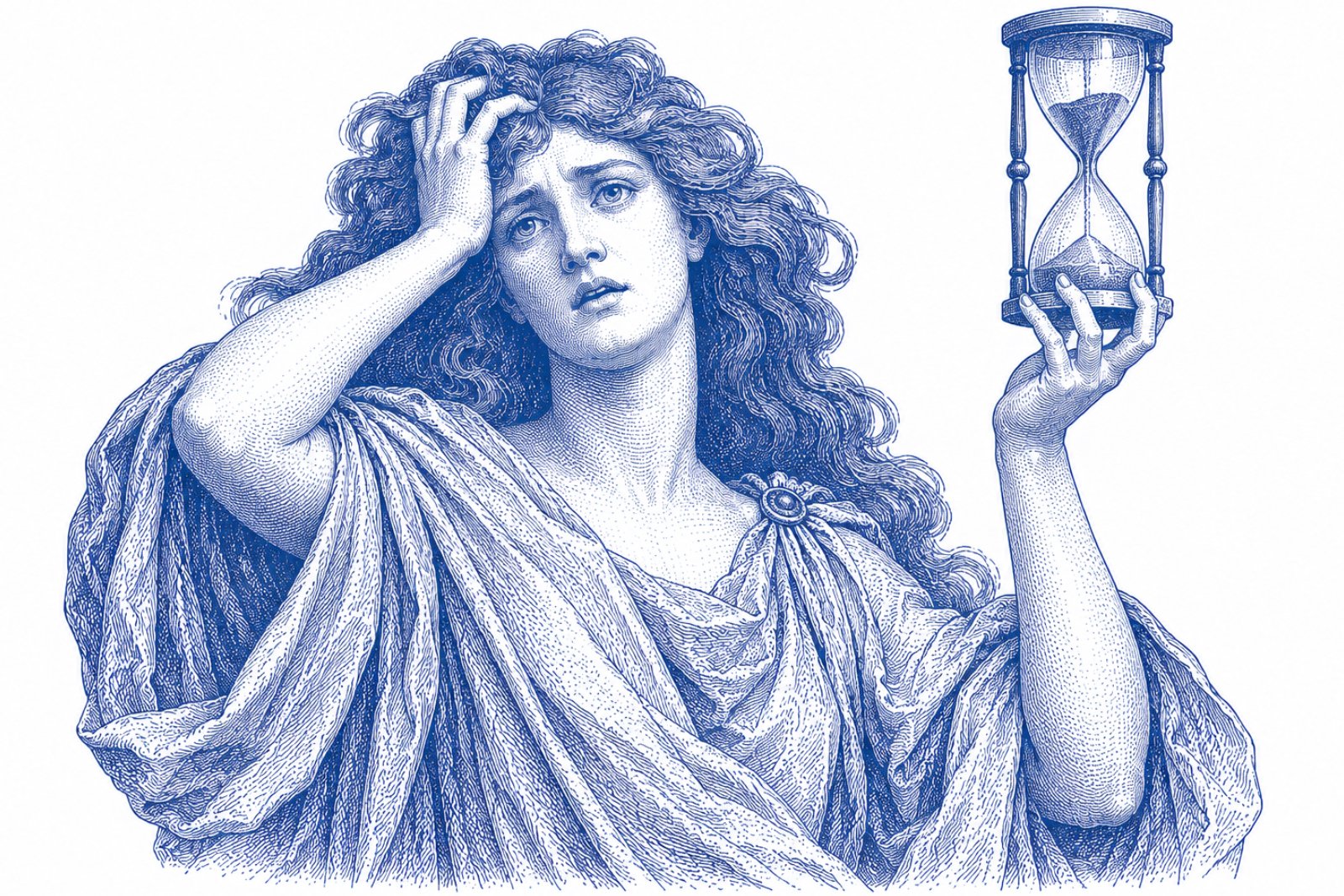
In the Agamemnon of Aeschylus a captive princess stands outside a palace door and describes a murder that has not yet happened. She names the weapon, the bath and the woman who will use it, and the old men of Argos, who make up the chorus, listen with growing unease and grasp very little. When she tells them that they will look upon Agamemnon dead, they pray that it may be otherwise, and she answers, “You do but pray; their business is to slay.” When she protests that she understands Greek all too well, they reply that so do the Pythian oracles, “yet they are hard to understand.” She has already stood silent through a long speech from the queen, who wanted her indoors, and the silence is the most sensible thing she does in the play. I have never decided whether the chorus is slow or merely polite.
Her name is Cassandra, and she explains her predicament herself. She had promised herself to Apollo in return for the gift of prophecy and then broken the promise, and the god, who could not take the gift back, saw to it that nobody would ever believe her. “Ever since that fault I could persuade no one of anything,” she says. It is a gift with a veto attached.
Homer gives her one appearance, in the twenty-fourth book of the Iliad, where she is the first to see her father Priam bringing home the body of Hector. Virgil supplies the passage on which the cliché rests. In the second book of the Aeneid, as the Trojans haul a wooden horse through the gap in their walls, Cassandra opens her mouth to foretell their doom, and no Trojan believes her. Boys and girls walk beside the horse singing hymns, glad to touch the rope. The Trojans, it should be said, had heard a better-qualified opinion shortly before. The priest Laocoön had told them not to trust the horse. His words were timeo Danaos et dona ferentes, which means that he feared the Greeks even when they brought gifts. He then threw a spear into the horse’s side, and two sea serpents killed him and his sons at the altar.
The city took this as divine displeasure with the spear, and the horse went in.
Bond markets keep a Cassandra of their own, and she has a professor’s chair. Her whole art is a line on a chart that joins two yields. A lender who parts with money for ten years expects more for the trouble than one who parts with it for two, so that a ten-year bond ordinarily pays more than a two-year one. When the order reverses, short rates above long ones, the yield curve is said to be inverted. The usual reading is that investors expect the economy to weaken and the central bank to ease soon, which makes tomorrow’s money cheaper than today’s. Banks, which borrow short and lend long, find their margins squeezed at the same moment.
Campbell Harvey, a Duke economist, wrote the relationship into his doctoral dissertation at the University of Chicago in 1986. His committee, he said later, was impressed that a single variable could forecast about as well as commercial services running hundreds if not thousands of equations. Many people were sceptical, and with good reason, because the United States had had so few recessions in the post-war period that there was little to test the idea against. His own preferred measure compares the yield on ten-year Treasuries with the three-month bill, and he held that a warning required the bill to yield more than the bond for a full quarter. Admirers date the indicator’s record to the late 1960s, and Harvey himself pointed to the downturns of 1991 and 2001 and to the financial crisis, with no false signal among them. He added the qualification that there could always be one.
Headlines in 2022 were made by another spread, two years against ten, which was not his own measure, as he had pointed out when asked. From early July 2022 the two-year Treasury yielded more than the ten-year, and it went on doing so for a very long time. Over those months the Federal Reserve raised its policy rate from close to zero in March 2022 to over five per cent by the summer of 2023, while the long end of the market priced in the cuts to come. The previous record for a stretch with the two-year Treasury yielding more than the ten-year was 624 days, set in 1978, according to Deutsche Bank. This inversion passed that mark in March 2024 and was still inverted in July of that year, more than two years on. By the standards of the Cassandra story it was a spectacular success: the prophecy had been heard by everyone, repeated on every news bulletin and written into every investment committee paper.
Harvey, meanwhile, was telling anyone who asked that the indicator he had found might be wrong, which is not the usual conduct of prophets. I rather like him for it. In an interview with NPR in 2023 he said that the model pointed to a recession, which was bad news according to his research, and that this time the signal might be false. The report gave three reasons. There were about 1.7 job openings for every unemployed American, so a person who lost a job on a Monday could reasonably hope to hold another by Tuesday. Households carried far less debt than before 2008, when borrowers drove the downturn. And a signal that everyone watches alters the conduct it was built to forecast, since companies braced for a downturn avoid the excesses that bring one on.
That last reason has a long philosophical pedigree. Karl Popper gave the general phenomenon, a prediction that alters the event predicted, the name of the Oedipus effect, after the king whose oracle came true through the very steps he took to escape it. A forecast that destroys itself by being heeded is the mirror image of the self-fulfilling prophecy that Robert Merton named in 1948. Cassandra stands at the opposite pole, since her warnings change nothing when nobody acts on them. Harvey’s third reason is a small modern case of the Oedipus effect: an indicator that the whole market consults could lose its power by being consulted. The record of the inversion settles nothing either way. The curve returned to a positive slope in the second half of 2024, with no recession in the data to that point, and economists went on disputing whether the signal had failed, merely run late, or been altered by the circumstances of the time.
A second prophet stumbled in the same year. Claudia Sahm devised her rule at the Federal Reserve in 2019, and it says that the economy is in recession once the three-month average of the unemployment rate has risen half a point above its low of the previous year. The rule fired in August 2024, after the July jobs report, and on the day it fired its inventor said that this time really could be different.
Later accounts treat the trigger as a false positive, put down to swings in the supply of workers. A profession that had spent two years waiting for one oracle found itself disbelieving another.
Nobody believed Cassandra, and almost everybody believed the curve, so the two predicaments differ. Her listeners could have saved Troy by trusting her and did not. Markets trusted the curve and, as far as the output figures went, the economy kept growing. The curve records fear, quoted to the basis point, and fear can be right about the danger and wrong about the date, a failing it shares with most human warnings.
Aeschylus lets his prophetess walk through the palace door knowing exactly what waits for her. The chorus stays outside, as choruses do, and a moment later hears the king cry out from within. They had been told, and they spend the rest of the scene deciding what to do about it.
Leave a thought