


ADAM SMITH’S SUSPICIOUS ATTENTION
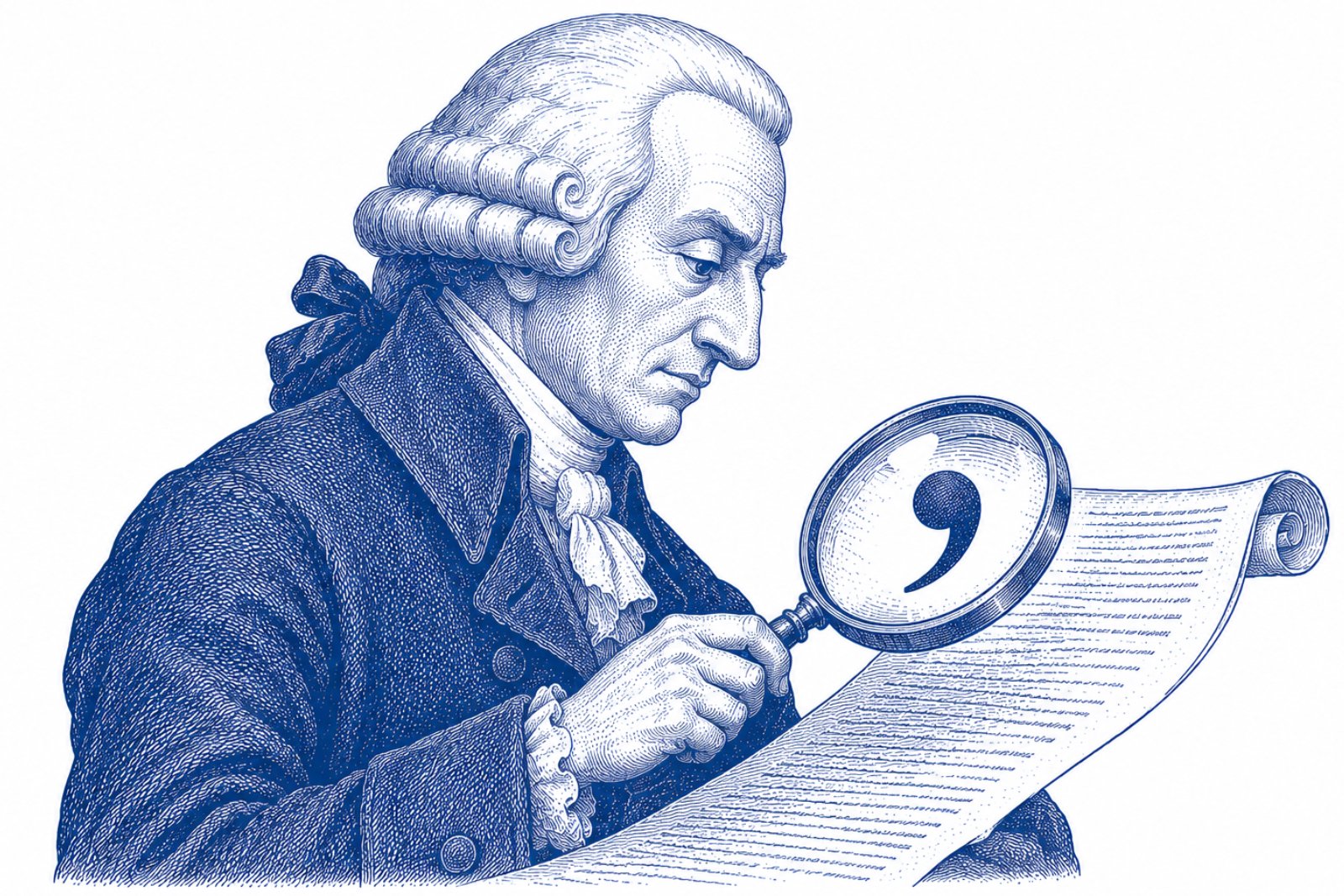
It began with a comma.
In the American Tariff Act of 6 June 1872 Congress reduced duties on a long list of goods, among them wool, iron and textiles, and the free list was meant to include fruit plants, tropical and semi-tropical, imported for propagation or cultivation. A nurseryman bringing in orange seedlings would pay nothing.
Engrossing is the fair copying of a bill in a clerk’s hand, and by the time it had been done the clause read fruits, then a comma, then plants. The word had gained a letter, and the comma split one category into two. Plants for the garden were still free, and so, on a literal reading, was the fruit that grew on them.
Adam Smith would not have been surprised. At the end of the first book of The Wealth of Nations he divided society into three orders. The landowner’s interest, he says, runs together with the public’s, but his comfortable indolence leaves him ill informed. The labourer has neither the leisure nor the schooling to follow a question of policy. The third order, the dealers and master manufacturers, understands its own interest better than either, and its interest, he says, never quite coincides with the public’s. Any proposal for a new law or regulation of commerce that comes from this order, he wrote in 1776, ought always to be listened to with great precaution, and ought never to be adopted until it has been scrutinised, in his words, with the most suspicious attention. The order, he added, has an interest to deceive and even to oppress the public, and has on many occasions both deceived and oppressed it.
He had watched the habit at close range. People of the same trade, he adds, seldom meet together, even for merriment and diversion, but the conversation ends in a conspiracy against the public. He allowed that the law could not prevent such meetings and thought that it should at least decline to encourage them. Two years after the book appeared Smith was made a commissioner of customs for Scotland, and he spent his last twelve years administering the duties on which he had written at length. He lived at Panmure House in Edinburgh with his mother and a cousin, Janet Douglas, and dined with the Oyster Club, a regular gathering of the Scottish literati, which he had helped to found.
Several of his contemporaries thought him comically absent-minded. Walter Scott recorded that when walking in the street Adam had “a manner of talking and laughing to himself,” and that passers-by were surprised that “a decided lunatic, who, from his dress, appeared to be a gentleman, should be permitted to walk abroad.” By one story he walked into a huge tanning pit while discussing free trade with Charles Townshend and had to be helped out, and by another he went out walking in his nightgown and was fifteen miles from town before church bells brought him back to himself. Of his appearance he is said to have remarked, “I am a beau in nothing but my books.” I wonder whether he ever read a free list with the suspicious attention he recommended.
Importers read the Act with care, and a cargo of fresh fruit is a perishable thing on which a duty is felt at once. A hold full of oranges does not wait while a lawyer reads a clause aloud. At first the Treasury held to what Congress had plainly meant, and in New York the duty was paid under protest, though at other ports it was paid without objection; before long the Secretary gave way. By one account the cure, when it came, was a hyphen, added in May 1874.
On 20 February 1874 John Sherman of Ohio rose in the Senate to explain what had happened. The mistake, he said, was a “little slip of the pen” in the engrossing, and he was very glad to find that it had not originated in the Senate. It had already led, in his words, to the loss of half a million dollars of revenue. That is a great many oranges.
Roscoe Conkling looked at the original amendment, found no punctuation between the words, and hoped for “an honest mistake rather than an intentional perversion.” Justin Morrill of Vermont agreed that it was “an honest mistake” and observed that the comma had been made with “the same pen and ink” as its neighbours. Senator Cameron was less charitable. Someone, he said, had put the comma there to suit a person who wanted to misinterpret the law, which looked “very suspicious to my mind,” and only New York had protested the duties. Three senators looked at one comma and thought it an honest slip, and a fourth thought otherwise, which was as far as agreement went. Sherman admitted that the error was made “by somebody, I do not know whom,” and thought that someone ought to inquire after it.
Nobody owned up.
Figures began to grow in the same debate. Charles Sumner put the cost at “a million or two of dollars.” Senator West would have none of it: the error, he said, “has not cost the country a cent,” since the Treasury had collected less and the public had kept the difference.
Sumner, for his part, blamed the system, and proposed that the Committee on Enrolled Bills consider “the expediency of superseding the present system of enrolling bills by writing on parchment.” Senator Anthony thought that bills should pass between the houses “in print, and not in manuscript,” and Senator Sargent feared that print would slow the hurried legislation of a session’s last days. The Senate agreed to the resolution. Its answer to a missing half million was a change of stationery, and I admire the economy of it.
Whether the comma was a copyist’s slip or a quieter hand, the record cannot say. Smith’s rule survives either answer, since it concerns attention. A tariff schedule is a long document, and few outside the room read it. The importers did, since a free list matters to the man who pays the duty, and in 1874 they found the gap first. Mancur Olson explained the economics of the asymmetry in 1965, in The Logic of Collective Action. Where a few parties stand to gain a great deal from one clause, they organise, attend and read, because each can pay for the effort out of the prize. Where millions each lose a few cents, nobody finds it worth the trouble to look. Concentrated benefits find their advocates, and diffuse costs find nobody.
The landowner could not follow the question and the labourer had no time for it, while the dealer had both the knowledge and the motive. Lobbying has its defenders, who point out, fairly, that legislators lack technical knowledge which only industry can supply. Whoever supplies the knowledge is also well placed to draft.
Smith’s book went through five editions in his lifetime, and its author went on revising it. The comma went through one printing and cost the Treasury, depending on the speaker, anything from nothing to two million dollars.
Leave a thought