


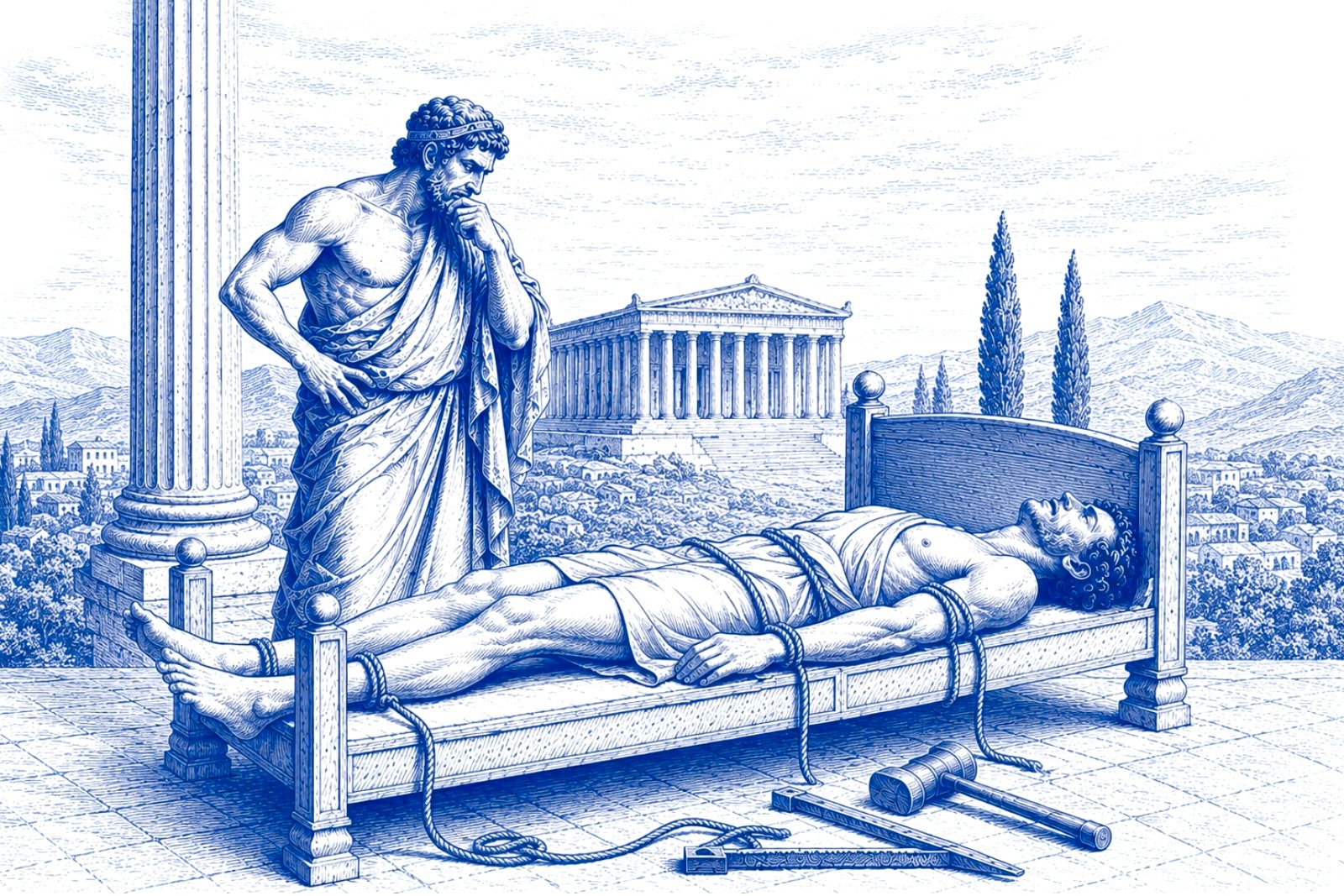
THE BED THAT MEASURED THE MAN
The standard was a bronze bar of a yard’s length, legalised by the Weights and Measures Act of 1824 as the imperial standard, and on the night of 16 October 1834 it was in the Palace of Westminster when the Palace burned. The bar survived the fire in the sense that pieces of it were recovered. It did not survive as a standard. For the better part of two decades the United Kingdom, at the height of its commercial reach, had no legally realisable unit of length, contracts, surveys, ordnance and tolls all referring, by statute, to an object that had been damaged beyond use and could not be measured against anything but its own copies. A commission was appointed. New bars were cast, compared against the surviving secondary standards and against each other, and the yard was re-legalised in 1855, defined once again as the distance between two marks on a particular piece of metal in a particular building.
Across the Channel the same problem had been answered thirty-five years earlier and with the same vulnerability. The Mètre des Archives, a platinum bar deposited in the French National Archives in 1799, was the metre, not a representation of it, the thing itself, and the length of everything measured in France was the length of that object, discoverable only by comparison with it.
Paris told a better story about where its number came from. The metre was supposed to derive from the Earth itself: one ten-millionth of the distance from the North Pole to the equator along the meridian running through Paris, a quantity nature had presumably fixed before any committee got involved. Two astronomers, Jean-Baptiste Delambre and Pierre Méchain, spent the years from 1792 to 1799 surveying that meridian arc between Dunkirk and Barcelona to fix the number, dragging instruments across a France in the middle of revolution and, in Méchain’s case, a war. Méchain found his own results would not quite agree with each other, kept the discrepancy to himself out of what his biographers read as professional shame, and died still trying to reconcile it. The survey he distrusted turned out to be off by a little under a quarter of a millimetre in every metre, once surveyors two centuries later checked his arithmetic against a planet that is not, in fact, a perfect ellipsoid. None of it mattered to the bar. The Republic cast the platinum standard from the number the astronomers delivered, flawed survey and all, and from that day the metre was whatever the bar said it was, nature’s supposed involvement notwithstanding.
One detail here repays close attention: both nations had chosen, deliberately and after argument, to anchor a universal scale to a perishable particular. The choice looks naive and was not. An object can be visited. It can be compared against its copies, and if it has changed, the copies will disagree with it in a pattern that no other explanation fits. The bar in the Archives could be wrong only in the sense that it could be damaged, and when the London bar was damaged, the fact was simply visible, the way a fire in a palace tends to announce itself, with nothing left to interpret. The fire settled it.
What replaced customary measurement, whatever the reformers preferred to say about the chaos they claimed to be fixing, was a working arrangement of enormous local intelligence: measures fitted to particular goods in particular places, in which the variation carried information about how grain settled, what soil yielded, which customary rights attached to a plot. The abolition of all that by decree was resisted for two generations in the French countryside, and the compromises that followed, permitting old names for new quantities, pleased nobody and worked reasonably well. Compulsion arrived late.
Comparison was the gain, and comparison is the entire point and the entire cost. A lender cannot lend against a parcel measured in a unit he does not recognise, and a tax cannot be levied equally across regions that measure differently, which is the same problem a market runs into when a commodity’s quantity is genuinely disputed. Every one of these is a genuine good, and each is purchased by the same transaction, in which a thing’s particular qualities are exchanged for a position on a scale. Finance performs this transaction more thoroughly than any other human activity. A business becomes a multiple of its earnings, and the multiple can be set beside another business in another industry on another continent. A borrower becomes a score. Somewhere past that, a portfolio turns into a single number describing how much of it might be lost on a bad day, and that number can be added to another such number, which is the property that makes it institutionally irresistible and also the property it least deserves.
None of these later measures has the bar. What does a scale actually need, at bottom, to be trusted? An anchor nobody downstream can quietly move, which is exactly the one thing a credit rating does not have: no object in an archive, no res in the old legal sense of the thing itself. Its referent is the agency’s own methodology, which the agency revises, and a downgrade may describe a deterioration in the borrower or a change in the definition of the grade, and the notation does not distinguish. When the referent is a definition and not an object, the measure can be adjusted without anyone being able to demonstrate that it has moved. There is no fire that settles anything.
And the institutions measured by it adjust in turn. Goodhart, writing in 1975 about monetary aggregates, put the mechanism as compactly as it has ever been put: any observed statistical regularity tends to collapse once pressure is placed upon it for control purposes. He was making a narrow point about central banking and it has outgrown him: the collapse he described turns out to be a general law of what happens whenever a measure acquires consequences, statistic or otherwise. Schools teach towards examinations, companies manage towards quarterly expectations, and public institutions prioritise what enters official statistics, and in each case the measured quantity improves while the thing it was chosen to measure does not. The adjustment is indistinguishable, from inside the notation, from a genuine improvement.
Ratings are useful, and produced by careful people; the point here is narrower than criticism, a statement about what happens to any scale when its anchor is a document instead of a bar. A document can be revised by the same institution whose subjects are adjusting to it. A bar cannot be revised at all, only damaged, and damage announces itself.
Both systems eventually abandoned their objects, and they did it for the reason the objects had always implied. A metre defined by a bar depends on the bar surviving, and bars do not: London’s proved that in a single night. The definition moved to a count of wavelengths in 1960 and to a fraction of the distance light travels in a second in 1983, the fraction chosen so that the new metre matched the old bar as closely as the measurements then allowed. Note what that choice concedes. The new definition was calibrated to the object it replaced, which is to say the object remained the authority even in the act of being retired. Nothing in the modern apparatus of financial measurement has an equivalent gesture available to it, because there is no bar to calibrate back to. A methodology’s previous version is simply an earlier draft, superseded the moment a revision arrives, with no independent authority of the kind the bar once had.
Procrustes at least had to do the cutting himself.
Leave a thought