


THE MAP WITH NO MONSTERS
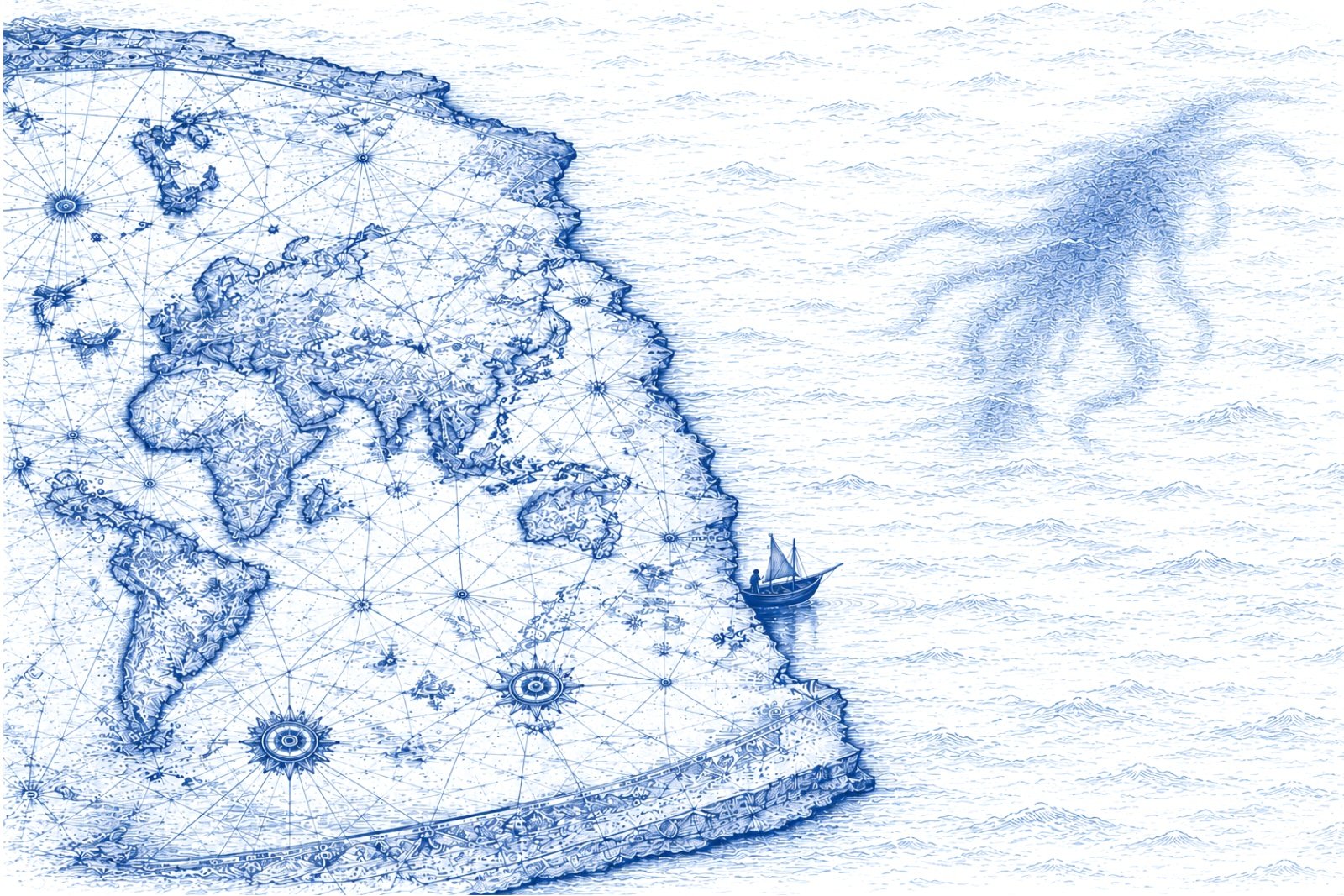
Hic sunt dracones. Here be dragons. The phrase every schoolchild knows to be written across the blank parts of old maps appears, so far as anyone has established, on exactly one surviving artefact: a small engraved copper globe of about 1508, the Hunt-Lenox Globe, held in the Rare Book Division of the New York Public Library. For most of the last decade it had rather less exclusive company. A globe engraved on two conjoined halves of an ostrich egg surfaced at a London map fair in 2012, dated by its owner to 1504, carrying the identical inscription in the identical place, and for some years the literature treated it as the copper globe’s older twin, possibly its model. An international research team concluded in 2024 that the egg was, in fact, a modern cast taken from the Lenox globe itself, most likely during a facsimile campaign in the 1980s, and not the original anyone had hoped for. One authentic object, then. Its own would-be sibling had made exactly the kind of confident claim this article is about, and it took twelve years to catch. The legend appears exactly once, on the coast of Asia, nowhere near any void, and generations of cartographers who supposedly reached for that same convention whenever the unknown needed marking would search their own margins in vain for a second example.
What mapmakers actually wrote in the empty spaces was more interesting and considerably more disciplined. Mercator, on his world map of 1538, inscribed across the southern continent a line to the effect that it is certain that there are lands here, but how many and within what limits remains uncertain. He was asserting existence while explicitly declining to assert extent, a statement with its own confidence interval attached to it in the same breath. The cartographer was distinguishing, in a single sentence on a printed plate, between what his evidence supported and what it did not, and he did it in public, on the face of the document, where a buyer could not read the claim without reading the caveat.
Consider what that placement accomplishes, since it is the whole of the matter. A caveat inside the measurement travels with the measurement. A caveat beside it does not. The reader of the 1538 plate had no way to extract the coastline from the admission that its limits were unknown, because the admission was printed in the same ink at the same scale in the same visual field. He could ignore it, as readers ignore anything, but he could not receive the one without receiving the other.
The instrument trade learned the same lesson a century and a half later and rather more precisely. Edmond Halley, commissioned into the Royal Navy for the purpose and not by training, sailed the pink Paramore into the Atlantic at the turn of the eighteenth century to measure magnetic variation, and what he produced was a chart on which curved lines joined every point where the compass erred by the same amount, translating the size of an error into a shape a navigator could read at a glance. A navigator knew his compass lied; the chart told him by how much, at his position, in that year, and Halley marked on the plate that the values would shift over time. He was right about the shift. The isogonic lines have moved a great deal since.
Getting there nearly ended the whole project on the first crossing. Halley’s own lieutenant challenged his fitness to command a naval vessel at all, an unusual objection to raise against a man Trinity House and the Royal Society had both vouched for, and Halley sailed home to see the matter settled by court martial; when the court let his officers off with a mild rebuke, he thought the sentence far too lenient and said so. A civilian directing a naval ship on a scientific errand was itself the novelty the officers seem to have objected to, and the Admiralty’s fix, giving Halley his own captain’s commission before the second voyage, says something about which kind of man the establishment actually trusted with the survey, once it came to it. He published the finished chart in 1701, the first of its kind ever printed, and the lines it introduced eventually gave Alexander von Humboldt the model for the temperature-contour lines still drawn on every modern weather map.
Honesty, in both documents, lay in what they refused to claim, and the refusal was structural rather than moral. Neither man was more scrupulous than his colleagues. Both were working in a medium, one plate, one visual field, no appendix, that made it physically awkward to publish a number without publishing what was wrong with it.
Then the notation improved, and the medium changed with it.
A modern risk report cannot do what the 1538 plate did, and the reason lives entirely in how the document is built. The number sits in a cell. The caveat sits in a footnote, or in a methodology appendix, or in a conversation that the person reading the cell did not attend. Institutions ignore their model risk disclosures for a purely structural reason: the disclosure and the decision live in different documents, and only one of the two is circulated to the committee that decides. Precision has become separable from its own qualification, and anything separable will eventually be separated by someone working under time pressure who needs the figure and not the discussion.
Embarrassingly, the pattern that follows repeats with a consistency that ought to trouble more people than it does. A class of exposure accumulates a record. The record is clean, because the event that would dirty it has not occurred within the window. Capital flows toward the clean record, since capital is priced against measured variance and this one measures low. The exposure grows until the sum at risk is large, and then the unrecorded event occurs, and the subsequent analysis observes that the model contained no term for it. This last observation is always correct and almost always useless, because the model could not have contained a term for it: a term requires a parameter, a parameter requires an estimate, and an estimate requires observations that by definition do not exist. The failure sits one step upstream of the arithmetic itself, in the moment an absence of observations gets converted into a small number when it should have stayed no number at all. That conversion is a presentational act, performed by someone who needed a figure for a committee that would not accept a blank.
Mercator had the option of the blank and used it. He also drew a southern continent of a size and shape that no evidence supported, which is worth saying plainly, because the temptation here is to conclude that the old cartographers were wiser than we are, and they were not. They admitted ignorance where admitting it was cheap and filled space confidently where a buyer expected a full plate. Ignorance is not evenly admitted even by the people who admit it best.
Of everything recruited to make this point, the dragons turn out to be the cleanest illustration. A profession that wrote careful, hedged, evidence-bounded statements into the margins of its unknown territory has been remembered instead for a decorative monster it essentially never drew. The honest notation did not survive as legend. The picturesque one did, on one globe, in one language, and it now stands in for a discipline it misdescribes entirely, which is roughly what happens to a model risk disclosure between the appendix where it is written and the boardroom where the number is read aloud.
Leave a thought