


FRANKLIN’S TWO-HUNDRED-YEAR EXPERIMENT
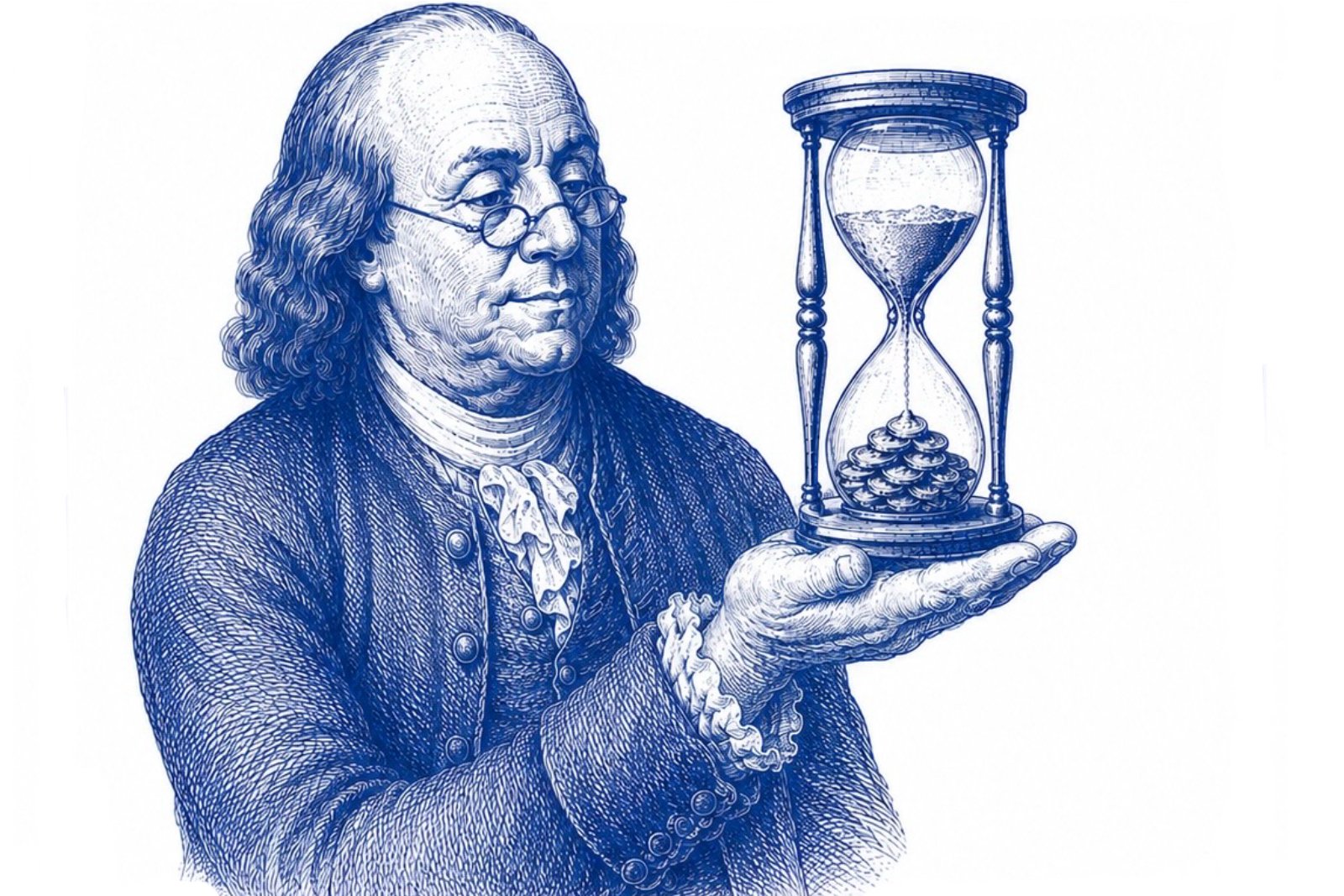
Franklin sat down in June 1789, roughly a year before he died, and added a codicil to a will already written, the sort of thing a man adds when something has occurred to him since, and it is not a short document. It sets aside a thousand pounds sterling to Boston and a thousand to Philadelphia, and then it does something a testator almost never does: it explains, at length and with evident pleasure, the reasoning behind the sum. The money was to be lent in small amounts, at five percent, to young married artificers who had served an apprenticeship and could produce two respectable sureties. After a hundred years each city might spend a portion on public works. After two hundred, the remainder fell to the city and the state, and the arrangement ended. It is a document a modern trust lawyer would recognise on sight: a defined corpus, a narrow class of eligible beneficiary, an investment mandate confined to a single kind of loan, and two hard distribution dates fixed in the instrument itself, with no room left for a trustee’s later discretion.
He had run the arithmetic himself and put the answer in the document: a hundred thousand pounds at the first century mark, something over four million at the second. Compound interest, one must admit, performed exactly as instructed on the page.
This design deserves more admiration than the punchline usually allows it. Franklin’s real achievement was compounding a class of borrower, a rather more ambitious project than simply compounding money. The loans went to tradesmen at the beginning of their working lives, at a rate below what a private lender would ask, secured by the reputation of two neighbours in place of the property the young man did not have. The fund was a credit institution aimed at people no credit institution wanted, and its collateral was standing in the community. He had been such a young man himself: a runaway printer’s apprentice who reached Philadelphia without enough capital to set up a shop of his own, backed into his first press by other men willing to vouch for a stranger, and the codicil reads like an old debt being repaid to a creditor long past collecting it.
Two centuries before economists gave it a name, this was peer guarantee in place of collateral: a borrower vouched for by people who knew him instead of property he could forfeit. Modern microfinance rediscovered the same substitution in villages that had no Franklin and no codicil, and rediscovered too that it depends entirely on the community doing the vouching staying intact. Muhammad Yunus built an entire institution on it two centuries later in Bangladesh. Grameen Bank lent to borrowing groups who vouched for one another, with no collateral anywhere in the transaction, and the Nobel committee gave Yunus and the bank its 2006 prize in the peace category, an early hint at how the innovation would eventually be classified in the literature.
What happened afterwards is where the two cities part company, and the difference is the whole of the lesson. Franklin never says why the bequest went to two cities and not one; the effect, whatever the intention, was a controlled experiment: identical terms handed to two different sets of trustees, with two centuries allowed to show what trusteeship adds to arithmetic.
Boston’s fund found, within a generation, that its intended borrowers were disappearing. Apprenticeship as an institution was dissolving; the young artificer with two sureties and a trade of his own was becoming a wage-earner in somebody else’s manufactory, and there was no longer a queue at the door asking for five percent against a neighbour’s word. Boston’s trustees, left with an emptying applicant pool and a document that named no alternative, did the conservative thing available to a fiduciary holding idle money: they moved it into savings banks and other securities, an investment the codicil had not contemplated and, read narrowly, had not forbidden either.
Philadelphia took a different course. Its trustees read the borrower requirements more loosely as fewer qualifying applicants presented themselves, and the fund kept lending against a shrinking pool of them. It recovered less. By the middle of the nineteenth century its books carried a long tail of loans nobody was ever going to collect, made to men whose sureties had died, moved away, or simply stopped answering. Both cities eventually litigated, and both went to court over whether the hundred-year disbursement could be spent on one purpose or another that Franklin had never enumerated; courts, faced with a dead man’s instructions and a living city’s preferences, did what courts do with instructions that have outlived their world. They construed them generously.
When the two hundred years closed in 1990, Boston’s share stood at something in the region of five million dollars and Philadelphia’s at rather over two, against the four million sterling the codicil had forecast for each. The gap is not small. It is also not, as the tidy version has it, a story of theft.
None of this shows up in the arithmetic. The shortfall went into loans excused because a tradesman’s shop had burned, into terms softened during a panic, into a trust managed by men who had also a bank to run and a war to finance and could not reasonably be expected to treat a bequest from the last century as their first obligation, and not one penny of it into anybody’s pocket. Every one of those decisions was defensible in the room where it was taken. The curve simply cannot distinguish between a percentage point lost to embezzlement and a percentage point lost to mercy, and over two hundred years the second is far more common than the first.
Compound interest requires no virtue whatsoever, per definition. That is its great administrative beauty and the reason it is the only financial mechanism that genuinely works unsupervised: it needs only an absence, the absence of any hand reaching in. An institution staffed by human beings across seven or eight generations requires virtue continuously, from strangers, with nothing to enforce it but a signature on an old paper and whatever embarrassment attaches to being the trustee who let the thing fail.
Modern finance meets this asymmetry constantly and calls it something smaller. A sovereign wealth fund with a withdrawal rule; a university endowment that spends a smoothed percentage of a trailing multi-year average, precisely so that one bad December cannot force a sale at the bottom; a pension whose assumed return is set by the same board that would have to raise contributions if the assumption came down. Norway publishes its oil fund’s withdrawal rule for exactly this reason: a promise made visible is a little harder for the people bound by it to quietly amend. In each case the mathematics is sound and the mathematics is not the exposure. The exposure is the governance, which is to say the exposure is whether a committee not yet appointed will keep a promise made to people not yet born by people already dead. No instrument exists for pricing that, and the honest reason is that it cannot be hedged: there is no counterparty willing to sell protection against the future virtue of strangers.
So the funds did what institutions given two centuries and only intermittent supervision generally do: they drifted, forgave a little more than the document strictly allowed, occasionally lent past the point good judgment would have stopped them, and still arrived at the finish line with real money, just a smaller pile of it than the curve had promised.
Whether he believed his own confidence is a fair question, given that the shrewdest observer of human conduct America produced in that century is the one who wrote this codicil. He assumed two hundred years of administrative restraint from institutions he knew perfectly well were run by ordinary men, and it is hard to believe he did not notice the size of that assumption. He may simply have trusted the arithmetic. He may also have set the terms exactly because he would not live to see how they were kept, which is a kind of immunity no other sort of investor ever gets to claim. The codicil does not say which, and he was not a man who left out a joke when he had one available.
The money was real in the end, in both cities, and considerably more than he had given. Boston put much of its share into a technical institute that bears his name until today. Philadelphia argued about its share and then spent it. Somewhere in the minutes of a hundred and some meetings, across seven generations of men who never met the donor and knew him as a face from the currency, sits the difference between what the mathematics promised and what the people delivered, and that difference is the only part of the experiment that was ever in doubt.
Leave a thought