


THE SHIPS THAT NEVER SAILED BACK
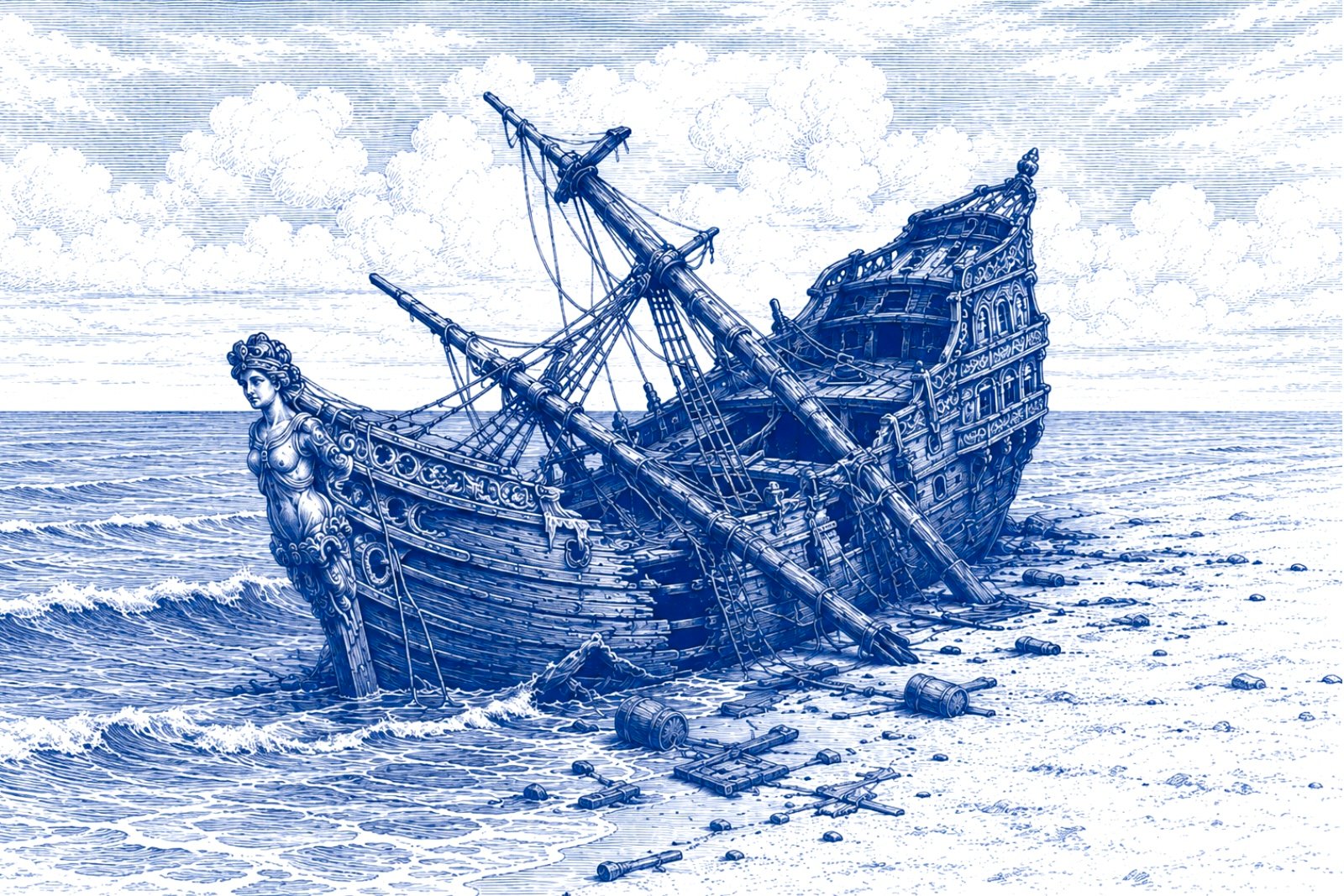
The beach at Veracruz, the summer of 1519, and eleven vessels drawn up on the sand with their gear coming out of them: cordage, sails, ironwork, anchors, the compasses and any planking worth saving. This is the part the legend leaves out, and it is the part that matters. Cortés stripped his fleet methodically and had the hulls holed and grounded, an inventory operation carried out in full view of his own men. The salvaged material, he put straight into the settlement he was founding on that shore, and Bernal Díaz, who was standing there, says the pilots were in on it.
Legend added the fire later, in the retelling, and it came from a good source: a chronicler a generation on reached for a classical parallel and the parallel stuck, as parallels do when they are better than the fact. For the men on the sand the distinction was academic. A wreck sails no better than ash. The embellished version, that one the schoolbooks kept. A better story was on offer, and nobody was left in the room to correct it.
What he was actually doing was closing a legal position, with the paperwork doing the real work. Cortés had sailed under a commission from the governor of Cuba, who had revoked it before the fleet left and would spend the next several years trying to have him arrested for it. A faction in the camp wanted to take a ship back to Cuba and make terms. Removing the ships removed the faction’s instrument, and founding a town on the beach, with a council he called a cabildo, that then appointed him captain-general, removed the governor’s jurisdiction by putting the expedition directly under the crown. It was a fiction every lawyer in the room would have recognised as a fiction, and it worked anyway, since the crown in Castile had every reason to prefer a captain who answered to it directly over a governor in Cuba who did not. The hulls and the paperwork were the same manoeuvre performed twice, and the second deserves rather more admiration than the first.
Finance has a polite name for what he destroyed. Optionality: the value of being able to reconsider, which is positive whenever the future is uncertain, and rises with the uncertainty. We are taught to guard it with something close to reverence. Keep the exit open. Stage the commitment. Never pay today for a decision tomorrow might regret. It is sound doctrine and whole careers have been preserved by it, and it contains one assumption that the beach exposes: that the holder of the option and the person whose behaviour it affects are the same entity, with the same interests, on the same day.
They rarely are. An option held by a company is exercised by people, and the people can read the terms as well as anybody. A plan that can be abandoned at any moment tends, contrary to the doctrine’s own confidence in it, to be abandoned at exactly the first genuinely difficult moment. Correctness has little to do with it; availability does, and the difficult moment always arrives dressed as now. Cortés had a faction who could read the terms. He deleted the terms.
Modern corporate finance knows this argument and has a formal name for one corner of it: commitment value, the idea that a firm can improve its position by credibly removing its own choices, so that rivals and partners recalibrate against a threat they can no longer wait out. The literature treats it as a special case. On the beach it looks less like a special case and more like the ordinary condition of anyone trying to hold a group of people to a plan longer than the plan is comfortable.
Thomas Schelling later gave the general case a name, the commitment device, and reached for the same image the beach already supplied: burning your own bridge functions as a signal sent to everyone who might have hoped for a retreat. The signal only works if it is irreversible, which is the entire point and also the entire risk.
Companies meet the same arithmetic in duller clothing. The lease with no break clause, the plant built to one specification, the acquisition that cannot be unwound at any price a board would survive. The purchase-price allocation, the covenant that bites at a ratio nobody expects to see, the fifteen-year offtake agreement signed because the counterparty would not finance the facility without it. Project financiers call this last one a condition precedent, for a reason: the lender’s money never arrives until the borrower has already burned the option to walk away. Every one of these is a fleet run aground, and every one of them is written by someone who has concluded, correctly or otherwise, that a flexible version of the same commitment would not be believed.
Honest accounting begins here, because the beach does not support the flattering reading.
Courage, on that beach, looked like arithmetic. With one path physically remaining, courage and necessity signed the same name, and perseverance turned out to be simply the only item left on the menu. This is worth saying plainly, since the management literature that celebrates burning the boats invariably addresses itself to the person holding the match, never to the several hundred who now have no way home. The irreversibility that concentrates a team’s effort also transfers the entire downside onto people who did not price it, and that transfer of downside is precisely what the technique consists of, however it gets described in the founding narrative.
Vocabulary arrives only after the outcome does, and its whole job is to sort one decision into one of two bins. Success gets written up afterward as nerve, and enters the founding narrative that way. Failure gets written up as a captain who gambled with other men’s lives. The paperwork inside the decision itself stays exactly the same, and only the label stapled onto it afterward is ever any different. Nothing about the decision differs between the two cases. The decision was taken at a moment when the outcome was unknown, by definition, and is then judged by information that did not exist when it was made. Finance has a technical term for this error and applies it to other people’s judgements rather more readily than to its own.
There is a coda that the story usually omits. Some months afterwards, needing to face a force sent from Cuba to arrest him, Cortés had the salvaged ironwork and rigging carried inland, and later still he had vessels built on the lake at Texcoco from timber cut in the mountains and hardware taken off the beached fleet. The ships came back. Not the same ships, and not to the same water, but the material he had made unusable as an exit reappeared as an instrument of attack, which is either the most complete vindication of the original decision or a demonstration that nothing is ever quite as irreversible as the man announcing it would like his people to believe.
Nobody standing on that sand in 1519 had a name yet for what was happening to them, and no way of telling whether the chroniclers would eventually call it a captain’s finest hour or his least defensible gamble. What they had, that afternoon, was the tide working at the hulls, the carpenters going quiet one by one, and a single direction left to walk in.
Leave a thought