


THE FOUNTAIN WITH NO ONE LEFT TO DRINK
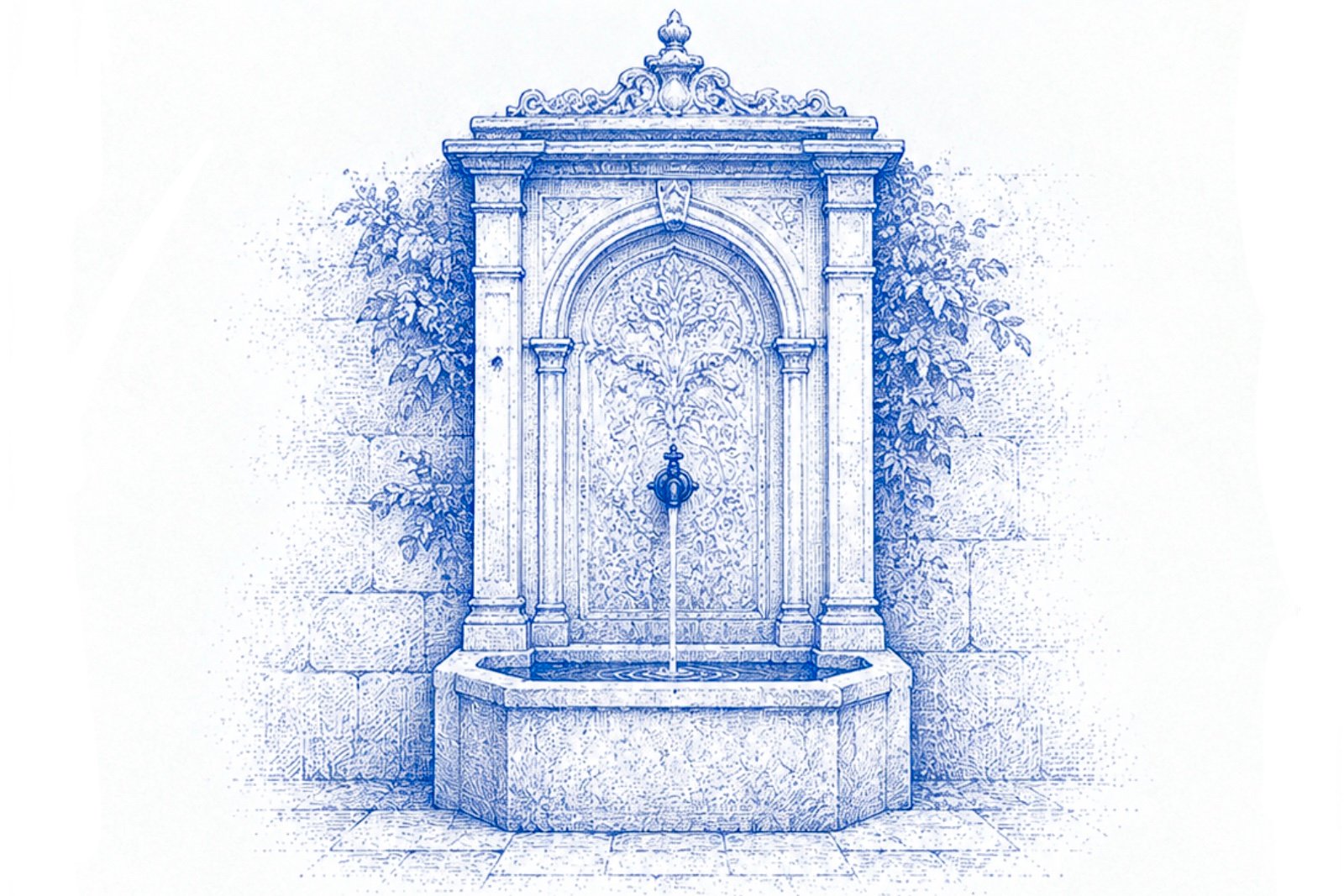
Istanbul still keeps hundreds of small stone fountains built into the walls of old streets and courtyards, each with a tap, a basin and a carved inscription naming whoever paid for it and why. Most no longer run. A visitor who stops to read one of the drier inscriptions usually finds a sentence promising water to anyone passing along one specific road, or to pilgrims bound for a particular gate, in a city that has long since grown around both the road and the gate until neither one means anything a passer-by could actually point to. The stone itself is in no danger. It has outlasted the road, the gate, several empires and at least one change of alphabet, and it will almost certainly outlast whoever is reading it today. It no longer performs the single function it was actually built for.
Each of these fountains began as a waqf, the Ottoman and wider Islamic world’s instrument for making a gift outlive its giver. A man with money and a wish to be remembered signed a deed, a waqfiyya, assigning some income-producing property, a row of shops, a bathhouse, a flour mill, permanently to a stated purpose: feeding the poor at a soup kitchen, keeping a bridge in repair, watering travellers at exactly this fountain. The property itself became inalienable the moment the ink dried, and a trustee, a mutawalli, was afterward bound to the deed’s own words, whatever became of the people the fountain was actually meant to serve. The Haseki Sultan Complex in sixteenth-century Istanbul shows the scale this could reach: shops, a bazaar, two soap works, eleven flour mills and two bathhouses, all of it endowed income funding a single mosque, a soup kitchen and two inns for travellers and pilgrims.
Deeds of this kind are, as legal documents, remarkably exact. They identify exactly who benefits, fix stipends, set precise bread rations and lay out repair schedules in a level of detail that would satisfy a modern auditor, down to the precise order in which successive beneficiaries stood to inherit a post if an earlier one died or resigned. No such deed can specify whether two hundred years from now the same road will see any travellers at all, or whether the quarter around the fountain will still hold anybody thirsty enough to need it. Purpose decays faster than masonry. Ottoman jurists recognised the problem early enough to build a narrow door out of it, istibdal, a mechanism letting a trustee swap a damaged or unproductive endowed holding for a different one of equal or greater value, so long as no simpler remedy existed. The door required real discipline to keep narrow. Trustees who discovered convenient damage exactly when a swap happened to suit them personally were common enough a problem that, from the sixteenth century on, no exchange could proceed without the sultan’s own permission. A later refinement went beyond even that: in some provinces a waqf property could be let on an extraordinarily long lease, occasionally running across two lifetimes, even when nothing about it was damaged at all, whenever the arrangement was judged materially advantageous to the endowment as a whole. Each such swap let a single property quietly change hands, sparing anybody the need to announce, in public, that a promise meant to run forever still needed the odd correction.
By the early nineteenth century, endowments across the empire had accumulated so much property bound permanently to centuries-old deeds that the imperial government moved to bring the whole arrangement under its own direct control. In October 1826, within months of abolishing the Janissary corps in the same sweeping burst of centralisation, Sultan Mahmud II folded waqf administration, previously scattered across the Grand Vizier’s office, the religious establishment and the palace, into a single new ministry answering directly to him, a reform of the kind a ruler only attempts once he has already shown he is willing to dismantle an older power to get it. The body meant to keep each founder’s wishes untouched by ordinary politics had, in the stroke of one sultan’s decree, been absorbed directly into the government’s own machinery. It began, in fact, as a comparatively modest bureau; full ministerial status followed only in 1840, one more piece of the broader Tanzimat reforms then remaking the empire’s administration office by office.
English law met the identical problem centuries earlier, under its own name. Cy-près, Norman French for as near as possible, lets a court redirect a charitable trust once its original purpose becomes impossible or pointless, aiming the money as close to the founder’s intention as the world will now allow. The doctrine is considerably older than any single ruling: strands of it reach back to Roman and Byzantine charitable law, and English ecclesiastical courts and Chancery practice had been applying something like it since at least the Statute of Charitable Uses in 1601, long before Parliament modernised the whole area in the Charities Act of 1960. It produced one of its more striking rulings in 1844, when the House of Lords took up the estate of Thomas Betton, a merchant who had died in 1724 leaving income earmarked for a single stated purpose: ransoming British captives held as slaves in Turkey or the Barbary states, a hazard real enough along contemporary shipping lanes that several European governments kept standing funds for precisely this purpose. By the 1840s Britain’s own anti-slave-trade treaties had made that purpose both obsolete and illegal to pursue. Lord Chancellor Lyndhurst redirected the income to Church of England charity schools, a different purpose entirely, in a judgment that the court defended as the nearest available thing to what Betton would plausibly have wanted done with money that could no longer buy the single commodity he had actually asked it to buy.
America supplied its own twentieth-century version of the same problem, with an ending no Ottoman waqf ever got to enjoy: the underlying problem was actually solved. Franklin Roosevelt, himself partly paralysed by the disease, founded the National Foundation for Infantile Paralysis on 3 January 1938 with a single, narrow purpose written into its name: fighting polio and nothing else. The foundation succeeded so completely that it put itself out of a job: Jonas Salk’s vaccine was licensed in 1955, and within a few years the disease the charity existed to fight had all but disappeared from American life. Rather than dissolve, the foundation’s president, Basil O’Connor, announced at a press conference in July 1958 that the organisation would redirect itself to birth defects, later adding prematurity to its mission as the original one receded permanently into the past. The charity renamed itself twice more as the shift settled in, becoming the March of Dimes Birth Defects Foundation in 1976 and simply the March of Dimes Foundation in 2007, folding prematurity formally into its mission not long afterward. It still operates today, under a name that no longer mentions the disease printed on its own founding charter.
The pattern repeats across traditions that otherwise share almost nothing: a Muslim merchant’s soup kitchen, a British slave-ransom fund, an American polio charity. Each tried to solve the same underlying problem the same way, by fixing a purpose permanently in writing so that no future trustee, however well meaning, could quietly redirect the money toward something easier or more fashionable. Each discovered within a few decades, a historical eyeblink against a promise meant to run forever, that the world does not hold still long enough for any purpose to stay permanently necessary. The asset survives. The instructions survive with it, word for word, exactly as written. Only the actual problem those instructions were drafted to solve goes anywhere.
A trustee bound to a dead man’s exact words has no good option left. Follow the letter, and the fountain keeps running for nobody; everybody can see the absurdity and nobody can stop it without breaking the promise that funds it. Depart from the letter instead, and the departure looks like theft to anyone who wanted the original promise honoured, however pointless that promise has since become. Both readings are available at once. The one vote that would actually settle which reading is correct belongs to a man who has been dead for centuries. The stone fountains built into Istanbul’s walls mostly keep standing long after the thirst they were built to answer has moved somewhere the original deed never anticipated. A hundred years from now, somebody will stand in front of whatever foundation exists today to cure a disease medicine has since made unnecessary, read its founding charter, and wonder exactly what the fountain’s own passer-by already wonders. Nobody involved in either decision will ever be consulted on the question, and the fountain, dry or not, will go on standing regardless. Of everyone now arguing over what a long-dead benefactor’s money should still be doing, how many would change their answer if he could somehow walk back in and simply say what he meant?
Leave a thought