


THE MAN WHO EATS SLOWLY
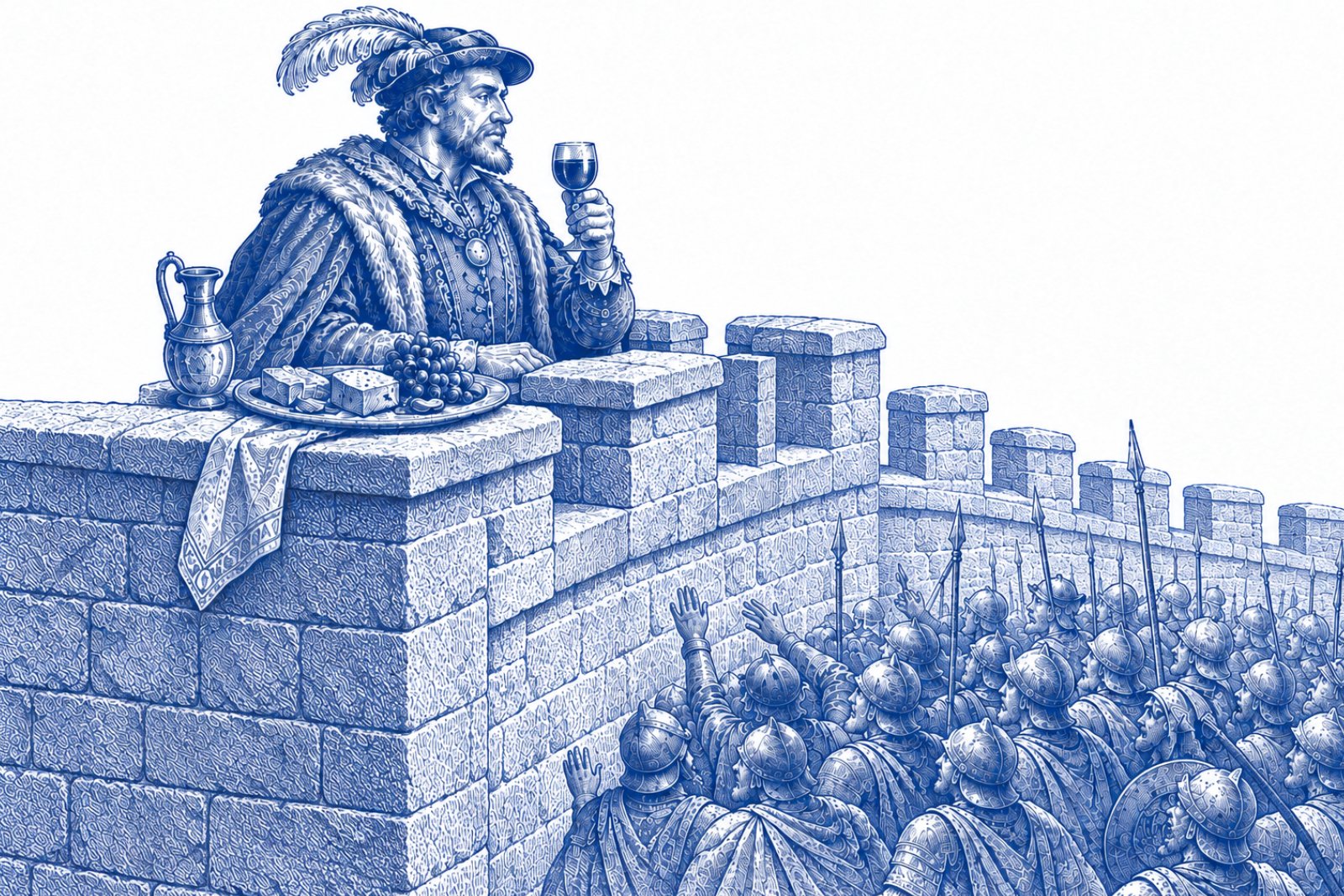
Forty-seven days. That is how long Vicksburg, Mississippi, held out against the Union siege lines thrown around it in the spring of 1863, and the number was kept, meticulously, by the one man outside the walls doing the actual counting. Ulysses S. Grant had already tried to take Vicksburg by storming it twice, on 19 and 22 May, both attacks thrown directly at the Confederate earthworks and both repulsed at real cost in dead and wounded soldiers. After the second failure, Grant switched to a different weapon entirely: a count. How many days of food sat behind those walls, and how many days he himself could afford to spend waiting outside them while that number fell toward zero.
Grant’s patience had a commander to work against and an arithmetic behind it. Lieutenant General John C. Pemberton commanded roughly thirty thousand Confederate soldiers and an uncounted civilian population inside Vicksburg, cut off from any hope of resupply or reinforcement once Grant’s lines closed completely around the city in the final days of May. Within weeks the civilians had moved underground, cutting more than five hundred bombproof shelters directly into the hillsides to escape a bombardment that, unlike the soldiers defending the earthworks above them, they had no way of returning in kind. Mary Loughborough, who lived through the siege and later published her own account of it, described daily life inside these caves, as did another diarist, Emma Balfour. One child, Lucy McRae, was buried alive when a Union shell collapsed the cave around her family and survived only because she was dug out in time. By late May a small piece of mule meat cost around five dollars at market; by early July, with mule meat largely exhausted too, rats were being sold alongside it, reportedly tasting, to those driven to try, rather like squirrel.
By the end of June roughly half the garrison was listed sick or unfit for duty, scurvy and dysentery doing more damage over six weeks than Union artillery alone had managed in the same stretch of time. Pemberton asked Grant for terms on 3 July, the two generals meeting that afternoon near the Third Louisiana Redan to negotiate the surrender neither army’s own numbers left much room to argue about. Grant, who had opened the campaign demanding unconditional surrender, settled for a negotiated parole instead, sending something like twenty-nine thousand Confederate soldiers home unarmed on their own word rather than feeding and guarding them as prisoners of war for months. The city surrendered on 4 July, the same dateline a telegraph office might have used to report Gettysburg, fought thirteen hundred miles away and concluded the previous afternoon; the two victories, announced together, did more to convince a watching public that the war had finally turned than either could plausibly have managed on its own.
The logic Grant applied to a besieged city is, formally, identical to the logic any negotiation runs on, a point negotiation theorists now give a name of its own. Roger Fisher and William Ury’s 1981 manual Getting to Yes introduced the acronym BATNA, the best alternative to a negotiated agreement, as the real source of bargaining power in any dispute: whoever has somewhere else entirely to go controls the shape of the outcome, and whoever genuinely has nowhere else to go is simply told what that shape will be. A strong BATNA, in Fisher and Ury’s own framing, protects a negotiator from accepting a deal that should be refused and improves the terms of whatever deal is eventually accepted; a weak one does neither. Pemberton’s best alternative, inside Vicksburg, was starvation, slower or faster depending on how the rats held out. Grant’s was going home for dinner, resupplied down a river the Confederacy no longer controlled. Neither side needed to say any of this aloud for both sides to already know exactly where they stood.
Patience, read this way, behaves like an asset class, funded in advance like any other and spent only by whoever arranged that funding beforehand. A besieging army needs a supply line it controls. A negotiator needs somewhere else to be. An investor needs cash that is not already owed to somebody else by next Tuesday. The actual waiting, in every case, costs almost nothing. The standing capacity to keep waiting indefinitely, without ever being forced to blink first, is the expensive part, and somebody always pays for it well before the waiting itself even begins.
Financial markets run the identical arithmetic every day, though professional vocabulary dresses it up: a position’s liquidity, the optionality built into a contract, how long a holding period an investor can tolerate before a decision gets forced on them. An investor sitting on cash with no debt due this quarter can let a falling price sit there until it recovers, the same way Grant could let a siege run its own slow course without needing to storm anything a third time. An investor who owes money this quarter, or who faces a demand for more collateral by tomorrow morning, has no such freedom at all. Two portfolios can hold exactly the same positions down to the last share, and still carry entirely different amounts of this particular freedom. Cash held deliberately against exactly this kind of moment has its own familiar name among professional investors, dry powder, kept idle for years at a stretch for the sole purpose of being available on the one afternoon when everybody else has run out of it.
Long-Term Capital Management supplied, in 1998, an almost laboratory-clean demonstration of what happens on the wrong side of that freedom. The fund had been founded in February 1994 by the former Salomon Brothers bond trader John Meriwether, its partners including Myron Scholes and Robert Merton, who shared the 1997 Nobel Prize in economics for a new method of pricing derivatives, work directly relevant to the trades LTCM ran every day. For its first few years the fund performed spectacularly, which is precisely what let its own leverage grow as large as it eventually did. Russia defaulted on its debt in August 1998, markets seized up in places that had nothing obvious to do with LTCM’s own positions, and the fund lost forty-four per cent of its value that single month, its equity falling from roughly two billion dollars to around four hundred million within a few weeks. The fund’s own models may well have been right about where prices would eventually settle, yet they carried no supply of the one resource a margin call actually demands: time. A margin call does not wait politely for a model to be vindicated: a position correct in principle but unfunded in practice loses exactly as much money, just as fast, as a position that was simply wrong from the start.
Fourteen banks and brokerages, among them Goldman Sachs, Merrill Lynch, J.P. Morgan, Morgan Stanley and UBS, were convened by the Federal Reserve Bank of New York in September 1998 and put up roughly three point six billion dollars between them to take over the fund’s positions and unwind them in an orderly fashion, heading off a disorderly fire sale regulators feared could have damaged markets having nothing to do with LTCM at all. No public money changed hands; the Fed organised the room and left the cheque-writing to the banks sitting in it. Those banks had simply purchased, at their own considerable expense, the one resource LTCM’s own partners had run out of: time to be wrong for a little longer, without anybody forcing the position closed before it had the chance to be proven right. Many of the fund’s individual positions are generally reckoned, with the hindsight the rescue itself bought time for, to have eventually moved back much closer to where its models had always expected, a vindication of sorts that accrued mainly to the consortium which had bought the waiting room, and barely at all to the original partners who had run out of rent money inside it.
Outside Vicksburg, Grant’s own soldiers, camped through those forty-seven days, did not go hungry for a single one of them; supply boats reached them freely down the Mississippi the entire time, protected by Union gunboats that had already cleared the river for exactly this purpose, while the besieged city could not get a single boat through at all. A fund manager watching a margin call arrive at four in the afternoon is besieged by exactly the same arithmetic, several centuries and one continent removed from the hillside caves of Mississippi; a bank’s collateral department now does the work Grant’s gunboats once did on the river, deciding who gets resupplied and who does not. A dependable supply line decided both contests long before anyone inside either one had the leisure to notice, and it will decide the next one too, quietly, long before the walls, the models, or the morning’s headlines get any credit for the result.
Leave a thought