


THE HUNDRED KNIGHTS
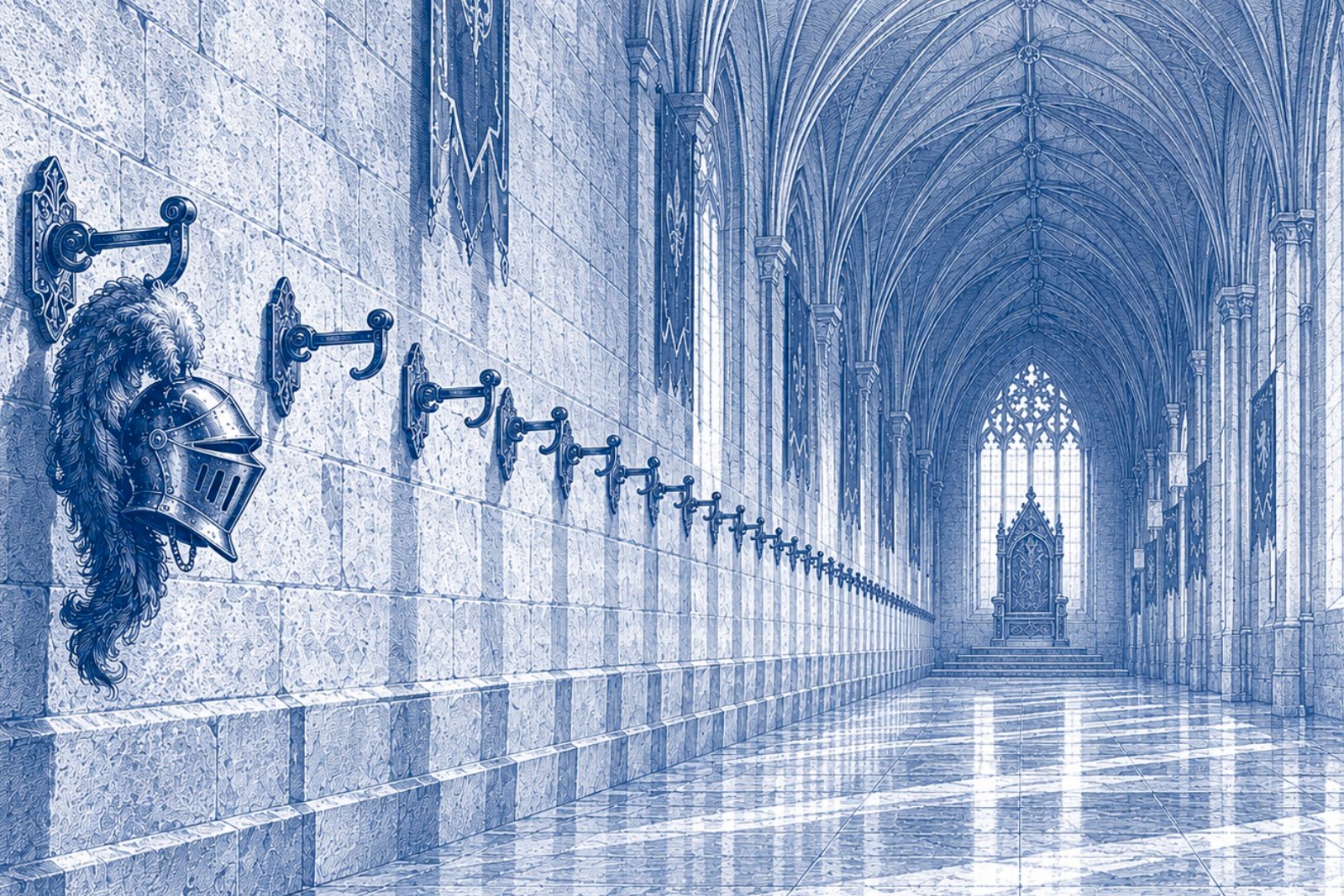
At the opening of King Lear, an ageing king stages a contest. Each of his three daughters must declare, in front of the whole court, how much she loves him, and the size of her inheritance will be measured against the performance. Cordelia, the youngest and the one who actually loves him, refuses to perform and is disinherited on the spot. Her two sisters, who perform beautifully and mean rather less of it, divide the kingdom between them. Lear keeps, for himself, the royal title and a personal retinue of a hundred knights. Shakespeare wrote the scene around 1605, borrowing from an older, half-legendary chronicle of a British king, but the mechanics of what happens in it have not aged a single day.
The transfer itself goes perfectly. No court challenges the division, no daughter contests her share, and the land changes hands exactly as the old king intended. The scene’s real failure lies elsewhere entirely: in Lear’s own judgement about which daughter actually loved him, a judgement that turns out to have been exactly backwards, and no will or deed anywhere in the play was ever going to catch that mistake before the ink dried.
Erosion follows the division almost immediately, quiet and procedural, which is exactly what makes it so recognisable to anyone who has watched a family argue about money. A hundred knights becomes fifty within a single conversation. Fifty becomes a smaller number Lear is invited to name himself, and then a smaller one still, until Regan finally asks what need he has of even one. Lear’s own answer survives in four words: “O, reason not the need.” Goneril and Regan frame each cut as simple housekeeping, a houseful of armed men causes friction with their own staff, and fifty, or twenty-five, or none, are plenty for a man his age. Whether this is cruelty dressed as prudence, or prudence that happens to look cruel from the outside, the play pointedly declines to settle, which is part of why the scene still unsettles audiences four centuries later.
A modern trust can be built to hand over money gradually, releasing a portion when a beneficiary turns twenty-five and the remainder a decade later, rather than resting the whole fortune on one old man’s say-so, decided in a single afternoon. Lawyers can wall that money off from a future creditor, a messy divorce, a bad decade in the markets, or, more delicately, from the beneficiary’s own worst night out. Dynasty trusts in a handful of jurisdictions can now run for several centuries, layering spendthrift clauses and independent trustees between the money and any single beneficiary’s worst impulse. None of this was available to a Jacobean king working from loyalty and improvisation alone, and the comparison genuinely flatters the modern structure.
No clause in any of these structures, however, can hand over the one asset that actually built the fortune being protected: judgement, acquired the only way judgement is ever acquired, by paying personally for a specific mistake. A bad partner, a loan that should never have been signed, a decade spent recovering from a single hard winter, each of these teaches restraint precisely by hurting, and a well-designed trust exists, among other things, to make sure the next generation never has to feel that particular kind of hurt.
Lear had held power, and presumably exercised judgement, for decades before the play’s first scene, which rules out any excuse of youth or inexperience. The judgement that failed him was narrow and specific: reading sincerity in a performance staged entirely for his own benefit, by people with every incentive to get the performance right. Four decades spent ruling a kingdom, it turns out, builds no particular skill at the one afternoon when a daughter is lying to your face for an inheritance.
English speakers have had a name for the wider pattern since at least 1874, when an essayist wrote that America allows but three generations from shirtsleeves to shirtsleeves: the first generation builds a fortune through its own hard labour, the second enjoys it without quite remembering how it was built, and the third returns to the shirtsleeves the first generation started in. Lancashire kept its own version of the same observation, clogs to clogs, three generations, which suggests the pattern was never a uniquely American vice. A five-character Chinese proverb carries the identical warning back further still: fu bu guo san dai, wealth does not survive three generations.
John D. Rockefeller Jr. tried to engineer the missing lesson on purpose, requiring each of his six children to keep a written ledger of every allowance they received, tied to chores actually performed, and insisting that two-thirds of it be saved or given away before a penny was spent. The sums involved were trivial next to the Rockefeller fortune itself. The habit they were meant to install was not.
Warren Buffett has made the opposite calculation, in public, more than once. His own stated formula is to leave children enough so they can do anything but not enough that they can do nothing. The sum he actually intends to pass on directly is a small fraction of his fortune. The bulk of it goes to philanthropic foundations, administered in part by those same children, and administering a foundation for decades is its own long apprenticeship in judgement, which a single inherited cheque never has the chance to teach.
Lottery winners run the purest version of the same experiment, performed at random on thousands of strangers: hand someone the money without the years of smaller decisions that would have earned it, and the money routinely outruns whatever judgement was supposed to be managing it. Competence with money, like competence at most things, seems to arrive only by making decisions about it and living with whatever the decisions cost, practice that a lump sum simply skips over.
More careful family offices now build real governance around the money itself: regular sit-downs that tackle actual disagreements, and a deliberate willingness to let a young heir lose a modest, survivable sum on his own bad decision while he is still twenty-two and the number involved would embarrass nobody. A costly mistake made early, while it is still small enough to absorb, buys a family roughly the same education Lear’s own money never had to pay for. Made for the first time at fifty, with the family’s full capital behind it, the identical mistake buys only a crisis and a board meeting.
Lear’s own lawyers, if the play had employed any, would have had nothing whatsoever to reproach themselves for. Every acre reached the daughter it was promised to. Every clause did exactly what it said on the parchment. The one piece of information that actually mattered that week, which daughter could be trusted, and why Lear had got it backwards, reached no jurisdiction’s clause-drafters at all, because no clause has ever been written to carry that kind of cargo.
Property, in this sense, travels remarkably easily. It is divisible, documentable, and enforceable down to the last acre or the last basis point, and a competent lawyer can move it precisely where a client directs. What a client has actually learned, about himself, about his children, about which of them can be trusted with money and which cannot, travels the way a childhood language travels: slowly, informally, and only to whoever happened to be in the room while it was being learned the hard way.
Families that get this right tend to share one habit that no clause can replicate: they let the next generation make genuine decisions, with survivable consequences, well before any real money is at stake. A teenager given a small trading account and permission to lose all of it learns something about risk that no seminar, however well catered, can substitute for. A thirty-five-year-old receiving his first unsupervised distribution from a trust, with no prior practice at losing anything smaller, is being handed a live exam in a subject he has never once been allowed to fail. None of this requires a fortune on Lear’s own scale. The principle holds just as well for a family business worth a few million as for one worth a few billion, since the asset actually being protected, in both cases, is the same fragile and non-transferable thing.
In a house with far less at stake than a kingdom, a father is watching his twenty-two-year-old lose four hundred pounds this week on a transparently bad investment, and is, with some effort, saying nothing at all. He has the money to cover the loss twice over, and the sense to know that covering it would be the single most expensive mistake available to him. His son will remember the four hundred pounds for the rest of his life. A decision made for him by someone else, however carefully drafted into whatever clause eventually reaches him, leaves no memory behind at all.
Leave a thought