


THE BOTTLE THAT WAS NEVER POURED
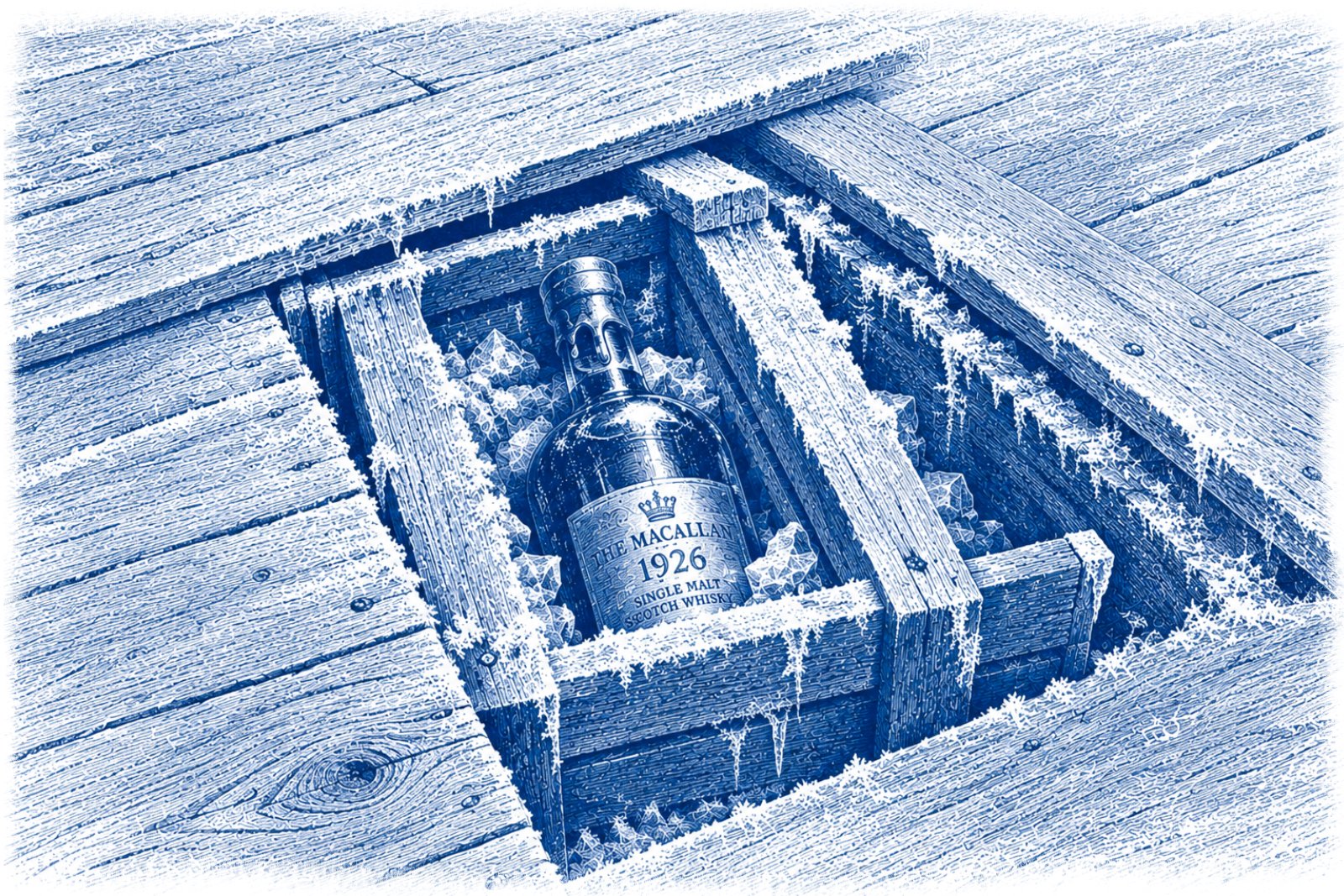
In 2006 a member of the Antarctic Heritage Trust, crawling beneath the floorboards of Ernest Shackleton’s hut at Cape Royds, found wooden cases marked simply WHISKY. The stores belonged to the Nimrod expedition, which had spent the Antarctic winter of 1908 attempting to become the first party to reach the South Pole and turned back, in January 1909, some ninety-seven nautical miles short of it, having rationed almost everything else along the way. The crates stayed exactly where they were found for four more years, frozen too deep into the ice to move. Only in 2010 did conservators finally work them free, revealing close to a dozen bottles inside, most of them still completely intact, their labels legible, their contents unspoiled by a century spent at the bottom of the world.
Nobody opened a bottle to find out how it tasted. In 2011 three of the intact bottles travelled to Scotland, where Whyte & Mackay’s chief chemist, James Pryde, drew a sample through each cork with a syringe fine enough to leave the wax seal undisturbed. His analysis found a spirit built on Orkney peat and bottled at forty-seven per cent alcohol, strong enough to stay liquid through a century in Antarctic ice without ever quite freezing solid. In January 2013 the bottles themselves flew south again, returned to the Antarctic Heritage Trust and the hut that had kept them, handled throughout with the caution a conservator gives a fragile manuscript.
Richard Paterson, the firm’s master distiller, used Pryde’s findings to recreate the vanished recipe from scratch, blending surviving stock from the long-closed Glen Mhor distillery with whisky from Dalmore, Benriach, Glenfarclas, Balblair, Pulteney and Jura until the chemistry matched. The result went on public sale in a wooden box marked with the name of the 1907 British Antarctic Expedition, a bottle anyone could buy and anyone could open. The explorers’ own bottles kept their seals. The replicas, by design, did not.
Most valuable possessions tolerate being used. A painting can hang above a dinner table for a hundred years and still be sold at the end of it. A bond pays its coupon every six months and remains, afterwards, exactly as much of a bond as before. Even a classic car splits the difference less generously than either, since driving it hard enough, often enough, does erode its value, yet a single afternoon on the road costs only a fraction of what the car is worth, and the car survives to be driven again. A bottle of rare whisky offers no such instalment plan. The instant its seal breaks, the asset becomes an evening, and whatever pleasure that evening contains has been taken, permanently, out of the bottle’s price.
Sotheby’s put a number on that trade-off in November 2023, when a bottle from the Macallan’s 1926 vintage, one of just twelve ever to carry a label the artist Valerio Adami painted for that batch of forty, sold in London for £2,187,500, comfortably clearing a pre-sale estimate of £750,000 to £1.2 million and setting a new record for any bottle of spirits or wine ever sold at auction. Barely ten Adami-labelled bottles are thought to survive intact. Whoever paid the record price bought a liquid whose value depends entirely on staying exactly where it was.
When Knight Frank added rare whisky to its Luxury Investment Index in 2019, the category immediately overtook classic cars as the index’s own former champion, posting a reported rise of close to six hundred per cent over the preceding decade. That curve is made almost entirely of other people’s ordinary evenings, repeated by the thousand, year after year, each one worth nothing to an index and everything to the two people at the table.
An asset class this size has grown its own supporting trade. Specialist insurers now underwrite climate-controlled vaults built solely for bottles, and authentication has become a profession in itself, because a market built on six-figure sums for ninety-year-old glass has inevitably attracted forgers filling ordinary bottles with ordinary whisky and ageing the labels by hand. Scientists at Scotland’s SUERC laboratory have even turned nuclear weapons testing to the trade’s advantage, reading the radiocarbon signature that fallout left in the atmosphere through the 1950s and 1960s to date a whisky’s true distillation year; one 2018 survey of fifty-five supposedly antique bottles found twenty-one of them, collectively valued at around £635,000, to be outright fakes or simply misdated. Buyers at this level pay, in effect, for someone else’s certainty as much as for the whisky, a cost no drinker worries about over an ordinary dinner.
Ordinary scarcity is a fact about supply: a mine runs dry, a print run ends, a species dwindles. This scarcity instead tracks a fact about other people’s evenings. The number of surviving bottles falls every time an owner, somewhere, decides that a wedding or a promotion is worth opening one, and pulls the cork.
This arrangement, looked at honestly, recruits an enormous unpaid workforce. Every drinker who opens one of the surviving bottles is, without being asked and without being paid, doing exactly the job a central bank does when it retires old currency: reducing the stock still in circulation and, by doing so, raising the value of what remains in somebody else’s safe. The collector who never pours a drop is the arrangement’s only beneficiary, and its only member who contributes nothing to the scarcity he profits from.
Economists have a name for goods whose value rises the more conspicuously they are consumed, a diamond watch, a sports car driven loudly through the middle of town. Rare whisky inverts the logic without breaking it. Value here rises with conspicuous non-consumption instead, a public, verifiable record of a bottle sitting untouched in a vault year after year, its restraint advertised rather than hidden. Thorstein Veblen never wrote the chapter for an asset that gets more valuable by doing absolutely nothing, though he would almost certainly have recognised the species on sight.
Distillers, for their part, have no stake in any of this. Whisky is made to be drunk, matured specifically so that it eventually tastes of something worth drinking, and a cask is a cost on a balance sheet until the day it is bottled and sold. A buyer’s own choice afterwards, make the bottle somebody’s Tuesday or somebody’s inheritance, has never been the distiller’s business, and still is not.
A pension fund defers a payment that will eventually reach someone; a whisky collector defers a pleasure that, left alone for long enough, reaches no one at all. The point of holding the bottle, by then, has very little to do with the whisky.
That record price carries its own evidence, worth naming plainly: nothing more than patience, maintained slightly longer than anyone else’s. The spirit inside is exactly as good as it was the day it was bottled, since whisky stops ageing the moment it leaves the wood. The remaining pool it is being measured against has simply thinned, year after year, as other bottles from the same 1926 vintage disappeared one by one into somebody’s dinner party.
Shackleton’s own crates remain the purest version of this logic, stripped even of the pretence of an eventual sale. No one involved in a decade of handling them has ever suggested pouring a glass. A syringe through a cork was already judged more invasive than the moment strictly required. By the time those cases finally came free of the ice, the expedition they represented, a vanished age of polar ambition, a hut kept exactly as its last occupants left it, had grown far larger in anyone’s imagination than anything the liquid itself could still deliver on a palate.
Their value, at this point, is entirely custodial. They are kept the way a reliquary is kept, which is to say precisely because nobody intends to find out what is actually inside.
The whole scheme depends on staying a minority taste. If every owner of a rare bottle adopted the collector’s discipline at once, scarcity would stop rising, since nothing would ever again be subtracted from the pool, and the price would settle, static and ordinary, like any other finite stock sitting quietly in a warehouse. The collector’s advantage survives only because almost everyone else, reasonably, prefers an evening to an asset, and keeps on proving it, one open bottle at a time.
Somewhere tonight, in a city the collector will never visit, a stranger is choosing a special bottle for an anniversary, a homecoming, an excuse invented on the spot because the week has earned it, with no thought at all for Scotland, Antarctica or auction prices. The stranger pours, toasts and feels nothing about markets whatsoever. Several thousand miles away, in a safe or a vault or a climate-controlled case, somebody’s unopened shelf has just become very slightly more valuable, and its owner will almost certainly never learn the stranger’s name, let alone thank him for it.
Leave a thought