


ARISTOTLE
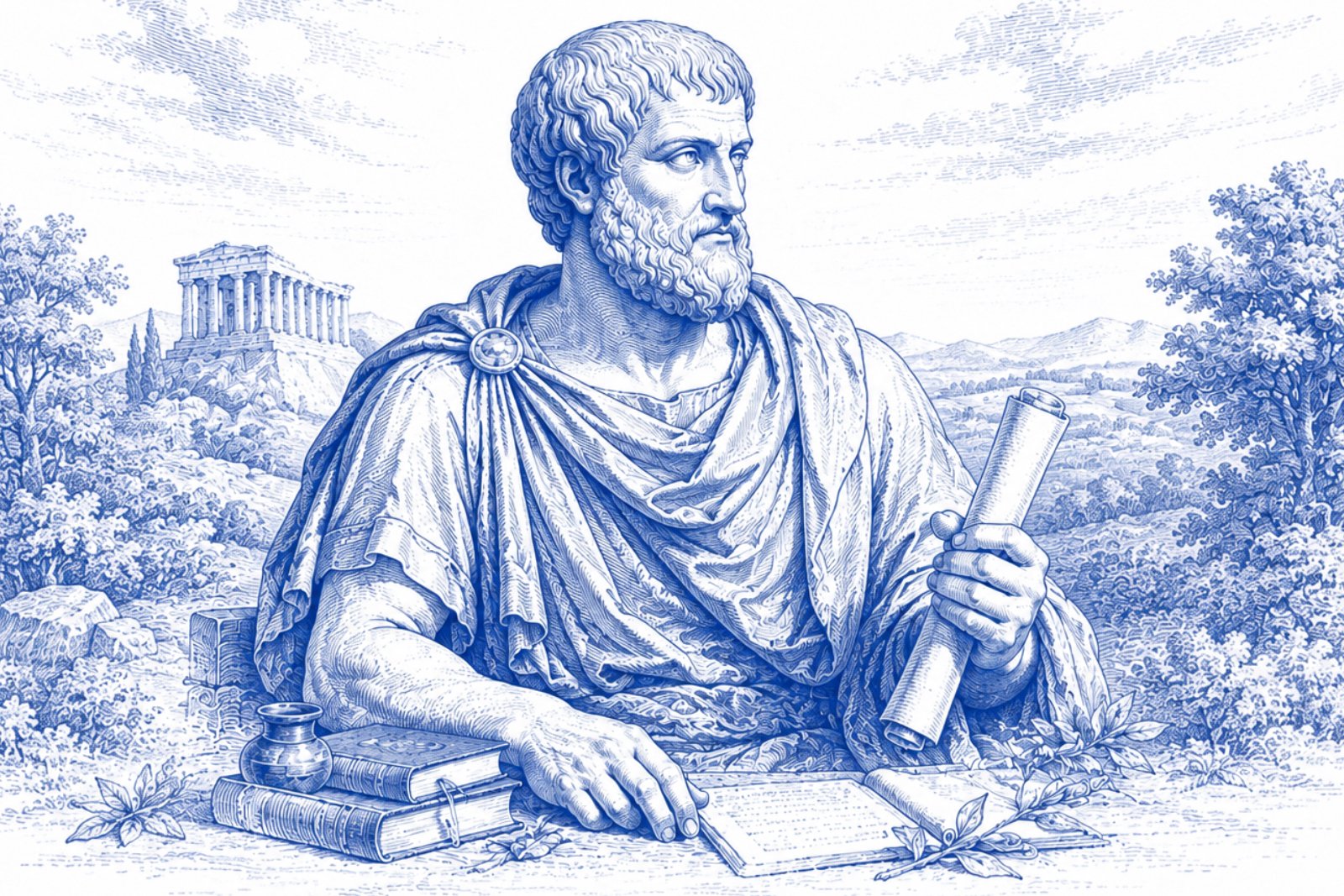
In the winter of a year nobody can date with certainty, somewhere in the sixth century before our era, a man went from one olive press to the next along the coast of Miletus, and across the water on Chios. His deposits he paid quietly, press by press, through a season when nobody else wanted the equipment at all. Idle equipment draws no bidders. He had been mocked for his poverty more than once, on the grounds that a life spent watching the sky produces nothing a household can eat.
Such a press was simple machinery: a heavy wooden beam pivoted against a stone weight, turned by hand or by a mule harnessed to a pole, crushing fruit into a paste that ran off through woven mats into waiting jars below. Nothing about the apparatus looked as though it could make anyone rich, and that, in its way, was the whole point of the arrangement he was quietly building around it.
What made him certain a large harvest was coming? The sources give only the stars, and it is simplest to leave the matter there. A shortage of presses at harvest time meant one thing above all: whoever controlled access to them controlled the season entire. He had almost no capital of his own, only enough for the smallest deposits, and a deposit turned out to be all the arrangement required. The sums involved were, by every account, trivial, small enough that no press owner thought refusing them worth an argument. Owner after owner took his money for a right that nobody else in the district particularly wanted yet, first in Miletus and then across the water in Chios, and by the time the olives began to ripen he held, in effect, the region’s whole supply of presses without having spent very much at all to acquire it.
When the harvest came in exactly as heavy as predicted, every farmer in the district needed a press at once. He let them out on whatever terms he pleased.
The profit that followed was real, and belonged, so the story goes, to Thales of Miletus.
Aristotle tells this in the first book of the Politics, without much admiration for the money itself. He offers it as an illustration of a wider principle, and it seems fair to say he remained unconvinced the tale was even true. Clever schemes of this kind attach themselves to famous names regardless of who thought of them first; a reputation for wisdom makes a convenient hook for whatever a listener already wants to believe. Aristotle appears less curious about settling that question than about what the story is doing there at all.
By Aristotle’s own day the name had become shorthand for cleverness in general, the very word a Greek reached for when he meant someone unusually sharp. The comic playwright Aristophanes has a character exclaim, of somebody merely quick witted, that the fellow is a regular Thales, tossing the name off the way a modern speaker might invoke a famous physicist without meaning anyone in particular. Behind the joke sits a small warning for anyone reading Aristotle’s version too literally. A story hunting for its ideal hero would have had little trouble finding him, whether or not he ever set foot near an olive press, and the historian’s task, faced with a name this useful, is to notice how conveniently it fits before believing a word of it.
No leverage was involved, and no counterparty risk in any modern sense. Only the plain right, bought cheaply in advance, to use something later on one’s own terms.
One is tempted to call this the earliest option contract on record: the right without the obligation, purchased before anyone else had noticed what that right would soon be worth. No formal market existed to price the risk Thales was taking, and no counterparty stood ready to buy him out had his reading of the sky proved wrong. The comparison is imperfect. Its shape survives the imperfection anyway.
Others read the episode more literally. Thales controlled a physical resource, not a claim on some more liquid asset, and calling a monopoly an option flatters an arrangement that amounted, underneath the vocabulary, to nothing more exotic than a corner on the market. The true Thales, him no one now can produce. The only surviving account of the affair is Aristotle’s own, set down at least two centuries after anyone could have checked it, and a story that old rarely settles into a single, agreed shape again.
Underneath the anecdote sat something Aristotle actually cared about, a distinction he draws a few pages earlier and returns to throughout the same book: between oikonomia, the management of a household, and chrematistike, acquisition pursued for its own sake. The first has a limit, because a household’s needs have a limit. The second has no such boundary built into what it is. A pursuit with no stopping point written into its own definition can only ever be interrupted from outside. It cannot be concluded from within, which is worth remembering later, when Thales himself does the interrupting.
A farmer selling last season’s oil to buy grain is plainly provisioning a household, in exactly the sense Aristotle approves. A merchant who buys oil where it is cheap and carries it where it is dear looks, mechanically, like the same activity, though it does not feel like the same activity at all, and Aristotle cannot quite say at what point the second shades into the first. Thales fits neither case cleanly. He noticed a scarcity before anyone else could see it coming, priced it, and kept the difference.
Modern finance has, in place of one philosopher’s hunch about an olive crop, an entire apparatus built to do the same thing at scale: desks whose whole occupation is noticing, ahead of everyone else, that some kind of scarcity is coming. The mathematics would mean nothing to a sixth century Milesian. The instinct needs no translation.
An option is, at bottom, compensation paid to a seller for surrendering a possibility, and the man who leased cheap wintertime access to a region’s olive presses was doing exactly that, without the vocabulary for it. Real options theory, developed within corporate finance only in the final decades of the twentieth century, treats an investment opportunity itself as a kind of option, one a firm may exercise or let quietly expire depending on how conditions unfold, and the logic fits a Milesian olive harvest at least as well as it fits most of the projects it was actually built to analyse. Two things determine what such a right is worth: how uncertain the outcome is, and how much time remains before the choice must be made. A calmer, more predictable olive market would have made Thales’s foresight worth very little, and a market resolved a week before harvest would have left him almost no time to act on it. Volatility and time are, in this sense, the whole of the story, and everything else is decoration around them.
Consider an oil company paying today for the right to drill a well at a fixed cost some years out, free to abandon the plan if the geology disappoints. The shape of the arrangement is Thales’s, transplanted from an olive grove to a drilling site: a forecast worth paying for in advance, and a reward for whoever commits money while the rest of the market is still making up its mind.
Nothing would be easier than concluding that the ancients understood everything already and that later centuries have only added decimal points. Aristotle himself would probably have resisted that conclusion more than anyone. What actually interested him was what the making of the money revealed about the character of the man who made it, more than the money itself or however much of it there eventually was, and on that count his verdict on Thales is unexpectedly gentle. Having proven that wealth was available to him whenever he wanted it, Thales went back to studying the stars and never repeated the exercise.
Not every profitable idea needs to become a habit.
Somewhere among the presses of Chios, in a winter now twenty five centuries gone, some farmer must have paid his deposit to a man he had never heard of, and thought nothing more of the matter until the following autumn, when he found himself paying rather more to use equipment he might once have secured himself. He never learned the stranger’s name, and it is unlikely, pressed for time at the start of a long harvest with every press in the region suddenly spoken for by somebody else, that he would have cared to stop and ask.
Leave a thought