


HAMLET’S CASTLE WAS A TOLLBOOTH
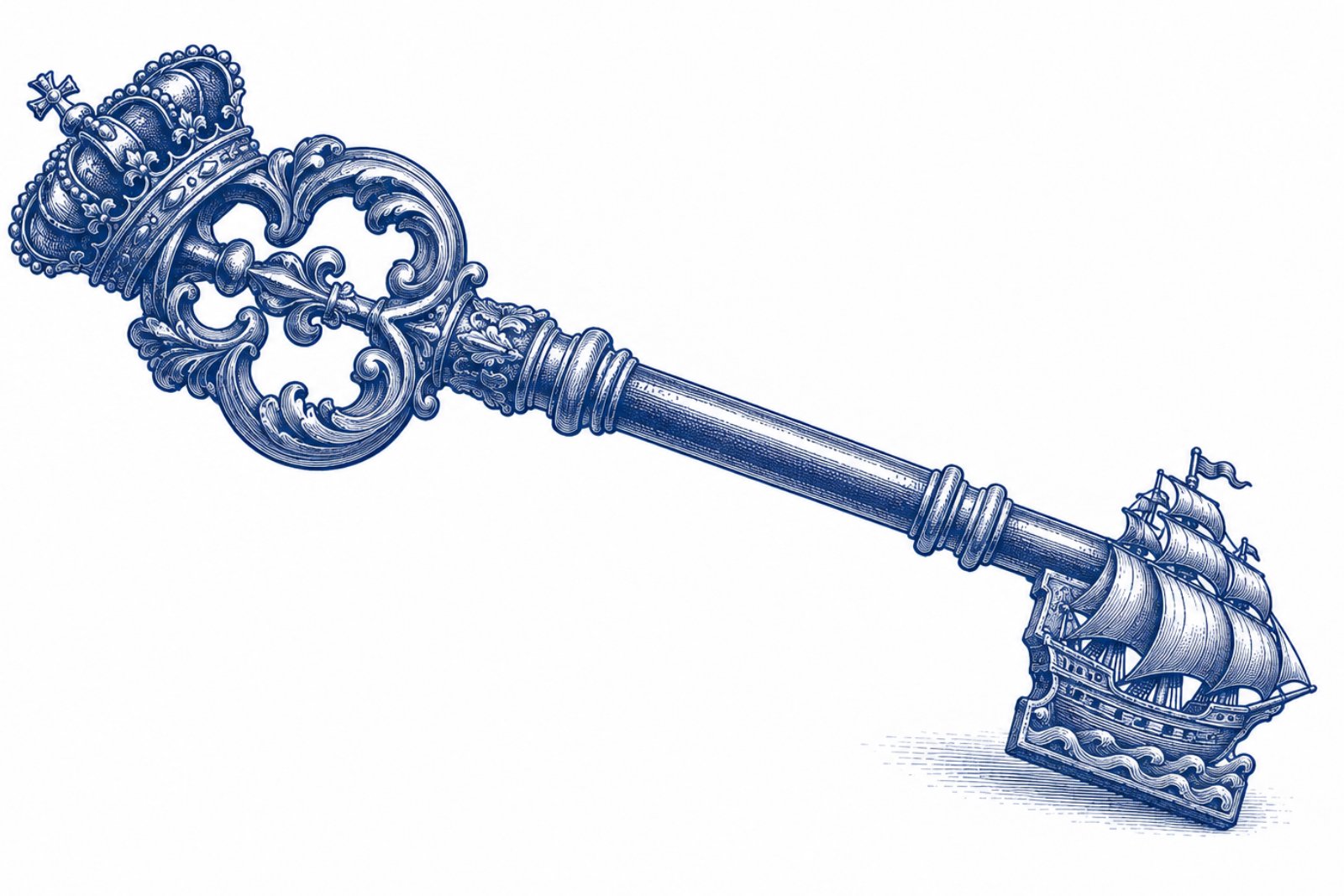
On 17 May 1816 a man named P. M. Mathiesen took 104.85 tons of barley, about 320 kilos of cannon and a miscellany of goods valued at ninety rigsdaler from Stockholm towards Holland, and paid thirty daler and nineteen shillings at Elsinore for the right to go on. A clerk wrote it down.
Clerks had been writing such entries since 1497, and by 1857 they had filled some 700 volumes with about 1.8 million passages, which survive in Copenhagen and occupy sixty metres of shelf. A historian who has worked through the database that has been growing out of them since 2007 reports, among much else, 41,000 rabbit skins shipped from Hull in 1566, which he eventually learned were headed for glue, an ivory cargo of 800 pounds in 1589 that cost a man called Jann Jacobssen eleven and a half shillings, and a great many tiled stoves travelling in both directions for reasons nobody has explained. The ledgers record the stoves and decline to say more.
Behind the ledgers stood King Eric of Pomerania, who started the toll in the 1420s. Sources give 1423 and 1429, and I shall not referee. At Helsingør the Sound narrows to four kilometres, and until 1658 Denmark held the coast on both sides, with cannon on each. A ship struck her topsails, dropped anchor and sent her master ashore to pay. If she tried to slip past she was fired on, and the powder, it is said, went on the bill.
Nobody could buy his way round the Sound, since the Belts were taxed as well, and the cargoes that came through were the sort that cannot easily go any other way: grain from Prussia and Livonia, timber and masts, salt, herring, tar, iron and copper.
Until 1567 a ship paid so much for being a ship. After that she paid a percentage of what she carried, usually one or two in the hundred, which is said to have tripled the revenue. The value was declared by the party who knew it best, and the crown could take the cargo for itself at the declared figure. A merchant who shaved the figure might find his goods sold to the king at his own price. No inspector had to disbelieve him. The king had only to be willing to be a customer.
A toll that can be raised against one nation is a policy as much as a tax. After winning the Kalmar War of 1611 to 1613, Christian IV forbade Dutch traffic to Sweden and raised the duties. The Dutch, who were by the 1640s buying all of Sweden’s copper and three quarters of Finland’s tar, answered in 1645 by sending their navy into the Sound as a threat to Copenhagen, and the king withdrew the new tolls.
For generations the dues were the chief revenue of the Danish crown, by one reckoning as much as two thirds of the state’s income in the sixteenth and seventeenth centuries and still an eighth of it in the 1850s, and in the middle of that decade the tolls came to about two and a half million rigsdaler a year, from a traffic that had topped fifteen thousand ships in 1840 alone. Between 1479 and 1581 the number of ships passing grew more than fivefold, and by 1672 Helsingør, where they all stopped, was the third largest town in Denmark. A king with an income of that kind can rebuild a medieval castle as a Renaissance palace with a great ballroom, and Frederick II did. Its name was Kronborg. Shakespeare set Hamlet in it around 1600, under the name of Elsinore.
Some of it went to the stars. In 1576 Frederick II gave Tycho Brahe the island of Hven, which lies in the Sound itself between Zealand and Scania, together with the income of other holdings and, a review in the London Review of Books says, a share of the tolls charged to shipping through the strait. In return Tycho undertook to make his king famous throughout Europe as a patron of the sciences. The observatory he built there, Uraniborg, is estimated to have cost about one per cent of the state budget, so that every captain who paid his toll at Elsinore was, in a small way, paying for the heavens.
Guns in the play belong to the king, and they are fired for his drinking. “No jocund health that Denmark drinks today,” Claudius announces, “But the great cannon to the clouds shall tell,” and in the fourth scene of the first act the stage direction sends two pieces off to accompany his revels. Outside the play, the guns of Elsinore had a day job. They were there to tell the ships to stop.
Fortinbras, in the meantime, is marching a Norwegian army across Denmark to Poland with the king’s leave, and Hamlet falls into conversation with one of its captains, who says that the army is going to gain a little patch of ground which he would not farm for five ducats. Hamlet is left to count the price, which is two thousand souls and twenty thousand ducats. Denmark meanwhile owned four kilometres of water that paid more than any patch in Poland. A few scenes later the prince writes to Horatio that two days out to sea a pirate of very warlike appointment gave chase, and that the pirates dealt with him like thieves of mercy. The one ship that leaves Elsinore in the play is taken by somebody who has not troubled to buy a licence.
In September 1629 a moment’s carelessness by two workmen burned everything but the chapel, and Christian IV led the restoration. In 1658 a Swedish army under Wrangel took the castle and carried off the courtyard fountain, the royal canopy and several ceiling paintings made for the ballroom, while Holger Danske, who sleeps in the casemates until Denmark needs him, slept on. The first performance of Hamlet at the castle came in 1816, the year of Mathiesen’s barley, when soldiers of the garrison put it on in the telegraph tower to mark two hundred years since Shakespeare died.
Denmark let the strait go by treaty. The Convention of Copenhagen came into force on 14 March 1857, and the nations that used the strait paid a lump sum for the release, thirty-three and a half million rigsdaler by one account and thirty-five by another, which one writer reckons at about a year of Danish public spending. The United States had been paying under protest. President Pierce told Congress in December 1856 that efforts to relieve American trade of the exaction had not yet succeeded, and that dues collected in the meantime were being treated as paid under protest and subject to future adjustment. It signed a separate convention in Washington on 11 April 1857 and paid about $393,000 for the free passage of its ships in perpetuity.
Gates have not gone out of fashion. In 2016 COSCO Shipping, a Chinese state-owned group, paid 280 million euros for a majority stake of 51 per cent in the authority that runs Piraeus, with a further 16 per cent promised in return for about 294 million euros of investment. It had been running two of the port’s container terminals since 2009. In 2021 it took the extra stake for 88 million euros, although the Greek minister responsible said that only a third of the investments had been completed. Thousands of traders own the goods on the quays. One concession-holder owns the gate.
Hamlet begins on the ramparts with a challenge. “Who’s there?” says one sentry, and the other answers, “Nay, answer me. Stand and unfold yourself.” In the next scene the prince asks a friend who has arrived from Wittenberg what his affair in Elsinore might be. Who is there, and what is your business: for well over a century the Sound had been putting those two questions to every ship in the strait. Horatio said first that he had come out of a truant disposition. Then he said that he had come to see a funeral.
Leave a thought