


SENECA COULD NOT CHANGE HIS WILL
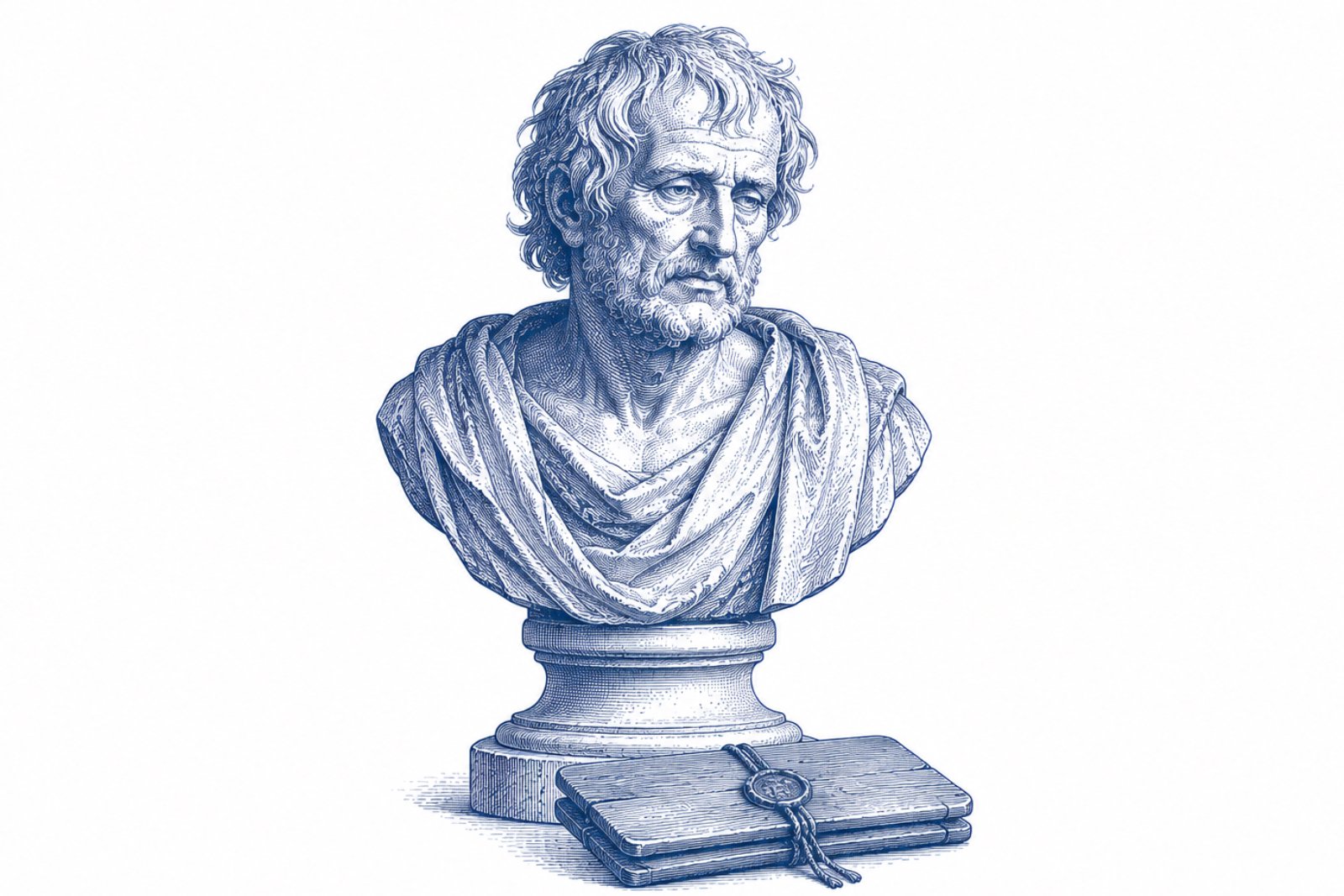
In 1754 diggers at Herculaneum lifted a bronze head out of the Villa of the Papyri, the head of a gaunt old man with deep lines about the mouth and the look of someone who has been reading the news. Antiquaries knew the face at once. The type had been printed as a portrait of Seneca since Theodor Galle put it into an Antwerp edition of Fulvio Orsini, the hollow cheeks being taken to reflect his philosophy, and by the seventeenth century about a dozen examples had turned up, each confirming the others. Winckelmann began to doubt it in 1764. In 1813 a marble herm came to light with Seneca’s name cut on it and a quite different face above, and the bronze has since been given to Hesiod, or perhaps Aristophanes, or to nobody in particular.
Rubens did no better with the body. His Death of Seneca, painted around 1614, drew on a black marble statue found in Rome in the sixteenth century, long taken for the dying philosopher and now generally known as the Old Fisherman. Seneca has had trouble being himself in portraits, which is perhaps what happens to a man who gave so much advice about how a life ought to look.
Tacitus gives the best account of how it ended, and it opens at supper. In the year 65 Seneca had come back from Campania and stopped at a country house four miles from Rome, where he was dining with his wife and two friends when a tribune named Gavius Silvanus surrounded the place with soldiers. The question he brought was whether Seneca admitted what an informer had said about his refusing to see the conspirator Piso. Seneca answered that he had begged off because of poor health and a wish for quiet, and that he had never had a talent for flattery. Silvanus, who was himself one of the conspirators, carried the answer to Nero and returned with the sentence, which he did not care to deliver in person. He sent a centurion.
The philosopher asked for the tablets on which to inscribe his will. The centurion would not allow it.
Of what he meant to write on them, Tacitus says nothing. Seneca turned to his friends, who were weeping, and told them that, since he was forbidden to repay their kindness, he would leave them the one possession still his, the pattern of his life, which, if they remembered it, would win them a name for moral worth and steady friendship. Where, he asked, were their maxims, and the preparation of so many years against misfortune? Nobody had been ignorant of Nero’s cruelty, and after the murder of a mother and a brother it was only to be expected that he would add the killing of his tutor.
It was a graceful remark, and it carried an edge, because he was among the richest men in Rome. He had come a long way from Corsica, where Claudius had sent him in the year 41, after Messalina accused him of adultery with Caligula’s sister and the Senate voted him death, and left him for eight years, until Agrippina had him recalled to teach her son. Soon after Claudius died in 54 his former exile wrote a satire on the dead emperor’s deification, usually rendered as The Gourdification of the Divine Claudius, in which the new emperor is promised more years and more wisdom than Nestor. By the time of the supper he owned houses at Baiae and Nomentum, a villa in the Alban hills and estates in Egypt, and he had written a treatise, On the Happy Life, arguing that a wise man may be rich. The prosecutor Suillius put the question in less philosophical terms. By what kind of wisdom or maxims of philosophy, he asked, in Tacitus’s account, had Seneca within four years of royal favour amassed three hundred million sesterces? The wills of the childless at Rome, he added, were caught in his snare, and Italy and the provinces were drained by boundless usury. Suillius was an enemy, and the sum is his. A scholar writing in 1966 argued that the unflattering picture of Seneca rests almost entirely on him.
Once he had tried to give the fortune back. Tacitus reports an audience in which he told Nero that he had been given such honours and riches that nothing was wanting to his happiness but a right use of them. He asked how a man of equestrian and provincial family had come to be numbered among the chief men of Rome, and he offered the fortune to the emperor’s agents. Nero declined, with an embrace, and a speech on how much his avarice and cruelty would be talked about if he accepted. Seneca thanked him, which Tacitus calls the usual end of an audience with a despot, and afterwards received fewer visitors and appeared in Rome less, as though ill health or philosophy kept him at home. He tried to retire in 62 and again in 64, and Nero refused him both times.
Cassius Dio, the Greek historian, writing a century and a half later and no friend of Seneca, adds a story of a different kind. Seneca, he says, in the hope of a good rate of interest, had lent the Britons forty million sesterces that they did not want, and then called in the whole loan at once, with severe measures. Dio lists it among the excuses for the revolt of Boudica. It is a convenient tale for a hostile historian, the only account of it is his, and nobody can say how much of the sum was ever lent.
Years earlier he had made a related point to a man who counted grain. On the Shortness of Life is addressed to Paulinus, who held the grain office at Rome and may have been the father of Seneca’s wife. In the third chapter the argument is that people will rush to stones and weapons over a boundary line and let others trespass on their lives. “No one is to be found who is willing to distribute his money, yet among how many does each one of us distribute his life!”
Planners call the modern form of this annuitisation, and have been recommending it to the rest of us for the better part of sixty years. In 1965 Menahem Yaari showed that a retiree with no wish to leave anything to heirs should hand his savings to an insurer in return for an income for life, because the money left by those who die early pays the survivors. Roughly half of the people asked say they like the idea, and about one in eight, by one recent count, do it. Researchers have found that retirees tend to see the contract as a bet on longevity rather than as insurance against it, a bet they lose if they die on the second day. Yaari’s retiree cares nothing for what he leaves behind. Seneca, refused his tablets, left his friends the pattern of his life.
Seneca had one thing that no spreadsheet has, the date. A centurion handed it to him with the order. The rest of us carry a plan that quietly assumes an age at which the money may stop, and carry it with the confidence normally given to interest rates.
Its date held, and the day went on. Seneca’s body, thin from a frugal diet, let the blood out slowly, so he had the veins of his legs and knees opened as well. His wife Paulina had said she would die with him, and Nero forbade it, and her slaves bound her arms. She lived on for a few years, Tacitus says, in praiseworthy remembrance of her husband, and her face and frame stayed white to a degree of pallor that showed how much of her life she had lost. Seneca asked a friend whom he had long esteemed for his faithful friendship and his medical skill for a poison he had prepared some time before, the drug that Athens used for its state executions, and the cold in his limbs defeated it. He was carried into a pool of warm water and sprinkled the slaves nearest him, saying that he offered the liquid to Jupiter the Deliverer. Then they took him to a steam bath, where he suffocated. He dictated a great deal to his secretaries along the way.
He was cremated without the usual rites, as a codicil to his will had directed, written in the years when he was at the height of his wealth and power and had the end in mind. Whatever he wished to add that afternoon went unwritten. The old codicil was carried out to the letter.
Leave a thought