


VAN GOGH
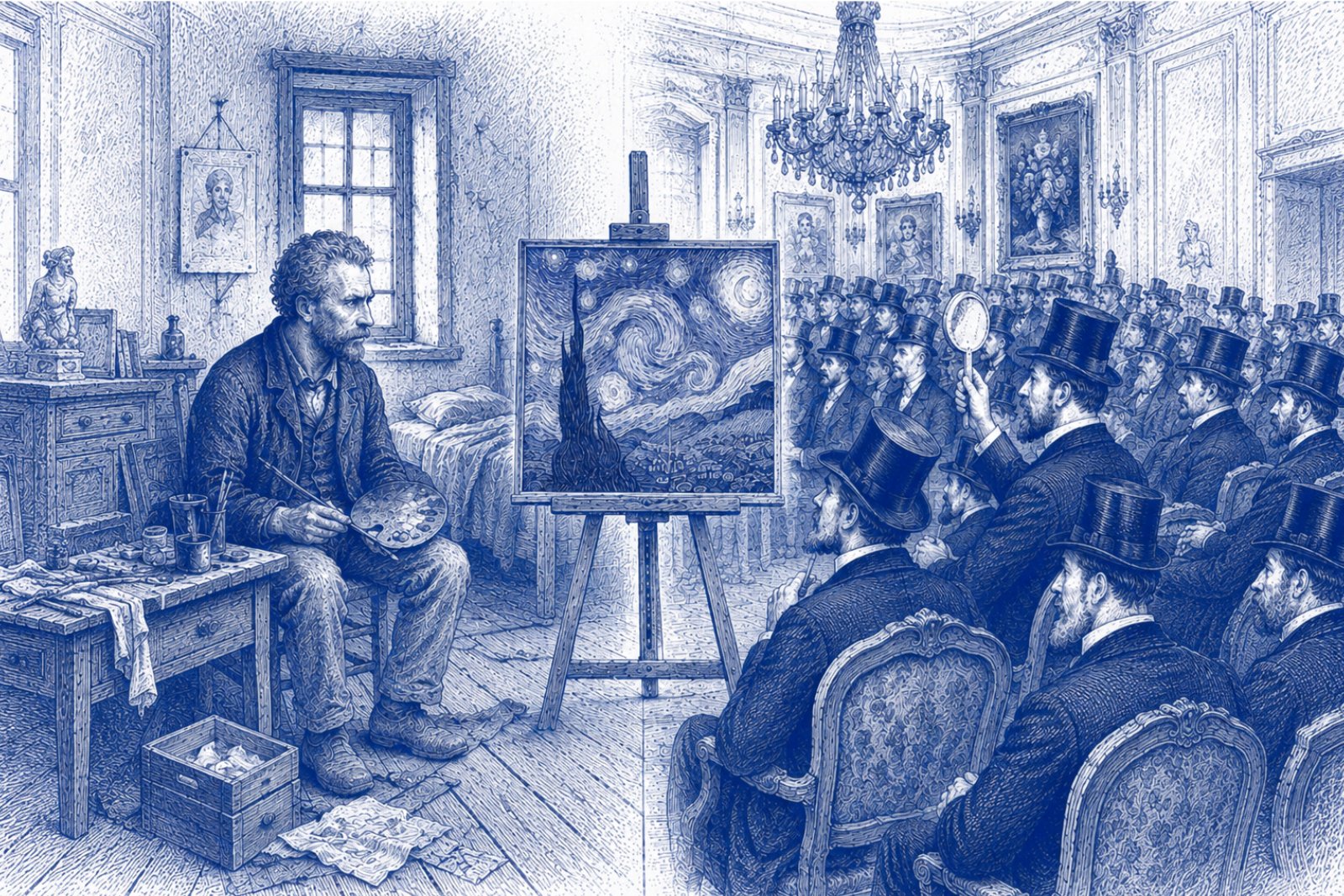
Brussels, then, the second week of March in the year 1890. Inside a rented exhibition hall, canvases by Cézanne, Renoir, Toulouse-Lautrec and Signac hung on walls that had carried the annual show of a group calling itself Les XX since 1884. Among them, one small picture of vines gone the colour of wine changed hands that week for four hundred francs, the only sale of its kind the year would record for the man who painted it.
The buyer was Anna Boch, herself a painter and a member of Les XX since its founding, whose brother Eugène had sat for a portrait some years before and remained a friend of the artist’s despite the distance that had grown between Arles and Brussels. The seller, a red-haired Dutchman with a temperament most of the room found difficult, was present that evening, and later admitted some embarrassment that his friends had insisted on the full price when a discount was theirs to expect.
Its title was The Red Vineyard, made the previous autumn near Arles, and it is, so far as the more careful accounts agree, the only canvas Vincent van Gogh sold during his own lifetime. A handful of other transactions complicate even that modest claim, trades for paint and lodging rather than clean cash sales, but none of them changes the plain fact of the evening in Brussels: one sale, one buyer, one price, in a working life that produced, by the counts historians generally accept, somewhere close to nine hundred paintings and something over a thousand drawings, most of it in the final two years before the Brussels sale.
A far older story, better documented in some ways and stranger in others, makes it easier to see what was actually happening in that hall.
Johannes Vermeer painted in Delft through the sixteen sixties, earned a modest local reputation, and then, for the better part of two centuries after his death, all but vanished from the written record of Dutch art. He went unmentioned in the standard survey of the period, a multi-volume history that several generations of students learned Dutch painting from without once encountering his name. His surviving canvases were frequently attributed to lesser, better remembered names, sold and resold under labels nobody thought to question, and at least one major work hung for years in a private collection under a different painter’s name entirely before a museum director, on a visit that was not even meant to be about attribution, recognised the brushwork for what it was.
It took a French critic writing under a Dutch pseudonym, Théophile Thoré, a political exile travelling Europe on funds he could barely spare, to reassemble a scattered handful of paintings into a single body of work and publish it, finally, in 1866, across three instalments of the Gazette des Beaux-Arts. He called the painter the Sphinx of Delft, on account of how little anyone had thought to record about him, and the phrase stuck rather better than most critical judgements manage to. His own catalogue eventually claimed some sixty six pictures for the artist, considerably more than the roughly three dozen that scholars today are prepared to defend with real confidence. Enthusiasm, once it finally arrives, tends to overreach a little before it settles.
Van Gogh’s case ran on a similar delay, though a crueler one, and Thoré’s story is what makes the cruelty visible. Vermeer at least was dead and beyond feeling the wait. Vincent had four months left to live when Anna Boch wrote her cheque, and he spent most of them still convinced the wait might never end.
His brother Theo worked as a dealer at Goupil et Cie, running the firm’s branch at 19 Boulevard Montmartre in Paris from 1881 onward, and understood the trade as well as almost anyone in Europe. It availed him little in this one respect. He could build no market at all around paintings that unsettled the eye of nearly every buyer who saw them. Selling art in that decade ran almost entirely on critical review and gallery reputation, since no futures market existed to price an artist’s prospects the way a commodity’s price could be read off a board that same morning. Theo could place his brother’s canvases in a back room and wait. Waiting was the whole of the strategy available to him.
Markets need more than one good object. They need enough people, arriving independently at the same judgement, each willing to defend a price to whoever buys from him next. In 1890 that number of people did not exist yet for Vincent’s work, and it had not existed for two centuries after Vermeer’s death either. Reach was never the difficulty. Goupil et Cie kept branches in Paris, London, The Hague and Brussels, and a print-reproduction arm so successful that its name was known to collectors who had never once set foot inside a gallery. All that machinery for making a name known, and none of it could be turned, in time, toward the one name that needed it most.
What Thoré did for one painter, Jo van Gogh Bonger did for the other, though not while her brother-in-law lived to see it. Within a year of the artist’s death that July, she found herself, recently widowed herself after Theo died only months later, holding the bulk of his surviving Nachlass. What she did with it over the following three decades amounted to a second career she had never trained for and had not chosen: organising exhibitions, negotiating sales to dealers who had once found the work unsellable, and compiling and publishing her brother-in-law’s letters, in a Dutch edition that first appeared in 1914.
Neither painter’s brushwork improved after the fact, not by a single stroke. Only the number of people prepared to agree on its value did, and that number, once it started moving, moved a very long way.
Financial assets, in the ordinary run of things, are priced against something they can be expected to produce, a stream of earnings, or a claim on some future flow of cash, estimated however imperfectly and discounted back to the present. A painting produces nothing of that kind. Its price rests instead on a scarcity that cannot be manufactured after the fact, since the artist makes no more of it, and on the slow accretion of critical agreement. It rests, finally, on whoever happens to be standing in the room with the largest appetite to pay that day.
Seen this way, Theo’s decade of monthly remittances to his brother was nothing so exotic as a very long-dated wager, placed by a backer who did not live to learn how it settled. It did settle, eventually, and handsomely. Only not to him. It settled on his widow, and through her on his son, which is a different thing from saying it settled on nobody.
Auction houses formalise this today with a device unavailable to Anna Boch: a reserve price, fixed privately in advance, below which the work simply does not sell and is returned unsold to its owner, sometimes for years, until fashion or scholarship brings the number of interested buyers back above whatever threshold the owner quietly set. That fact alone is proof enough that liquidity for a single painting can vanish in an afternoon if the room simply does not cooperate. A share of stock nearly always finds a buyer at some price, however unfavourable, because a functioning exchange exists to match one order against another continuously, all day, every trading day, whether or not anyone in particular is paying attention. A painting has no such standing exchange behind it, only whichever room happens to be paying attention on the one evening it is offered.
Scarcity and room dynamics can price an asset every bit as rigorously as a discounted cash flow model prices a bond, and the two methods are reaching for the same thing by different roads. What the painting method adds, that the cash-flow model does not, is a specific cruelty: the person who bore the entire cost of producing the asset, in labour and in years spent unpaid, is rarely the same person who eventually collects the return on it. Liquidity is carrying most of the weight in this account.
He could not have discounted his future reputation into a livable income, and not for want of understanding his own work. No instrument existed, in his day or in ours, to let a person borrow money against a fame that has not yet arrived and that may, quite simply, never come at all. He lived, as everyone eventually must, entirely within his own present. That present held very little, and it held it for four more months, until the summer, and until a wheat field outside Auvers that this article has no need to describe further.
That same canvas can still be seen today, in the Pushkin State Museum of Fine Arts in Moscow.
We may doubt whether a market can ever really repay someone for having been right too early, in art or anywhere else money changes hands on a delay, and nobody has settled that question with much confidence in either direction. Anna Boch, at least, did not wait around to find out. She paid what was asked, and by her own friend’s slightly mortified account, a little more besides.
Leave a thought