


THE SWAN THAT WASN’T SUPPOSED TO EXIST
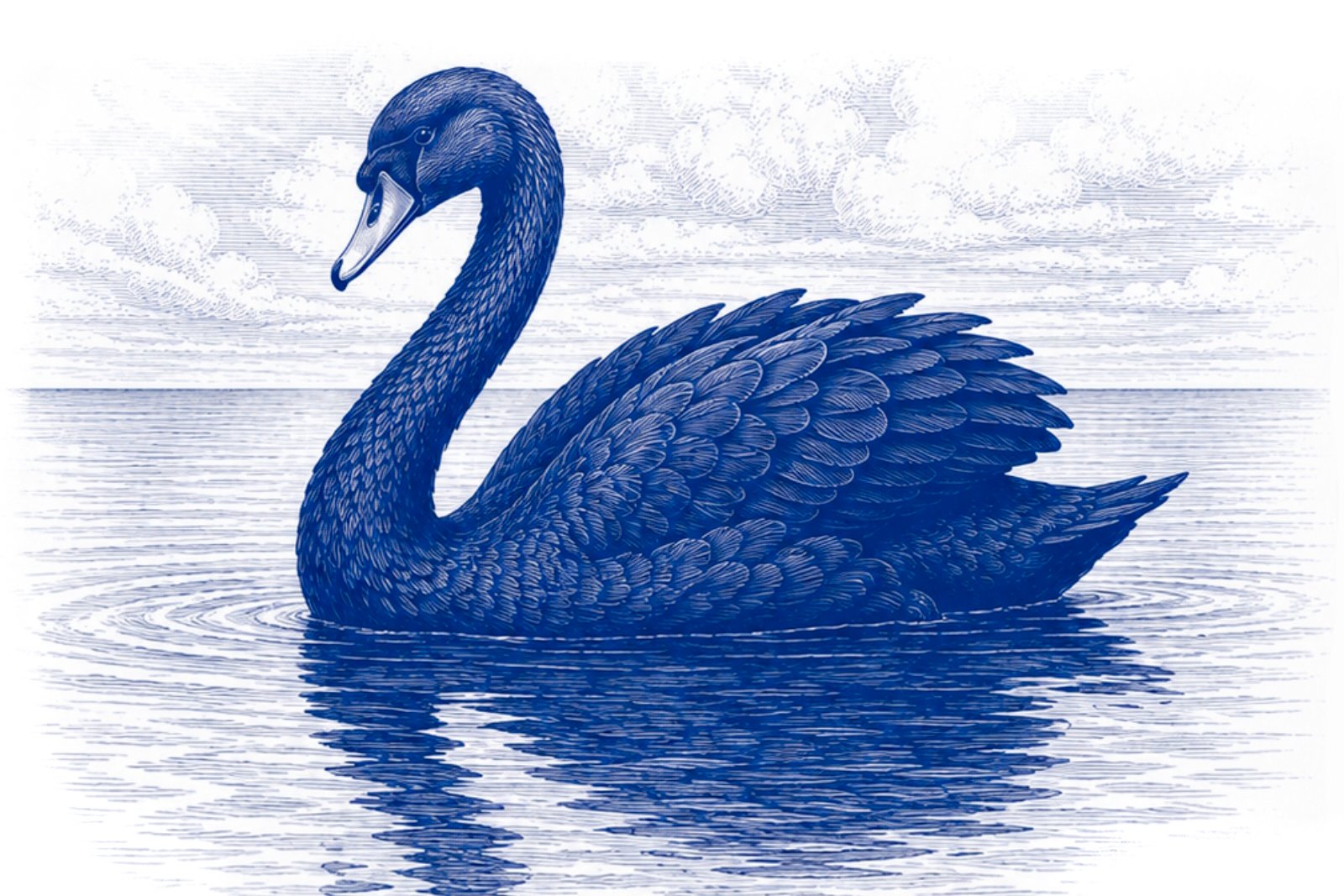
Juvenal reached, in the sixth satire, for a phrase to describe a woman who did not exist, and what he produced was rara avis in terris, nigroque simillima cygno, a rare fowl upon the earth, and very like a black swan. The joke works only if the audience agrees instantly that the thing is impossible. It functions as a stock impossibility, in the same family as a square circle, a figure of speech doing no ornithological work at all, and for fifteen hundred years European writers used it exactly that way, a proverb for the thing that cannot be, deployed by men who had never conducted a survey of swans and did not imagine one was required.
That is the first thing the standard version gets wrong. The black swan started life as a figure of speech, hardened by centuries of repetition into something people mistook for a fact about the world, and it was never the well-supported empirical generalisation the standard version imagines, precisely because nobody along the way had ever gone looking for the observations that would make it one.
In January 1697 a Dutch squadron under Willem de Vlamingh, sailing the west coast of New Holland and looking chiefly for survivors of a lost ship, put boats up a river and found black swans on it. They took several aboard; the river is called the Swan to this day. Nobody on that expedition was testing a theory. A sailor spotted an unfamiliar bird, and the log noted it, the way a log notes weather.
Both errors, the ancient one and the modern account of it, sit in the same place, and it is not the place people usually look.
Nassim Taleb borrowed the proverb in 2007 for a book about a different problem entirely, the risk that lives outside any model’s sample, and the borrowing was apt. What travelled less well was the origin story that came bundled with it, retold ever since as a lesson about insufficient data, when the actual lesson sits one level further back, in the false confidence of a category nobody had thought to question.
Consider what the proverb actually asserted: a generalisation built entirely from the birds available to one peninsula’s naturalists, silently extended to cover a species nobody there had fully surveyed. That extension is the entire error, made in a single step nobody thought to examine. Every individual sighting recorded in Europe had been accurate down to the last feather. What failed was the unstated assumption that the surveyed range and the animal’s actual range were one and the same, a different kind of mistake entirely, one no quantity of further sightings inside Europe could ever have corrected. More data from inside the sample tightens the interval around a number that was never the question.
This distinction has a name in the discipline, given by Frank Knight in 1921, and it has been admired steadily and applied almost never. Risk is a distribution you can write down: the outcomes are enumerable and the probabilities estimable, and an insurer can quote a price. Uncertainty is the state in which you cannot write down the outcomes at all, and no quantity of observation converts the second into the first, since what is actually missing is the list itself, an enumeration nobody has seen yet and cannot produce in advance no matter how carefully they measure what they do have.
A modern risk model speaks with the proverb’s confidence, unfortunately without the satire’s self-awareness attached to it. It is built from a record, describes that record with real fidelity, and its confidence intervals are honest, in spite of themselves, about everything except their own perimeter. Value-at-risk asks what loss is exceeded on the worst day in a hundred, given a history; it answers that question correctly and says nothing whatever about the worst day in a history that never contained one. The output is a number with a currency symbol in front of it, and a number of that shape carries an implicit promise, that the quantity has been measured, which the method never made and cannot support. Regulators adopted the method precisely because it produces a number, and a number is something a regulation can require; a capital requirement pegged to an honest shrug would not have survived a single committee meeting.
Institutions know this. The disclosures say it. The disclosures live in a methodology appendix and the number lives in a cell in a committee pack, and only one of the two gets read aloud in the meeting where the limit is set.
Why the number wins has a plain answer: institutional convenience. A figure can be added to another figure, compared across desks, tracked over quarters, and defended to a regulator who requires a figure. What can a doubt be defended with? Silence, mostly, and a footnote nobody reads aloud. The person who keeps raising it acquires a reputation for raising it, quarter after quarter, until she stops. The institutional preference for a precise mistake over an admitted unknown is, at bottom, a rational response to which of the two a spreadsheet can actually hold.
There is something almost sympathetic in this, and I want to put it fairly, without sneering. The risk officer who converts an absence of observations into a small positive number is meeting a requirement the committee will not waive, using the only material available, and she writes the caveat down in the place caveats go; nobody is deceived who bothers to read the appendix. The damage happens one step further on, where the cell travels to the meeting and the appendix does not.
The Dutch sailors on the river, for their part, recorded the birds and moved on, having no stake at all in what the sighting did to a Latin proverb.
What the episode really demonstrates is narrower than the fable suggests and rather more uncomfortable. It is not that rare events occur, which everyone knows. It is that a category can be wrong in a way that generates no warning from inside itself: every observation confirming, every confirmation correct, the confidence rising with each one, while the actual defect sits in the assumption that the measured region and the world share the same edges. There is no diagnostic for this available to the person inside the category. That absence of any internal warning is what makes the failure worth taking seriously on its own terms.
Which is easier to defend in a committee pack: a precise number that later turns out wrong, or an honest shrug that fits no cell at all? The institutions made that choice long before any of the software arrived to help them keep making it.
Leave a thought