


THE COINS THAT NEVER MOVED
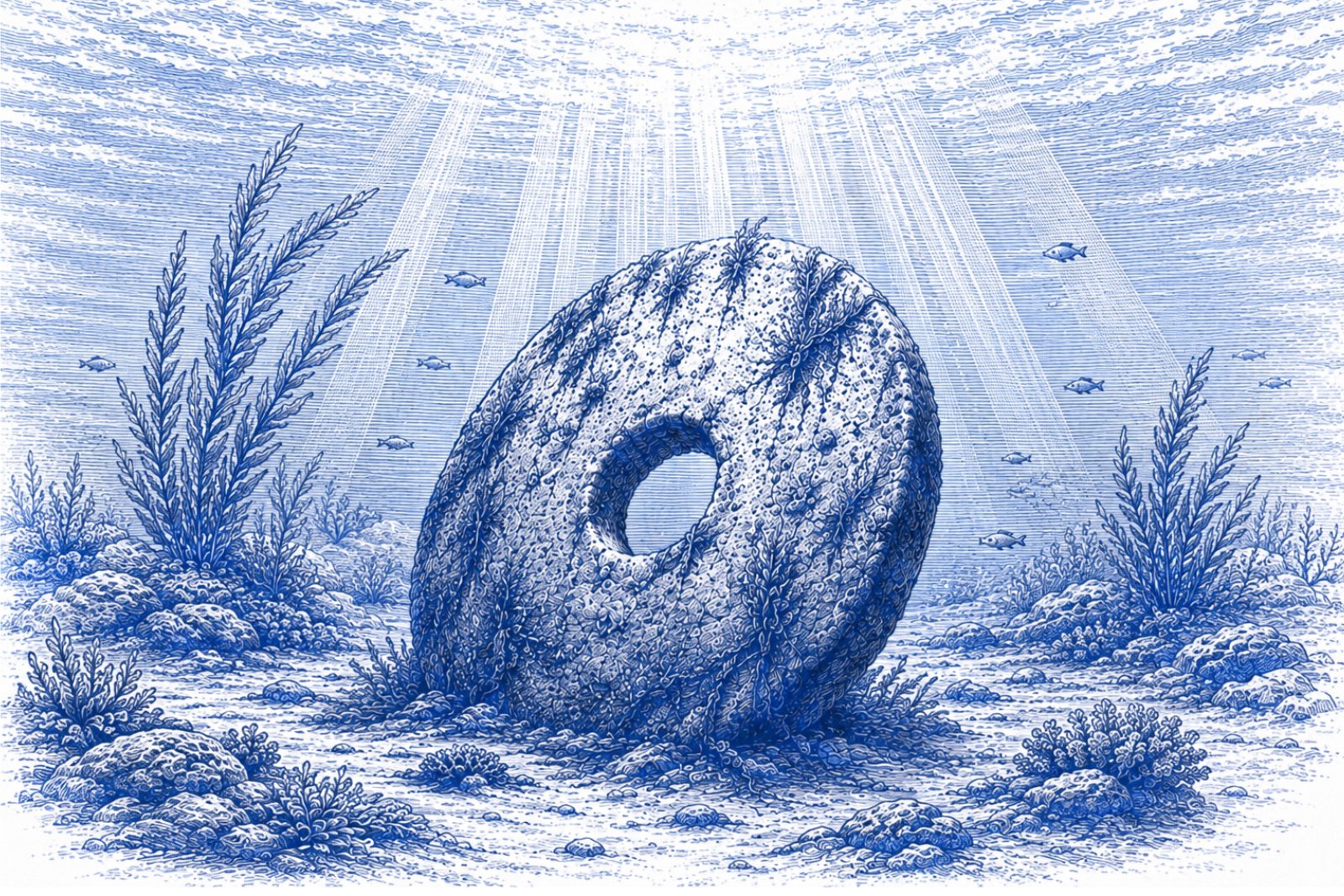
Yap has no limestone. That single geological fact is the beginning of the whole arrangement, and it is the detail most retellings drop first. The stone from which the discs were cut lies on Palau, some two hundred and fifty miles of open Pacific away, and every disc on Yap arrived there by canoe and raft after men had quarried it with shell tools on somebody else’s island, negotiated for the right to do so, and carried it home across water that regularly killed them. Some of the largest discs, quarried whole from a single block of stone, exceed three metres across and weigh several tons, far too heavy to lift without a crew and rope; that impracticality was itself the design, since a stone nobody could carry off was a stone nobody needed to guard. A chief typically sponsored the voyage and took the largest share of what it brought home, and a single expedition could take months and, on the open crossing alone, cost lives to the weather. Their worth came from the very difficulty of that voyage, and the islanders kept the histories of individual stones the way a European family keeps the provenance of a painting.
One disc, according to tradition, went over the side during a storm on the return. The crew came home without it and with an account of where and how it had gone down, corroborated by everyone aboard. The account held up because everyone with any reason to dispute it had been sitting in the same canoe when the stone went under, and a fact witnessed by your only rivals is a fact that is very hard to contest later.
The village accepted the account. The stone was held to have arrived; its owner traded on it for the rest of his life, and ownership passed down through his family for generations afterwards, transferring hands that never touched it and eyes that never saw it. Nobody dived for it. Nobody proposed that they should. The arrangement had stopped to need the object long before anyone noticed, which is the ordinary career of every monetary instrument that has ever worked.
What makes the case more than an anthropological curiosity is what William Henry Furness recorded when he spent time there around 1903 and published a few years later under the title The Island of Stone Money: the ownership system on Yap functioned as a public ledger held in memory. There was no register and no writing. There was a community small enough that everyone knew which stone belonged to whom and what had been given for it, and that shared knowledge alone settled every transaction; the stones themselves never needed to move at all. Moving a two-metre disc is, above all, an engineering problem, and the islanders had correctly identified that the engineering itself was optional.
Keynes read Furness not long after the book appeared and thought the Yap arrangement more rational than most European monetary practice of his own day. Milton Friedman read the same material in 1991, and did something sharper with it than admiration.
His parallel was an episode at the Federal Reserve Bank of New York. In the nineteen-thirties the Bank of France, wanting its dollar holdings converted into gold but not wanting the expense and risk of shipping bullion across the Atlantic, asked the Federal Reserve to hold the gold on its behalf. Clerks went down to the vault, moved the appropriate number of bars into a compartment designated as French, and put a label on the drawers. The newspapers reported a loss of gold from the United States. The financial press discussed the outflow and its implications for American reserves. No metal crossed anything at all, and the bars in question may not even have moved shelves; the entire transaction consisted of a change in the description of a compartment and the ledger entry that recorded it.
Friedman gave his essay the same title Furness had used six decades before, and his point was that the bankers and the islanders were performing exactly the same operation, and that only one of the two groups had ever been described as primitive; foolishness had nothing to do with it.
This is what the Yap system proves: an asset requires exactly two things to function, an agreed record of who holds the claim, and a community willing to enforce that record. It does not require the object. It does not require the object to be visible, or accessible, or in the same hemisphere, or, in the case of the sunken disc, extant in any sense a receiver could act upon. The physical item is a device for anchoring the record when the record cannot be trusted on its own, and a community that trusts its own record can dispense with the anchor and lose nothing. Yap could dispense with it because everyone enforcing the record lived within walking distance of everyone else who might contest a claim; the mechanism depends on a population small enough that reputation can substitute for paperwork, and larger societies have generally found they cannot get away without the paperwork.
Modern settlement is this, at scale, with worse acoustics. The depository itself exists because physical certificates once nearly broke the system built on them: trading volume in the late nineteen-sixties outran the back offices meant to move paper between firms, exchanges shortened their hours so clerks could catch up, and immobilising the certificates in a single vault, with ownership tracked only in ledger entries, was the fix that stuck. Securities are held in a depository, in America a single company called the Depository Trust Company, under a name that is not the beneficial owner’s; title passes by book entry between accounts and the certificates, where they exist at all, sit immobilised in a vault nobody visits. The depository’s own nominee name, Cede and Company, appears on the face of nearly every certificated American security still in existence, one fictional holder of record standing in for millions of real owners who will never see the paper and would not know what to do with it if they did. Central bank gold has largely been held in custody on someone else’s premises since decades now, tracked as a numbered entry on an allocation list. None of this is a scandal and none of it is new. It is the Yap arrangement with a legal department.
Cryptocurrency proposes the opposite arrangement: a ledger nobody owns, verified by anyone who cares to run the software, designed by people who distrusted every small number of institutions history had ever produced and who answered the trust problem by making the ledger too large and too widely copied for any single institution to quietly alter it. Whether a distributed ledger held by strangers who owe each other nothing ends up more trustworthy than a village that knows everyone’s face is a question the islanders never had to ask themselves, and the industry built to answer it is, by the standards of Yap, remarkably young.
Where it gets uncomfortable is in the one thing the islanders had that the modern version does not. Their ledger was held by everyone. There was no registrar to be captured, no single institution whose failure would leave ownership undeterminable, because the record was distributed across the entire population that had any interest in enforcing it. Modern records are held by a small number of institutions, and the question of who is permitted to write to them is answered by charter and statute, a form of memory considerably more exclusive than a neighbour’s recollection ever was. Money is wherever the agreement says it is, but somebody has to be authorised to speak the agreement, and that authority is the actual asset in the whole arrangement. A share register or a central bank’s own balance sheet is, in this sense, a village ledger with far fewer villagers and a locked door. The stone was never the point. Neither is the gold, and neither is the compartment label. The point is the pen.
2022 supplied the clearest modern proof of this, when Western governments froze a large share of a foreign central bank’s reserves. No bar of gold and no bond certificate moved an inch; what stopped, instead, was the willingness of anyone downstream to honour that central bank’s instructions, the Yap mechanism running in reverse. A reserve turns out to be a form of permission, held at someone else’s pleasure, wearing the metal only as a historical costume.
That disc at the bottom of the lagoon went on being, as far as anyone on the island was concerned, a family’s wealth for generation after generation, without once coming back into view. Several currencies kept in plain sight on dry land, in vaults built specifically to watch over them, cannot make the same boast
Leave a thought