


THE OBJECT WE REFUSE TO DESTROY
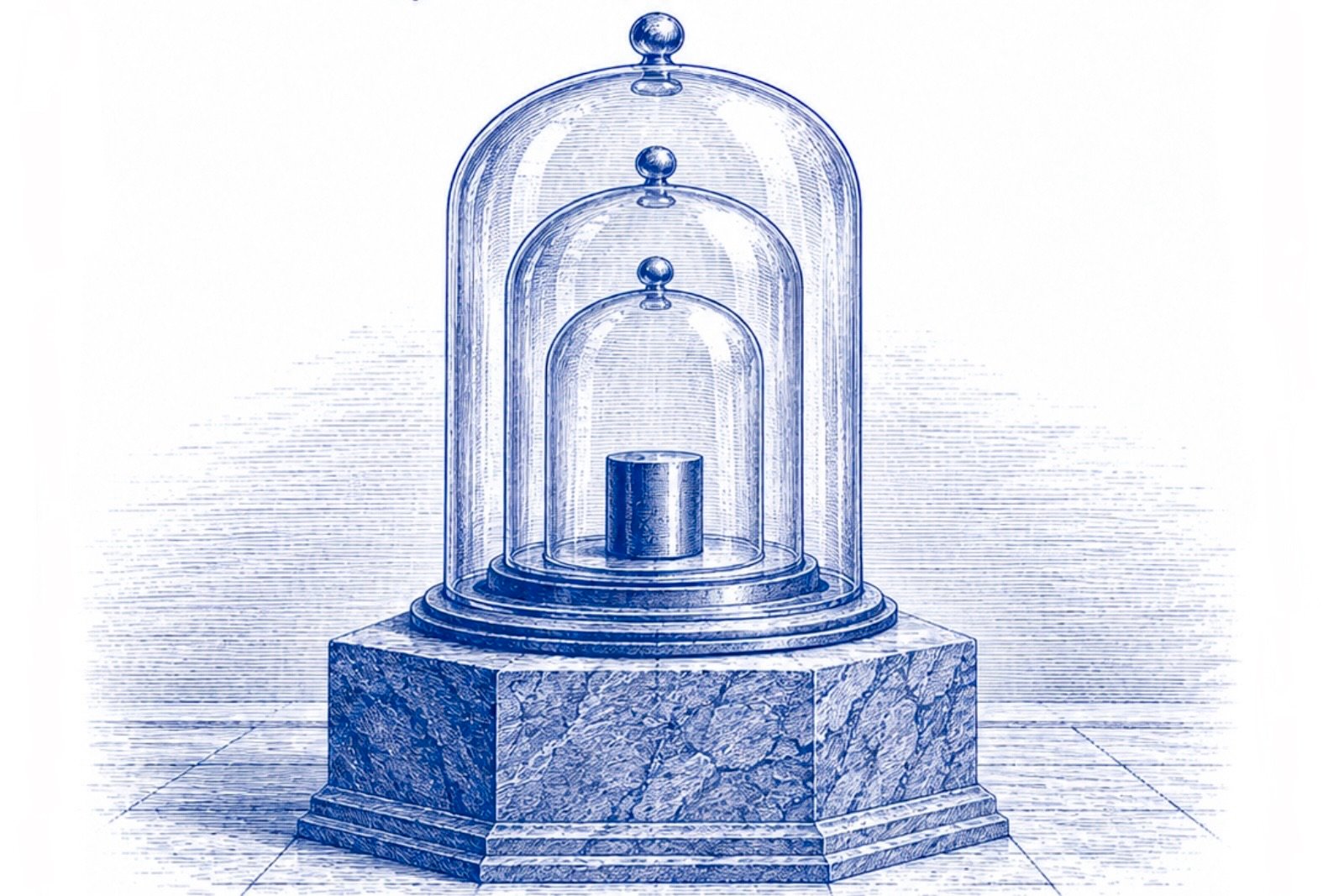
A cylinder of platinum and iridium, thirty-nine millimetres in diameter and thirty-nine millimetres in height, sits in a safe in the basement of a small pavilion in Sèvres, on the western edge of Paris, under three bell jars of glass nested one inside the other. Ninety parts platinum, ten parts iridium, an alloy chosen because it resists nearly everything the air can do to a metal. To reach it, three keys are required, held by three different officials, and none of them can open the vault alone. It was sanctioned in 1889 by the first General Conference on Weights and Measures, which declared that this prototype shall henceforth be considered the unit of mass, and for a hundred and thirty years the sentence was true in the most literal sense available to a sentence. Whether the object was actually a good kilogram was never the question anybody was allowed to ask. It was the kilogram, and the two things stopped being separable the moment the Conference said so.
This cylinder is older than its authority. Johnson Matthey, a firm of metallurgists in London, cast it in 1879, a full decade before the 1889 Conference got around to declaring it the unit of mass. For ten years it sat as an unusually careful piece of platinum-iridium with no official function at all, waiting on a committee. In 1889 the metal itself stayed exactly as Johnson Matthey had cast it a decade earlier; what changed was the sentence written about the metal, and the sentence is what did all the subsequent work: a status conferred by an institution willing to stake its credibility on the choice, not a property the object had discovered in itself.
Consider what that arrangement actually required of everybody downstream. A chemist in Osaka, a customs officer in Valparaíso, a pharmacist in Lyon: each of them weighed things against a national prototype, which had been weighed against one of the official copies, which had been weighed against the cylinder in the basement. Metrology calls this traceability, and it functioned as an enormous tree of trust with a single object at the root. The national prototypes came back to Sèvres for recalibration, hand-carried, occasionally in the passenger cabin of a commercial flight in the care of a nervous physicist. A comparison of the international prototype against its own official copies happened three times in the unit’s history: once in 1889, when the prototype was first measured against the working copies; again in 1946; and a third time across 1988 to 1992. Handling the thing was itself a risk to it, which is why the comparisons were so rare.
Cleaning it was a procedure with a name and a literature. The surface was washed with a chamois soaked in equal parts ether and ethanol, then steamed with twice-distilled water, in a sequence worked out so that the mass afterwards would be reproducible; the cylinder was understood to accumulate a film of contamination from the air, and the cleaning removed it, and the whole question of what the kilogram weighed depended on the state of that film on a given afternoon. Somewhere in the institution’s own records there is a named individual whose specific professional responsibility this was, year after year. A fingerprint on that surface would have altered, for a period and by a measurable amount, what a kilogram meant on this planet.
Then the problem, which nobody could repair, because it was not a fault in the apparatus but a fault in the idea.
Comparing the prototype with its copies, the metrologists found that the two were separating. The official copies, on the whole, appeared to gain mass relative to the cylinder: on the order of fifty micrograms across a century, by the figure most often cited. The median difference for the original 1889 set, measured in the verification carried out around 1989 to 1991, came to something like twenty-five micrograms. Either the copies were putting on weight or the master was losing it, and here the logic closes like a trap. The cylinder was the definition. It could not gain or lose anything, since by construction its mass was one kilogram whatever it happened to do. The drift was real, the direction was unknowable, and the sentence describing it was not quite writable in the language the system provided. We may see in this the whole difficulty of a standard that is also an object: it cannot be wrong, and therefore it cannot be corrected.
By 2019 the kilogram had become an embarrassment of a specific kind: the last of the seven base units of the International System still defined by a physical object instead of a constant of nature. The metre had been redefined in terms of the speed of light back in 1983. The second had been anchored to the vibration of a caesium atom since 1967. The kilogram alone still meant whatever a particular lump of metal in a French basement happened to weigh on a given day, and the whole architecture of scientific measurement rested, at its base, on an object that could be scratched, contaminated, or simply misplaced.
On 20 May 2019 the kilogram was redefined in terms of the Planck constant, a quantity answerable to no vault, no key, no chamois, and no nervous physicist riding in an airplane cabin. Care was taken that the new kilogram should be the same size as the old one within the uncertainty of the measurements, which is a detail worth pausing over: the replacement was calibrated to the object it replaced, so the cylinder remained the authority even as it was being retired. From that afternoon it no longer defined anything, though it still carried the market value of thirty-nine grams or so of platinum-iridium alloy, not nothing, and not remotely the point.
Seven years on, it sits exactly where it sat before, behind the same glass and the same three locks, in a climate nobody has stopped controlling.
No one has suggested melting it down for scrap, and no one has suggested giving it a glass case in the lobby, where visitors could file past the thing that used to weigh the world; that second proposal, one suspects, would meet more resistance than the first. It sits in the dark under its bell jars, and the protocol that once protected a definition now protects a souvenir, with no visible seam between the two jobs. The building is still guarded, the environment still monitored, the access rules unchanged. An accounting system somewhere carries the line item that funds all this, signed off every year by whoever holds the authority to approve it.
That signature is the part that interests me, because it is a portfolio decision and nobody involved would describe it as one. Preservation has a real cost: it consumes space, labour and capital that had other uses. An institution that keeps a retired artefact under active security is buying an asset with no cash flow, no liquidation intention, and a small negative carry. Central banks do exactly this with gold, in an era when gold anchors no currency at all. The metal yields nothing, costs something to store, and is not for sale. The difference between that position and an error is entirely a matter of what the holder thinks the object is doing while it sits there.
What a balance sheet cannot hold is the honest answer: the object is doing institutional memory. The closest category accounting actually offers is an intangible asset with no determinable life, held at cost and written down only once something forces the question, which is true and still misses what is actually happening. The cost is knowable to the euro. The value is not knowable at all, and the reason it is not knowable is that nobody has ever run the experiment of stopping. If the Bureau sold the cylinder for its metal content tomorrow and issued a note explaining that the definition no longer requires it, nothing measurable would fail. Every laboratory would go on realising the kilogram from the Planck constant without interruption. Something else would fail, and I cannot name it with any confidence, which is not the same as doubting that it exists.
Cathedrals still hold reliquaries whose saints no historian can now authenticate, kept in silver, lit, guarded, insured, and never audited on the question that would matter most: whether the bone inside ever belonged to the name on the label. The basement in Sèvres has quietly joined that category, with better climate control and a more defensible provenance. It is easy to say why institutions keep such things: continuity, and a real one.
The harder question is what we imagine would happen on the day one of them stopped.
Leave a thought