


THE PRICE THAT WEIGHS CIVILISATIONS
On the morning of 16 September 1992, the Bank of England raised interest rates twice in a single day, first from ten to twelve per cent and then, within hours, to fifteen, in a visible, public scramble to keep the pound sterling inside the European Exchange Rate Mechanism. By that evening the Chancellor, Norman Lamont, stood outside the Treasury and announced that Britain was suspending its membership of the mechanism altogether. The defence had failed. Billions of pounds in foreign currency reserves, by most estimates around two fifths of the Bank’s entire holdings, had been spent trying to hold a price that the market had already decided was wrong. On the other side of many of those trades sat speculators, famously including the investor George Soros, who was reported to have made around a billion pounds personally from the pound’s collapse, a sum that measured, in the crudest possible way, just how wrong the market judged the defence to have been.
A central bank defending a currency has only a few tools, and all of them are finite. It can raise interest rates, making the currency more attractive to hold and more expensive to bet against, at the cost of hurting borrowers and the domestic economy more generally the longer the rates stay high. It can spend its reserves directly, buying its own currency in the open market to prop up demand for it, until the reserves run out. Against a global market trading many times the central bank’s entire war chest every single hour, both tools eventually meet the same arithmetic limit, and on 16 September 1992 Britain met it by early evening.
That single day is worth returning to, three decades later, mainly for its speed rather than its drama. A currency that had anchored a global empire for the better part of two centuries was repriced, decisively and more or less permanently, in the course of one trading day, by investors most of whom had never set foot in Britain and felt no particular stake in its history.
Nothing in finance looks more boring, at first glance, than an exchange rate: two currencies reduced to a single ratio, glanced at by a traveller before a trip and forgotten the moment the trip ends. Underneath that dull ratio sits one of the single busiest, most information-dense prices any market sets, repriced in continuous real time, and that sheer density is exactly why the judgement is so easy to underestimate.
Each currency in that ratio is backed by something considerably more substantial than a government mint: factories that actually ship, courts that actually rule against the powerful, an army that actually holds the border, and an administrative state that actually knows who owns what and can make them pay for it. One printed number does the work of summarising every bit of that, compressed small enough to fit on the departures-hall currency board at an airport.
Much of this is invisible until it is tested. A land registry that reliably records who owns which parcel of ground makes mortgage lending possible at a reasonable rate. A central bank that publishes honest statistics about its own reserves lets other governments and investors take its numbers at face value, without needing to price in a guess about how much is being hidden. A court system that enforces a contract against a politically connected defendant, not only an ordinary one, tells foreign capital it can safely commit to staying for decades, well beyond a quick visit. Markets price all of this, continuously, whether or not anyone employed by the central bank ever writes it down as a line item.
Sterling’s own history shows the weighing mechanism at full scale. For a long stretch, roughly from the mid-nineteenth century through the First World War, the pound sat at the hub of nearly every major transaction in world commerce, and its exchange rate carried the accumulated confidence of an industrial base, a navy that could protect merchant shipping anywhere on earth, courts whose rulings foreign merchants trusted, and a colonial administration spanning a quarter of the globe. As that entire structure gradually weakened across the twentieth century, through two wars, the loss of empire and the slow rise of competing economies, sterling’s international standing declined with it, tracking the underlying institutions with a lag but, eventually, without mercy.
The decline arrived in instalments, a series of distinct steps across more than a century. Britain devalued the pound outright in 1949, then again in 1967, when the Prime Minister, Harold Wilson, went on television to assure the country that the devaluation did not mean the pound in people’s own pockets was worth less, a reassurance that history has not treated kindly. Each devaluation registered a fresh instalment of the same underlying story: an empire settling, in a currency market, debts that its factories, its colonial administration and its naval budget could no longer settle in full.
Washington’s currency rose as London’s fell: the same scale, read from its other side. The Bretton Woods arrangement of 1944 had already made the dollar the hub of the postwar monetary system, convertible into gold and treated by every other government as the reserve worth holding, because the economy and the military standing behind it looked, to everyone doing the weighing, like the safer bet going forward.
Foreign exchange is the largest and most liquid market in the world, turning over several trillion dollars in transactions every single day, which is part of why a currency’s rate can move so quickly: whatever a trader believes about a country’s prospects can be expressed in size, instantly, without waiting for anyone’s permission. A bond market can take weeks to fully reprice a change in outlook. A currency can do it before lunch.
Such asymmetry, a government’s reserves measured in tens of billions against a market turning over trillions before breakfast, explains why currency defences so reliably fail once speculators decide, in enough size, that a rate cannot hold. It becomes, in effect, a spending contest between a government with a fixed stock of ammunition and a counterparty that can keep adding to its own position for as long as the opportunity looks attractive.
This is the puzzle Black Wednesday answers. Exchange rates outpace the institutions, laws and habits that stand behind them, because institutions take generations to build and cannot be substantially rebuilt inside a single parliamentary term, whereas a rate can reprice within a single trading session. A number meant to summarise decades of slow institutional change ends up travelling at the speed of a single headline instead, an uncomfortable position to be in if your salary, savings or national budget happen to be denominated in the currency being judged.
Devaluation works on two levels simultaneously. On the surface it is a technical adjustment that makes a country’s exports cheaper. Underneath, it is also a downward revision of the market’s estimate of that country’s credibility: its solvency, its political stability, and its likelihood of honouring its obligations for decades to come.
Britain remembers the episode as a national humiliation. With the benefit of distance, many economists have judged it a release: freed from the obligation to keep interest rates high enough to defend a fixed rate, the Bank of England was able to cut them sharply within weeks, and an economy that had been grinding through recession began recovering soon afterward. Some commentators, only half joking, took to calling the day White Wednesday.
Exchange rates are not perfectly rational prices, immune to panic, overshooting or simple crowd behaviour, and currency markets have produced plenty of moves that look, in hindsight, like simple overreaction. Dismissing a currency’s move as only a trading phenomenon, divorced from anything real about the country behind it, still usually gets the causality backwards, since the trading phenomenon is frequently the fastest part of the economy to notice something the institutions themselves have not yet caught up to admitting.
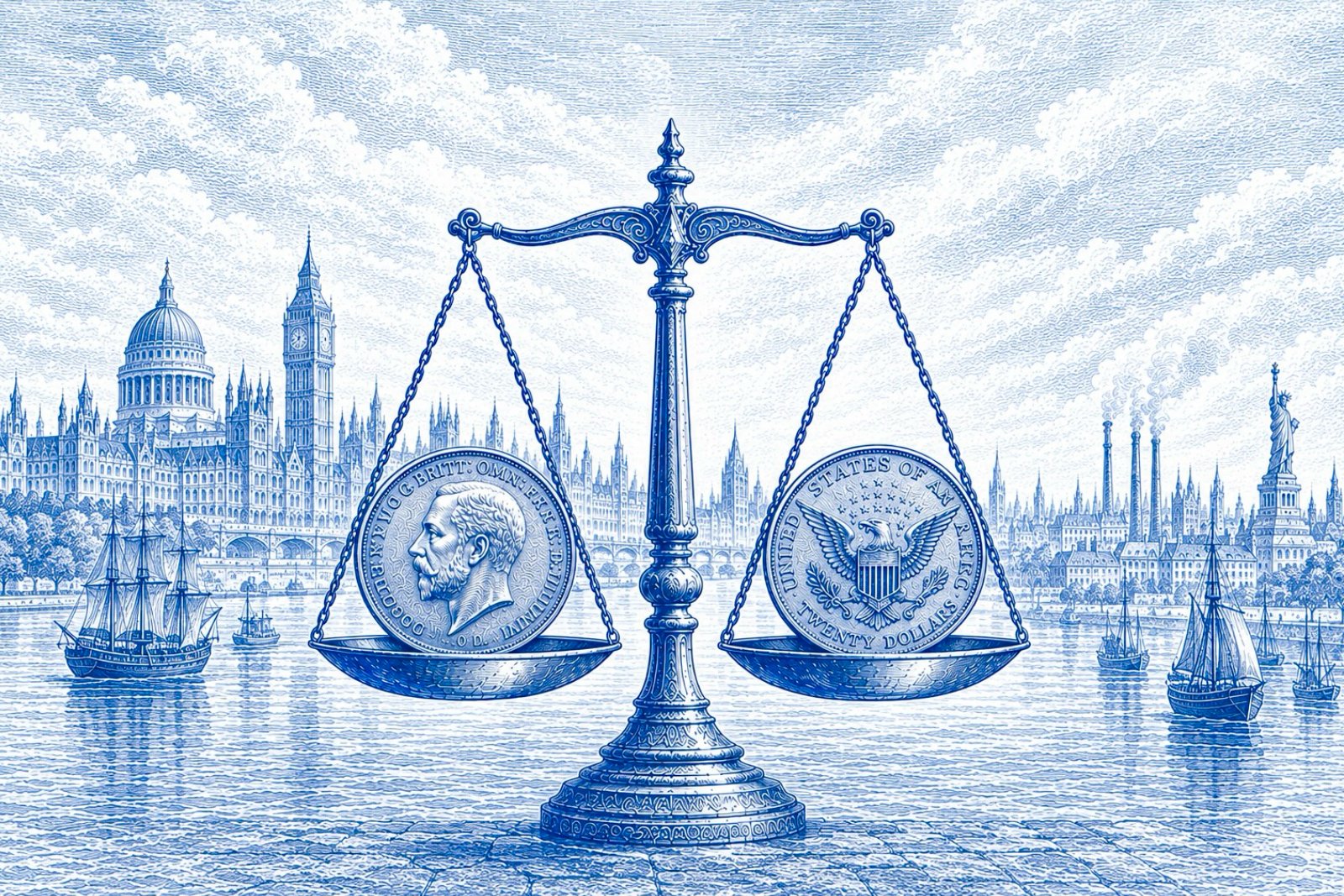
Picture two coins resting on an old-fashioned balance scale, a British sovereign on one side and an American double eagle on the other. The metal itself is almost incidental to the reading. Behind each coin stands a faint skyline of courts, factories, ships and record rooms, the whole apparatus a state uses to make its promises credible over time, and those two skylines are the actual weight being compared. The scale keeps updating its reading around the clock, out to several decimal places, long before most of what it is actually weighing has had time to change. Sterling took the better part of a trading day to lose an empire’s accumulated credit in 1992; the institutions behind both coins, by contrast, will take decades to earn whatever the scale decides to believe about them next.
Leave a thought