


BASIL HALLWARD’S LAST VALUATION
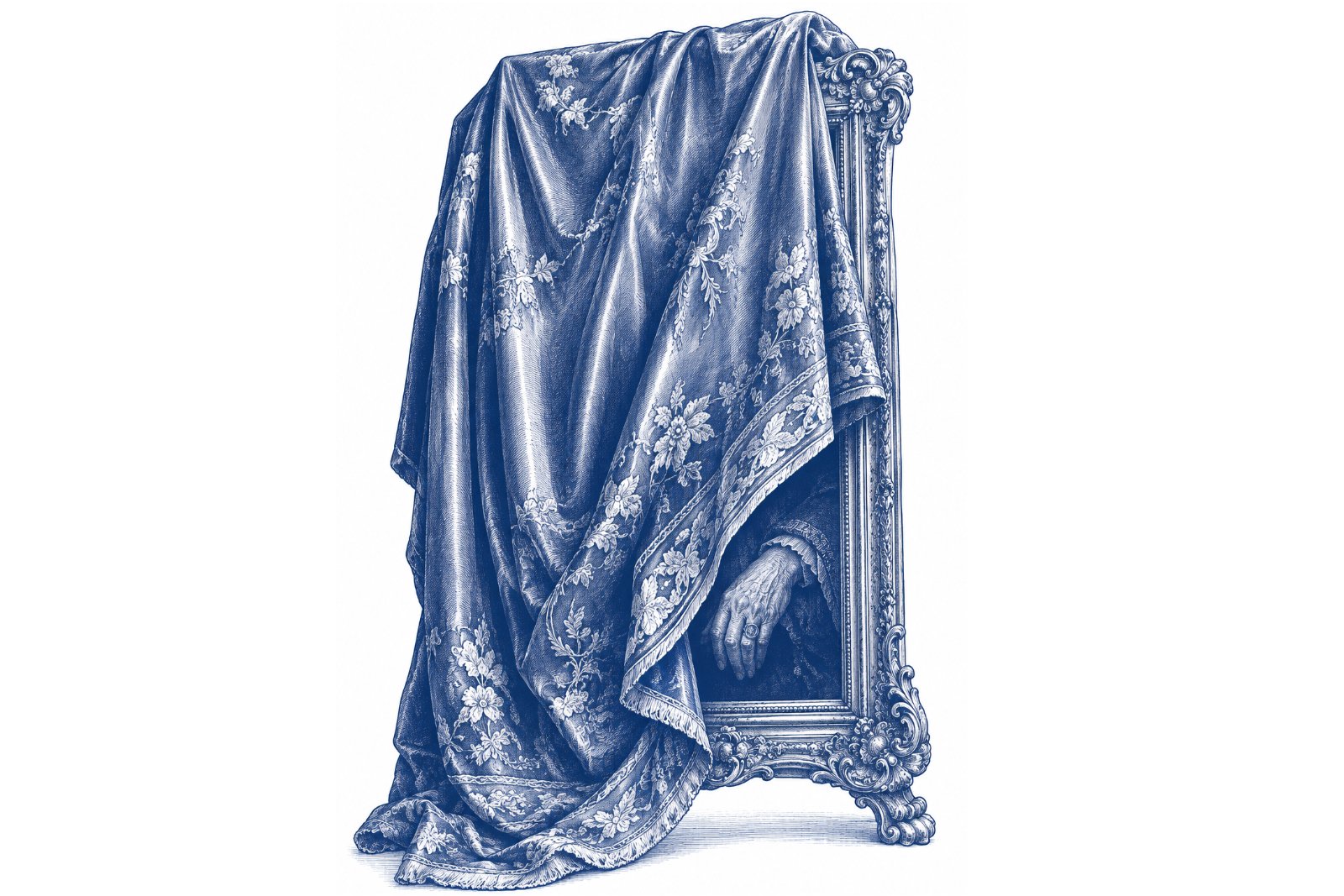
The night of the ninth of November was cold and thick with fog, the eve of Dorian Gray’s thirty-eighth birthday, and Dorian was walking home from Lord Henry’s in heavy furs when a figure passed him at a corner. It was Basil Hallward, who had sat in the library since nine and was leaving for Paris on the midnight train. He had come to say goodbye, and to put to Dorian the things London was saying about him.
Dorian answered the rumours with contempt, and when Basil pressed him he seized a lamp from the library table and said that he would show him his soul. The lamp threw fantastic shadows up the staircase. On the top landing he turned the key. The room beyond had not been lived in for years: dust on everything, a faded Flemish hanging, an old Italian chest with a knife lying on it, and against the wall a picture under a curtain. Basil would not draw the curtain back. Dorian tore it from its rod.
Hallward knew the canvas at once. In the left-hand corner, in long letters of bright vermilion, was his own name. Dorian had met the ageing of that face in instalments, one visit at a time, for years. His old friend, who remembered the picture on its first day, was given all of it in the time it takes to pull down a curtain.
Basil did not live out the night.
Murder and vanity fill the novel, and by accident it is also about appraisals. The schoolroom had been shut for nearly five years when Dorian asked his housekeeper, Mrs Leaf, for the key, and she warned him about the cobwebs. Behind that door the picture could grow worse by the day without anyone being obliged to report it. Each change was small enough to pass inspection alone. The sum was appalling.
Shares on an exchange change price every second, set by strangers risking their own money. A holding in a private fund is valued by appraisal a few times a year, usually by reference to the previous valuation and to models the manager selects, so each mark sits close to the last and the curve climbs politely. The phrase volatility laundering belongs to Cliff Asness of AQR: unsmooth the reported returns and private equity swings about as widely as the public kind, and in the first quarter of 2020, when American shares fell by roughly a fifth in a matter of weeks, the marks reported by private funds moved by far less.
At the end of October 2022 the Class I shares of Blackstone Real Estate Income Trust showed a net return of 9.3 per cent for the year to date, while listed American property, as the MSCI US REIT index tracks it, was heading for a year down by about a quarter. Early in December the trust told investors that it would limit withdrawals, and its rules allowed it to. Blackstone told the press that its business was built on performance, and that the performance was rock solid. Nothing in the episode suggests that anyone broke a rule.
One figure came from appraisers and the other from people trying to sell. An investor reading the quarterly statement saw a gentle upward line. An investor asking for the money back learned how little of the line could be turned into cash on request. A fund that promises withdrawals against buildings needs a gate, and a gate is the day the appraised price has to share a room with the price people will pay.
As a valuer, Basil had every qualification. He had painted the original and remembered the face on its first day, the best baseline anyone could ask for. Access lay with the owner, and the owner decided when the curtain came off. An outside valuer of a private holding works on the same terms: the inputs arrive from the manager, the comparison point is the previous appraisal, and the portrait is seen on the days the owner opens the door.
Freedom from the daily jostle of prices has its defenders, since it spares a long-horizon investor from selling at the bottom of a panic, and Asness has allowed that some investors may knowingly pay for a calmer ride. In many private vehicles the fees are charged on reported value. Every party can act in good faith, and still the fee is charged on the curtain while the change accumulates on the canvas.
Wilde’s novel, curiously, had a curtain drawn across Basil himself. Before it appeared in Lippincott’s Monthly Magazine in July 1890, the editor J. M. Stoddart had cut about five hundred words from Wilde’s typescript. Hallward’s confession that he had felt far more romance of feeling than a man should ever give to a friend reached print as “than a man usually gives to a friend”, a small change of degree that made the feeling ordinary. In 2011 Nicholas Frankel’s annotated edition, from Harvard University Press, restored the typescript.
Each cut could be defended as taste. So could each mark.
Five years later, on 3 April 1895, in the libel action Wilde had brought against the Marquess of Queensberry, Edward Carson rose to cross-examine him with the book in his hand. The transcript survives. Carson read out Basil’s account of meeting Dorian, with “usually” where Wilde had first written “should ever”, and Wilde defended the passage as the most perfect description of what an artist would feel on meeting a beautiful personality. It was a good answer.
Also in his hand was the preface, with its famous sentence: “There is no such thing as a moral or an immoral book. Books are well written, or badly written.” Was that his view of art? “My view on art, yes.” Wilde had set the sentence at the front of the book like a notice on a door, and a notice of that kind invites the visitor to go on and try the handle.
Carson read on to Basil’s confession, “I quite admit that I adored you madly”, and asked the plain question.
“Have you ever adored a young man madly?”
“No, not madly; I prefer love.” A higher form, Wilde added.
Never mind that, Carson said, and could they keep to the level they were at.
Back came this: “I have never given adoration to anybody except myself.”
Brackets in the transcript record loud laughter.
“I suppose you think that a very smart thing?” Carson asked.
“Not at all.”
He had been invited to be less clever and had declined, which saved the court from inviting him twice.
Courtroom laughter is cheap to earn and expensive to hold, and in that courtroom Wilde earned a great deal of it. Pressed on whether he had ever felt what Basil felt, he said the whole idea had been borrowed from Shakespeare, “I regret to say”. Asked whether the book was open to the interpretation of being immoral, he answered, “That could only be to brutes and illiterates.” Carson put it to him that the majority of persons would come under his definition of Philistines and illiterates.
Then: “I have found wonderful exceptions.”
No work of art, Wilde went on, ever puts forward views. The transcript had remained a record, laughter in brackets and all, and a later audience with other interests could ask to hear it line by line. Appraisals sit in files in the same way.
In the novel the owner carries the lamp, and decides whether the door opens. A redemption request is a knock from the other side, and in November 2022 it was answered for about forty-three requests in every hundred.
Leave a thought