


FOR SALE: THE FOUR DEAD SEA SCROLLS
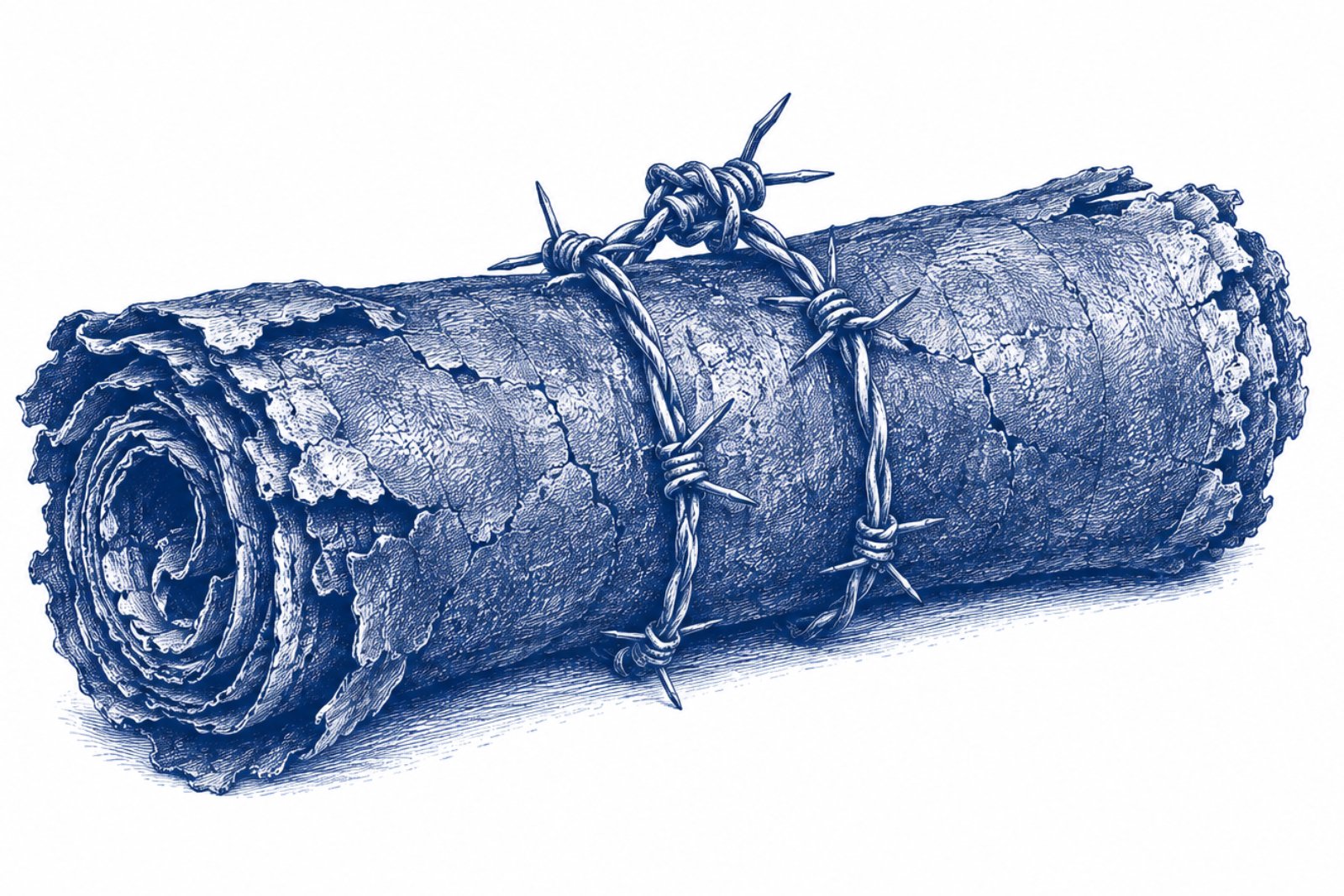
An ideal gift to an educational or religious institution: so the Wall Street Journal recommended four biblical manuscripts, at least two centuries older than Christ, in a small advertisement among its miscellaneous items for sale on 1 June 1954. The heading said only The Four Dead Sea Scrolls. The seller was Mar Athanasius Yeshue Samuel, the Syrian Orthodox Metropolitan of Jerusalem, who had acquired the same four seven years earlier for a few hundred dollars at most.
They came from a cave near Qumran, above the Dead Sea, where Bedouin herdsmen found the first of them in late 1946 or early 1947. Accounts differ on the year, on the number of finders and even on the name of the man who first climbed in; the name most often given is Muhammad edh-Dhib, called the Wolf. The route afterwards is better documented. It ran to Bethlehem, to a cobbler and part-time antiquities dealer named Khalil Iskander Shahin, known as Kando, who passed four scrolls to the Metropolitan, while three others reached the Hebrew University in Jerusalem through a second dealer, Faidi Salahi.
Eleazar Sukenik, who taught archaeology at that university, first heard of Salahi’s wares from an Armenian friend acting as go-between. They met at a gateway in the barbed wire that divided Jerusalem in the last days of British rule, and the Armenian held up a sample fragment of leather. Through the wire Sukenik recognised the lettering as the kind he knew from the first-century ossuaries of Jerusalem, the bone chests in which the dead were gathered.
A few days later, on 29 November 1947, the day of the General Assembly’s partition vote, he obtained a proper pass and took an Arab bus to Bethlehem. By one account he went against the wishes of his wife and his son. Salahi let him carry scrolls home to study before a price was settled, and he rode back on a bus full of Arabs with them under his arm, wrapped like an ordinary parcel. Two came home with him that day. A third, a second copy of Isaiah, followed within days.
At home he unrolled one of them. His diary says he suddenly felt “privileged by destiny to gaze upon a Hebrew scroll” that nobody had read for more than two thousand years. While he sat over it, the radio announced that the Assembly had voted for a Jewish state, and neighbours poured into the streets of Jerusalem. By the next morning there was fighting on several fronts. His son Yigael Yadin would remark that he could not escape the feeling that something symbolic lay in the timing. The purchase cost Sukenik little in money and a good deal in nerve, and it brought him something no receipt records. He had looked at an object whose age the people around him could not place, and he had read it correctly.
Four more had already found a buyer, and they included the finest pieces from the cave: the large scroll of Isaiah, the Community Rule, a commentary on Habakkuk and the Genesis Apocryphon. Sukenik was called to see them in January 1948 and could not close the purchase. Samuel preferred to wait for calmer politics and a better price abroad. Whether he grasped what he held I cannot say, since the record gives his price and his patience and little of his understanding. Sukenik wrote in his diary: “Thus the Jewish people have lost a precious heritage.”
The Metropolitan’s patience found one vindication within months, when the American archaeologist William Albright looked at photographs of the great Isaiah scroll and called it the greatest manuscript discovery of modern times. Samuel carried the scrolls to the United States, and Yale was among the institutions he approached. Nobody met his figure. Solomon Zeitlin of Philadelphia was publishing articles that held the scrolls to be of late date, and a seller asking a great deal for manuscripts whose age was publicly disputed would have found few bidders in any decade.
Yadin, lecturing in the United States in the summer of 1954, had the advertisement brought to his attention. Sukenik had died in February 1953, and the Metropolitan, who had put off the father, was about to sell to the son without knowing it. Yadin kept himself and Israel out of the transaction, fearing that Samuel would refuse a buyer from the new state. A New York businessman answered the advertisement and negotiated, and a philanthropist helped pay. One thing remained, an expert to look at the leather before any money moved, and Yadin would not do it himself.
He telephoned Harry Orlinsky of Hebrew Union College on Thursday, 1 July, from the office of the Israeli Consul-General in New York. Orlinsky was leaving for Toronto. By his own later account his wife was already seated in the car and he was locking the door when the telephone rang, and Yadin asked him to come at once on a matter of importance to Israel without saying what it was. At the consulate he was told to call himself Mr Green and to examine the scrolls for the Israeli government. He was to take a taxi to the Lexington Avenue entrance of the Waldorf-Astoria, where the businessman would meet him, each man carrying a code word, and go down to a vault in the basement with a representative of the Metropolitan. His instruction was to say as little as possible. Afterwards he found a telephone, dialled a number that was not listed, and said one word, lechayim, to life.
Payment came to 250,000 dollars. The paperwork of the sale was poorly drawn, so that American tax officers rejected the way it had been arranged, and the challenge to that ruling failed; much of the money went to the Internal Revenue Service. On 13 February 1955 the prime minister, Moshe Sharett, told a press conference that all seven scrolls were now in Israel. A father had written the diary entry, and a son closed the account. A novelist would hesitate to ask a surname to do so much.
Mispricings rarely keep such tidy books. The same four manuscripts changed hands at a few hundred dollars at most in 1947 and at 250,000 in 1954, a rise of a thousand times or more. Samuel was right that the scrolls were worth far more than he had paid, and he was right for seven years with nothing to show for it. The tax authority later took a large share of his correctness.
His consolation was the one every contrarian collects before the market pays him: the quiet pleasure of having been first to see, handed over in full before anyone tests the thesis. Sukenik had it that evening over the unrolled leather. He is remembered because the leather proved genuine. A man who bought worthless leather and told himself a story about Hebrew would have left no diary.
Around 2002 fragments began to appear on the antiquities market that nobody had seen before, rumoured to have lain for decades in a vault in Switzerland. At least seventy had surfaced by the end of the decade. Between 2009 and 2014 Steve Green, president of Hobby Lobby and founder of the Museum of the Bible in Washington, bought sixteen in four batches from four sellers, seven of them from William Kando, son of the Bethlehem cobbler of 1947. A volume from the academic publisher Brill in 2016 dated the museum’s fragments to the time of the scrolls.
Germany’s Federal Institute for Materials Research tested five of them in 2018 and judged them probably modern. The museum then hired Colette Loll and her firm, Art Fraud Insights, and gave her the right to publish whatever she found; her report, finalised in November 2019 and made public in March 2020, called all sixteen modern forgeries. The leather was probably ancient, one piece with a row of holes like those in a Roman shoe. It had been coated with a glue-like film that imitated the gelatin real scrolls form as their collagen breaks down, painted with ink that pooled in the cracks, and dusted with clay minerals consistent with the sediments of Qumran. All sixteen had been made the same way, although they came from four sellers over five years, and nobody has named the maker.
Ancient leather passes the first test a careful buyer applies, and the maker seems to have considered what the buyer hoped to feel when the box was opened. The history of 1947 had supplied the script: the quickened pulse, the sense of standing alone at the right moment before the right object. The advertisement of 1954 understood the market when it called the scrolls an ideal gift, since a buyer of rarities purchases an improved opinion of himself along with the object, and the manuscript serves as the receipt. The collectors of 2010 felt exactly what Sukenik had felt, and from the inside the two sensations cannot be told apart.
One of the scholars who vouched for the larger Genesis fragment later wrote that the handwriting bothered him and now seemed suspicious. The conservator Abigail Quandt, who studied the pieces, pointed out how brittle and inflexible the old leather had become, and how hard the writer had struggled to form each character and keep the pen under control. Some scholars looking at those unsteady lines had concluded that the scribes of the Judean desert must have been untrained. The tremor belonged to a modern hand working over a surface that would not let it steady.
Leave a thought