


THE EMERALD THAT WAS GLASS
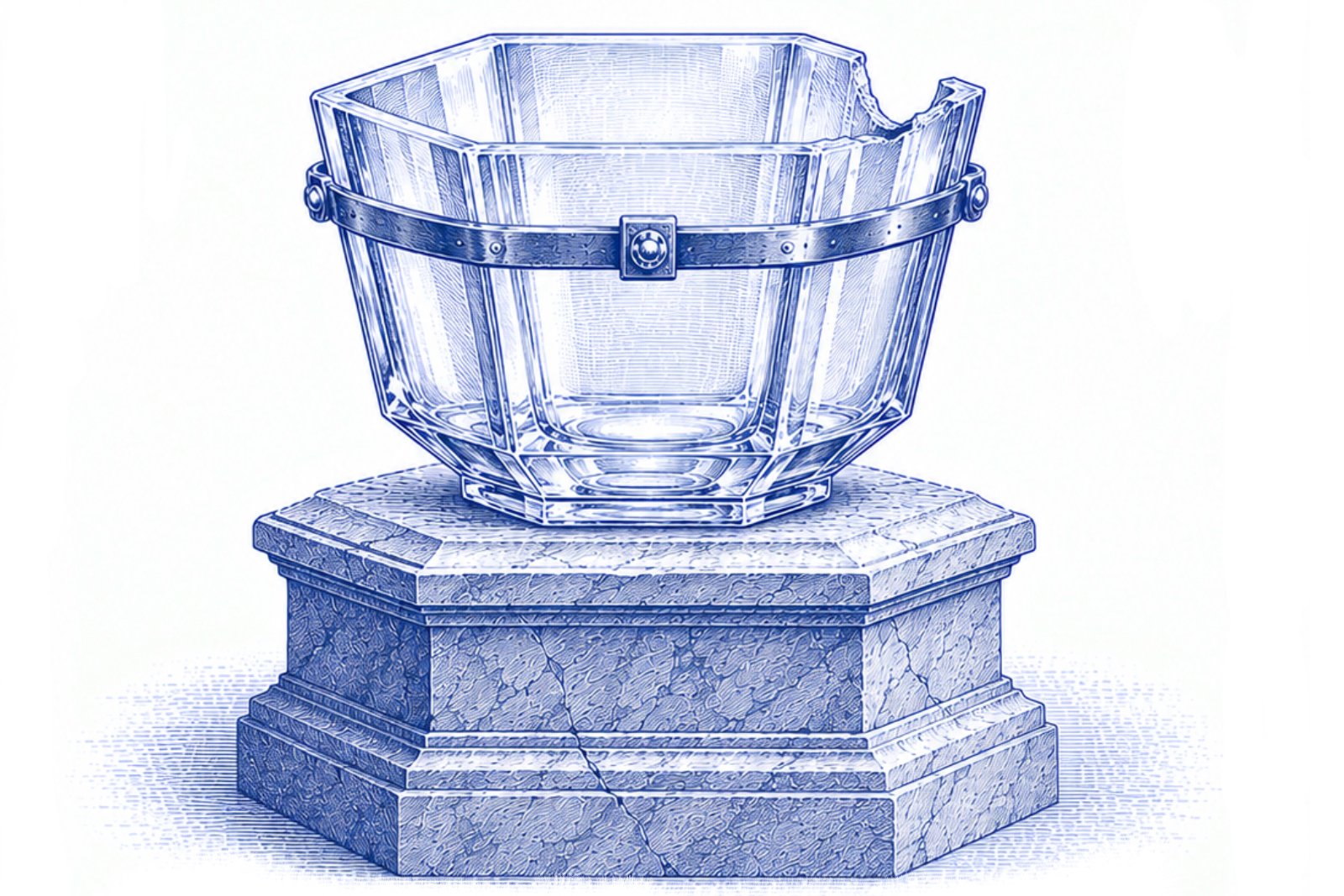
Genoa Cathedral keeps, behind glass in its own treasury and rarely shown to the public, a shallow bowl with six sides, the colour of still, deep water. The chronicles place its arrival in 1101, carried home by Guglielmo Embriaco after the crusader fleet he commanded took Caesarea. Not long afterward Genoa settled the question of what the bowl actually was: a single emerald of a size no later age ever matched, and the very dish Christ had used at the Last Supper. For roughly seven hundred years the Republic treated both claims as established fact, which, for every practical purpose that mattered to Genoa, they were.
Legend did not stop at a precious stone. Across the medieval retellings the Catino slid, by stages, into identification with an older and larger story: the vessel of the Last Supper became, for some chroniclers, something grander again, the Holy Grail itself, the object later legend sent a continent of knights to search for. Genoa never had to choose which version it preferred. A city that had just helped take a Levantine port during the First Crusade was, by the conventions of the age, expected to come home with something of transcendent value, and crusading fleets up and down the Mediterranean obliged with a steady traffic in relics whose documentation began, in nearly every case, with somebody’s say-so and ended there. The Catino was simply a better specimen of a very common kind of object: unusually beautiful, usefully ambiguous, and entirely unverified.
A relic of that supposed magnitude did real work for a mercantile republic with no empire to speak of and a permanent need for credit. Genoa was a city of bankers and shipowners before it was anything else, and a shipowner’s promise is only as good as what stands behind it when the ship is lost. Records survive of the Catino being pledged, in 1319, as security against a loan from Cardinal Luca Fieschi: an object sacred enough that no creditor would seize it carelessly, and valuable enough that no creditor needed to. The bowl spent most of its history seen rarely and believed completely, doing for the Republic’s credit something close to what a gold reserve does for a currency: sitting still, saying nothing, and making everything built on top of it easier to trust.
Such an arrangement had exactly one weakness, and fire or theft could not reach it. Anything lost to fire, to theft, or to ordinary decay can be priced in advance, because an actuary can count how often such things happen to objects of a given kind. A claim about what an object actually is admits no such table. It survives for precisely as long as nobody with the standing, the motive, and the opportunity bothers to look closely, and for six hundred years in Genoa nobody who could look had any reason to.
That changed in 1806, when Napoleon, having annexed the old Republic along with the rest of Liguria, had the Catino sent to Paris with a quantity of other confiscated Italian treasure for his scholars to examine, men with no stake in Genoese prestige and no reason to flatter the find. They tested the bowl the way a conqueror’s scholars test things, and reported back the only verdict that mattered: moulded glass, its one resemblance to an emerald being the colour.
Seven centuries of careful non-examination had just ended in a fairly ordinary afternoon’s work.
Where the glass actually came from turned out to carry its own small argument. The attribution has shifted since, and has not settled: for a long stretch of scholarship it was called Islamic work, probably Fatimid Egyptian, from somewhere around the ninth or tenth century; Genoa’s own cathedral museum today catalogues it instead as Roman, made in ancient Syria, closer to the first century. The two accounts cannot both be correct, and nobody currently writing on the subject claims to be sure which one is. The only point on which everyone has agreed since 1806 is the one Genoa would once have disputed to the death: it is glass, shaped in a mould by a skilled and perfectly ordinary craftsman, and an emerald is the one thing it has never been.
Returning from Paris, the dish broke, on 14 June 1816, somewhere on the cart track between the coast and the capital. The relic that had anchored a republic’s credit for seven centuries came home cracked clean through.
Decades passed before conservators intervened properly; the metal band now holding the bowl together belongs to a later campaign of repair, one chapter in a sequence of conservation work that continued into the twenty-first century.
Credulity is too easy a reading here, and probably an unfair one. Six hundred years is a long time for an arrangement to go untested, simply because nobody who could test it had any reason to want the answer. The spell broke because power changed hands: a city that needed the Catino to be precious gave way to an emperor’s court that needed only to know, precisely, what it had taken.
Expertise is no guarantee of disinterest. In 1937 the art historian Abraham Bredius, the most eminent Vermeer scholar of his generation, authenticated a painting called The Supper at Emmaus as a major early work by the master, and a Rotterdam museum paid handsomely on his word alone. The painting was the work of a struggling, resentful forger named Han van Meegeren, and Bredius’s own eagerness was precisely what let it through: he wanted a new Vermeer to exist, badly enough that, for a decade, one did. Napoleon’s scholars in Paris had wanted only an accurate catalogue entry from the Sacro Catino. Bredius wanted a discovery, and a claim is never safer than when the person testing it is hoping it turns out to be true.
Van Meegeren kept going. During the German occupation that followed, he sold a further forgery, Christ and the Adulteress, to Hermann Göring, passed off as a long-lost Vermeer. That one held up for exactly as long as nobody with both the expertise and the motive to doubt it was looking. After the war, Dutch investigators traced the painting back to van Meegeren and arrested him on a charge that carried the death penalty: selling a piece of the national patrimony to the enemy. His defence was that the patrimony in question was his own forgery, and proving a capital charge false required him to do something no forger ever wants to do twice, which was paint another one, under guard, while the court watched. He produced a third fake, Jesus Among the Doctors, over several weeks in 1945 in the presence of witnesses, and it convinced them. He was convicted of the far smaller crime of fraud instead. A story of this kind fails completely or not at all, in the one occasion somebody finally has both the standing and the reason to check it, having survived every day before that on nothing more than the absence of one or the other.
An entire modern industry now exists to manufacture, deliberately and for a fee, the scrutiny that Genoa received only by historical accident and Bredius failed to supply at all. Provenance researchers reconstruct a chain of ownership back to an object’s creation, forensic laboratories date pigments, canvas weave and wood panels against what the period could actually have supplied, and the authentication boards attached to the estates of dead artists exist for the sole purpose of having no reason to want any particular answer. Between them they do for today’s unique objects what Napoleon’s scholars did for the Sacro Catino without meaning to: substitute a paid, disinterested doubt for the far more comfortable default, which is simply not looking, or looking with the answer already hoped for.
Insurers will price the fire and the theft without hesitation. The examination itself they generally leave to someone else, because there is no table of base rates for a secret that has simply never been tested.
The Catino is back in Genoa now, in its case, metal band and all, described accurately for the first time in its working life: a very old, well-travelled piece of glass, with a biography more interesting than its chemistry. That is a real kind of value, just a much smaller one than seven centuries of silence had assigned it. Somewhere in a treasury or a vault or a drawer not unlike the one that held the Catino for six hundred years, there is presumably another object earning its keep on exactly the same terms, examined by nobody, because nobody with the means to look has yet had a reason to. How would we know, this time, before somebody finally does?
Leave a thought