


THE SOVEREIGN’S FACE ON THE COIN
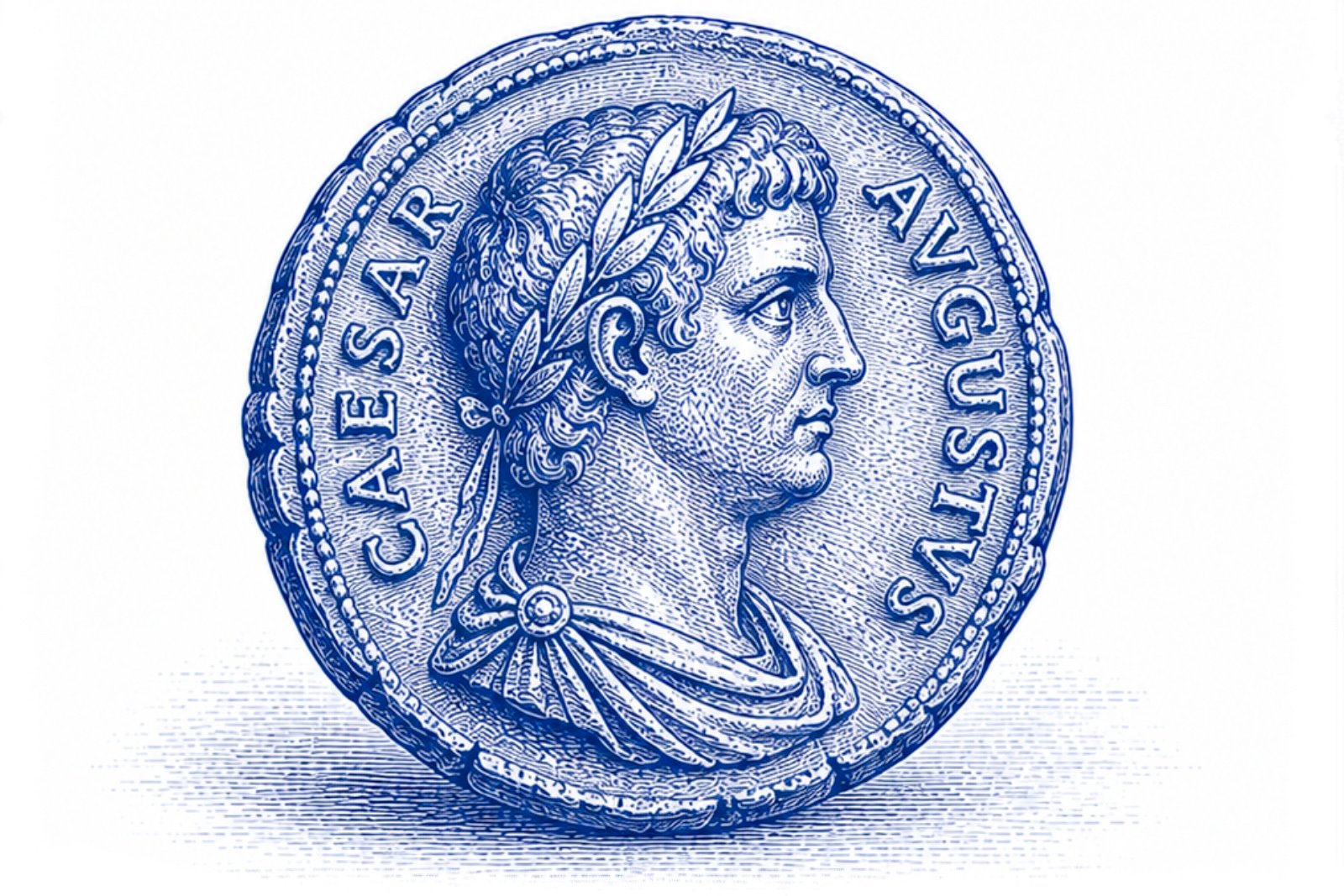
A denarius of Augustus, struck in the last decades before our era, is a disc of silver about nineteen millimetres across and some ninety-five to ninety-eight parts pure, and on one face there is a head in profile, laureate, turned to the right. A farmer in Gaul handling that coin in the year 10 is holding a portrait of a man he will never see. Getting word from Gaul to Rome, or an order back again, could take the better part of a season, and a farmer out past the frontier garrisons rarely learned what his emperor even looked like, though he always knew exactly what he owed him. The portrait was the only part of him that arrived.
It reached him anyway, and not just once. Every hand that passed him a coin in payment was, without meaning to, handing him the emperor’s face again: on the toll at a bridge, on a soldier’s pay, on the change from a jug of wine. Nobody else in the ancient world achieved that kind of circulation for a likeness, and nobody who achieved it had to ask permission first. Augustus had a particular problem that the medium solved elegantly: he needed to present a monarchy while insisting, in every public word, that he had restored a republic. A profile on a coin makes the claim without stating it, present on every transaction in the Mediterranean without ever once saying I rule.
None of this had anything to do with the metal itself. Silver is silver regardless of whose face sits on it, and any skilled forger who matched the alloy could cast a blank disc worth exactly as much as the official one, which is exactly why counterfeiters bothered endlessly with the alloy and essentially never bothered faking the portrait: nobody needed to. A merchant handed a suspect coin would bite it, weigh it against known-good specimens on a hand balance, or simply refuse it outright, and an emperor whose coinage was rejected in the marketplace had a political problem considerably more immediate than any senator’s disapproval. What the stamped face was actually doing was making a promise on the state’s behalf, that this disc was good inside whatever order the issuer presided over, and that the issuer was not hiding from the claim. A legionary drawing his pay knew, in the most immediate way available to him, which army was actually keeping him fed. Out on the Danube frontier, a trader closing his books at the end of a market day was running the identical currency as a moneylender in the Forum, whether either man ever thought about it that way or not. Small coins did the travelling that the emperor himself never could, turning up in frontier markets no legion had ever bothered to garrison.
There was profit in it too. That is what turns the portrait into a financial instrument, not just a decoration.
Minting is a margin business: whoever strikes the coin pockets the gap between the metal’s real cost and the face value stamped onto it. Rome exploited this for two and a half centuries with a persistence that the numismatic record documents almost year by year. Nero’s reform of 64, following the fire, dropped the denarius from something like ninety-eight per cent fine to around ninety-three and cut its weight by roughly an eighth in the same gesture. By the reign of Septimius Severus the fineness had fallen to the mid-fifties, in percentage terms, down from something like four-fifths at the start of his reign less than two decades earlier: the debasement was a ratchet, not a single event, tightened again every time the treasury needed more coins than the mines could back. His son Caracalla introduced around 215 a new and larger coin, distinguished by a radiate crown, which modern scholars call the antoninianus and which was tariffed at two denarii while containing something like one and a half times a denarius in silver: a seigniorage gain of roughly a third on the metal it actually contained, written directly into the denomination. By the later third century the silver in a nominally silver coin had fallen to a few per cent, and Diocletian’s Edict on Maximum Prices in 301 records what such currency now bought. The edict tried to freeze prices by decree, with the death penalty attached to violations, and it failed within a few years for the reason price controls usually fail: the coins themselves had already told everyone what they were worth, regardless of what the stone inscriptions said they were supposed to cost.
Something striking follows from this: the history belongs to a discussion of value, not of metallurgy. The debasements worked for a remarkably long time. Not forever, and not without consequence, but the coins went on circulating at close to their old purchasing power well after the metal had been thinned, because users were transacting against the portrait and the order behind it, not against the metal itself disc by disc. Engrave it properly, and authority itself becomes a form of collateral. The gap between the metal and the price is a credit extended by the population to the issuer, unpriced, unrecorded and unrecoverable, and one may read the whole third-century monetary history as that credit being drawn down until it was exhausted, at which point prices moved with the sudden violence of a re-rating instead of the slow gentleness of inflation.
Modern currency abandoned the living face almost everywhere it could, and what replaced it is the interesting part. The euro notes carry bridges, designed by Robert Kalina of the Austrian central bank, and the bridges are deliberately fictional: seven architectural periods, no actual structures, nothing that any member state could claim or any successor regime could repudiate. A Dutch town took the joke further than intended: Spijkenisse, near Rotterdam, built full-size pedestrian versions of all seven bridges in concrete in 2013, so that a currency’s own fictions now double as actual river crossings for actual pedestrians, a detail that would have delighted and puzzled a Roman moneyer in roughly equal measure, though beside the real point, which was to find an image that could guarantee without being anybody. Elsewhere the preference runs to poets and composers who are safely dead, for the identical reason. A face that can fall from favour is a liability on a currency; a face that has finished falling is safe.
What outlived every redesign was the structure, not the picture: a central bank behind the number, a treasury behind the central bank, a state’s power to tax behind the treasury, the whole chain meaning exactly what it claims for only as long as people trust it to hold. Buying bread confirms it, several times a week for most of us, and the confirming happens whether or not anyone means it to. The modern arrangement differs from the Roman one in the quality of the institutions and in essentially nothing else. Modern central banks get there by a different route: they print more paper, or these days credit more digits, against the same promise, instead of shaving silver off a disc. The mechanism looks nothing alike and the arithmetic is identical: each unit of currency created without a matching increase in whatever backs it dilutes every unit already in circulation, a tax collected from everyone holding cash without a single vote taken on it. Rome’s mint officials would have recognised quantitative easing instantly, if not the vocabulary.
One difference is worth naming, and it does not flatter us. Whoever a Roman’s coin answered for, he knew it: the face was right there in his palm and the name was spelled out in the letters ringing it, and when a new emperor took power the coins in his purse were visibly, physically the old regime for a year or two afterward, until the mints caught up. The object itself disclosed who stood behind it. Swipe a card at a terminal today and that same guarantee is still there, just buried: a settlement system, a deposit insurance scheme, a central bank’s balance sheet, none of which wears a face, all of which we lean on more completely than any Gallic farmer ever leaned on Augustus.
I am not sure it is better to see whose promise one is holding. The farmer could see it and could do nothing about it, which is a form of transparency that costs the issuer nothing to provide.
Somebody is still standing behind the number, several times a day, in a transaction so small and so automatic that nobody thinks to ask who, and the interesting question is how long it has been since we last glanced to check.
Leave a thought