


JAN VAN EYCK WAS HERE
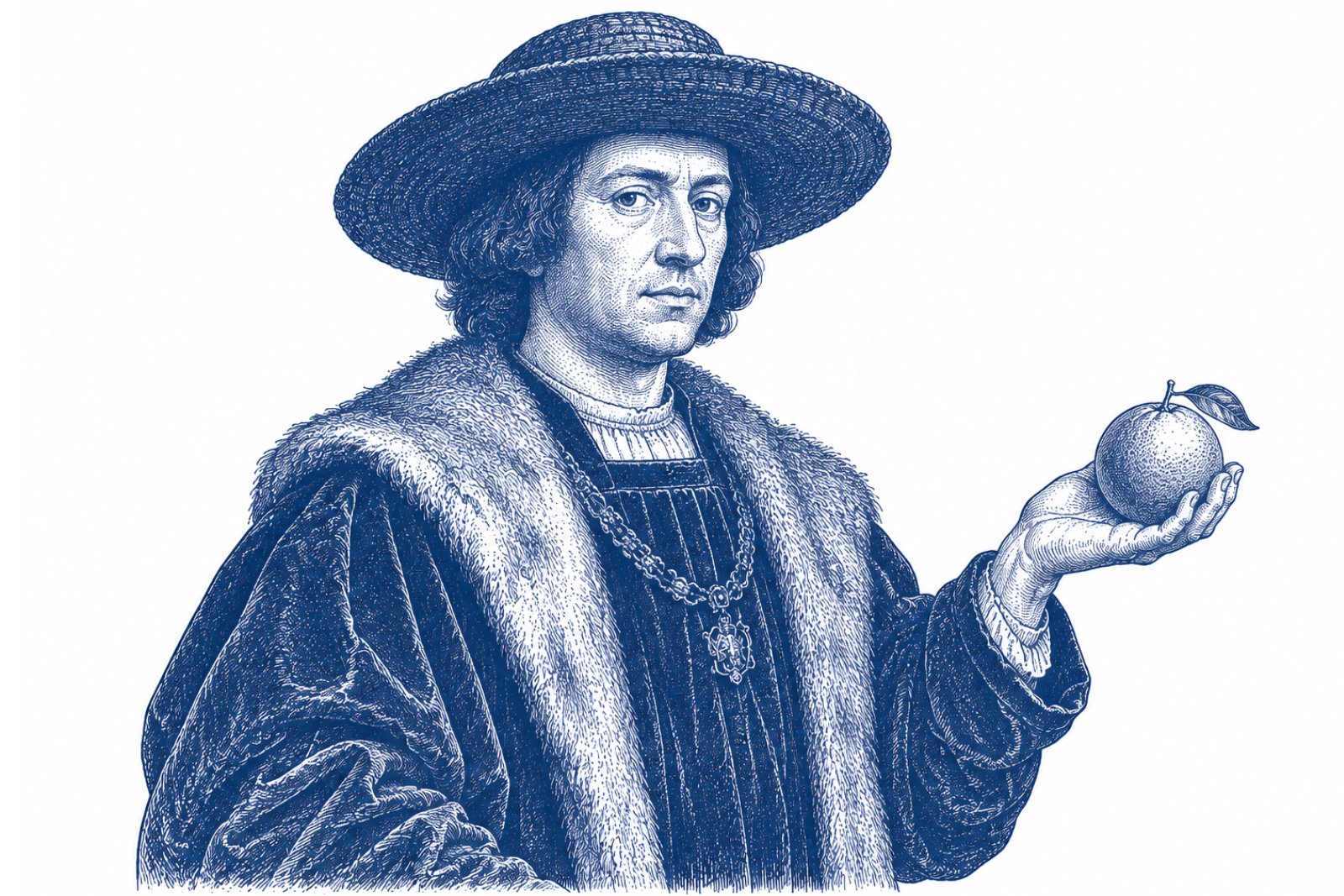
Whoever drew up the inventory of Margaret of Austria’s pictures in 1516 faced a large panel and very little else to go on. The entry reads a large picture which is called Hernoul le Fin, and the list moves on. The painting was eighty-two years old by then. It had been made to show, down to the last orange, what its two sitters were worth, and somewhere between Bruges and Brussels it had lost the man’s first name and wounded his last. Scholars have since decoded Hernoul le Fin as Arnolfini worn smooth by handling, the way a coin loses its king.
Oranges, anyway, survived. They lie about the room carelessly, in the National Gallery’s phrase, and the Gallery adds that such fruit was extremely expensive. The bed is hung in red wool, the dearest piece of furniture in the house. The man wears a tabard of what is probably silk velvet trimmed with brown fur, and the woman a green wool gown with a long train, edged in white fur, which she gathers up in one hand as ladies commonly did. Visitors have drawn conclusions from the way she holds it. The Gallery is firm on the subject: “She is not pregnant, though she might look it.”
Nothing in the room quite adds up. There is not enough space for the chandelier, no sign of a fireplace, the bed is too short and the mirror seems impossibly large. Van Eyck, the Gallery concludes, altered things to fit his aesthetic purposes and perhaps also to accord with Arnolfini’s aspirations. The infrared photographs add a small unkindness. The first Arnolfini had a larger face and even odder features, and on the second pass the painter improved his proportions.
The man paid for the velvet, and he paid for the face.
Above the mirror, on the plaster itself, the painter wrote Johannes de Eyck fuit hic, 1434. Jan van Eyck was here. Lorne Campbell’s catalogue calls it altogether exceptional for an artist to put his name on a wall, and for a good part of the twentieth century the sentence was read as a witness’s, because the picture was read as a wedding. The Gallery now says that it is no longer taken for one. He was there in a plainer sense as well: a thumbprint of his is still visible in the paint near the shadow of the dog’s leg, where he worked quickly and with his fingers. In the mirror, small and bent, two men come through a door that must stand behind the viewer. The Gallery asks whether they are van Eyck and a servant arriving on a visit, and the catalogue thinks the man in front, in blue, probably is. A painter who steps into his own picture to say that he saw the transaction is the oldest form of reference in commerce, and the least checked.
Giovanni di Nicolao Arnolfini of Lucca, if the Gallery is right to say probably, had been in Bruges since at least 1419 and sold silks, cloth of gold and tapestries to the court of Burgundy. In 1423 he sold Duke Philip the Good six tapestries of the life of the Virgin, which the Duke promptly forwarded to the Pope. He made what the catalogue calls disguised loans, to the town of Bruges in 1421 and to the Duke of Brabant four years later, and when a pair of Italian brothers named Sandei went bankrupt they owed him more than nine thousand ducats. His career was made of other men’s taste and other men’s debts. He went by Giannino, little Giovanni, at an age near forty, which the catalogue takes care to say is no sign of youth. Van Eyck painted him twice, and a second portrait of the same man, older, hangs in Berlin. The Gallery’s formal title still puts a question mark after his first name, and the identification has been less smooth than the velvet. From 1861 until the late 1990s the picture was assumed to show a cousin, Giovanni di Arrigo, and his wife Jeanne Cenami, until Jacques Paviot found that a Jehan Arnoulphin had been given silver pots by the Duke on his wedding in 1447, six years after the painter was dead, and the cousin’s claim did not recover.
His wife is the harder case. Giovanni di Nicolao’s only known wife, Costanza Trenta, whom he had married in 1426 when she was thirteen, is reported dead in a letter of February 1433. Campbell found no second wife anywhere in the records. The Gallery says the woman is probably his second wife, identity unknown, and Margaret Koster has proposed that the picture is a memorial, painted a year after the first one died. Nothing is certain except the gown.
Nobody knows how or when Don Diego de Guevara, who gave the picture to Margaret, came by it. By the next inventory, in 1523 or 1524, the clerk had it as Arnoult Fin, nearer than before and still not right, and the panel hung in Margaret’s private bedroom and study, with a marginal note recording a lock for its cover. It passed to her niece, then to the kings of Spain, where a visitor in Madrid in 1599 copied out the verses on its frame and got the first line wrong. An inventory of 1661 mentions the verses too, and the Gallery quotes two lines from Ovid’s Art of Love, which it translates as “In promises anyone can be rich.” The frame has been replaced more than once and the inscriptions were probably not original, so the line was added by somebody who understood the picture rather well. A Scottish officer named James Hay tried to sell the picture to the Prince Regent in 1816 and failed, and a dealer later told a story of how Hay had come by it in Brussels. The Gallery calls the story romantic, which in a museum is a form of rebuke. Hay did sell it eventually, in 1842, to the National Gallery, whose adviser Mr Seguier was authorised to offer six hundred pounds, and on 2 May the trustees recommended the purchase for the moderate price. It became the Gallery’s first Netherlandish painting.
Michael Spence won a Nobel prize in 2001 for working out why a degree, a brand or a famous name is worth buying: a signal is believed only when a bluffer cannot afford to send it. Arnolfini could afford it, and he had the Duke’s own painter to do the sending. Since 1425 Van Eyck had been painter and valet de chambre to the Duke whose court bought Arnolfini’s silks, and in 1435, the year after the picture, Philip converted his stipend into a life annuity and multiplied the sum. Bruges could hardly have offered a dearer witness than a man the Duke had pensioned for life. The oranges work in the same way, since anyone can say that he is rich and only a rich man leaves expensive fruit lying about. The merchant had no birth to show, and he bought the look of a man who had always been there, certified in a hand that everyone in the Netherlands knew.
Van Eyck died in July 1441, and the Duke gave his widow a sum equal to a year’s annuity. In 1442 Giovanni di Nicolao became a burgess of Bruges, for a moderate fee, after promising that he would no longer trade as a merchant, and was allowed the small crafts of a burgess, which he may never have practised. Campbell speaks of a mysterious reverse of fortune in the 1430s and wonders about the revolt of Bruges in 1437 and 1438. His last records show him arbitrating disputes among Lucchese merchants in 1446 and 1452, which suggests the community still trusted his word, if no longer his books. I would not like to be asked to prove that the witness’s death and the merchant’s withdrawal are connected. The dates simply sit side by side, like two guests who have not been introduced.
Still, the signature stayed where it was.
Among the things the infrared shows to have been added late, after the figures and the furniture had been settled, are the dog, the chandelier, the chair, the beads and the shoes. The shoes are a pair of wooden pattens, muddy, lying on the boards where the man stepped out of them. It seems that someone decided, at the last, that the house wanted a little of the street in it.
Leave a thought