


THE FISH KNIFE
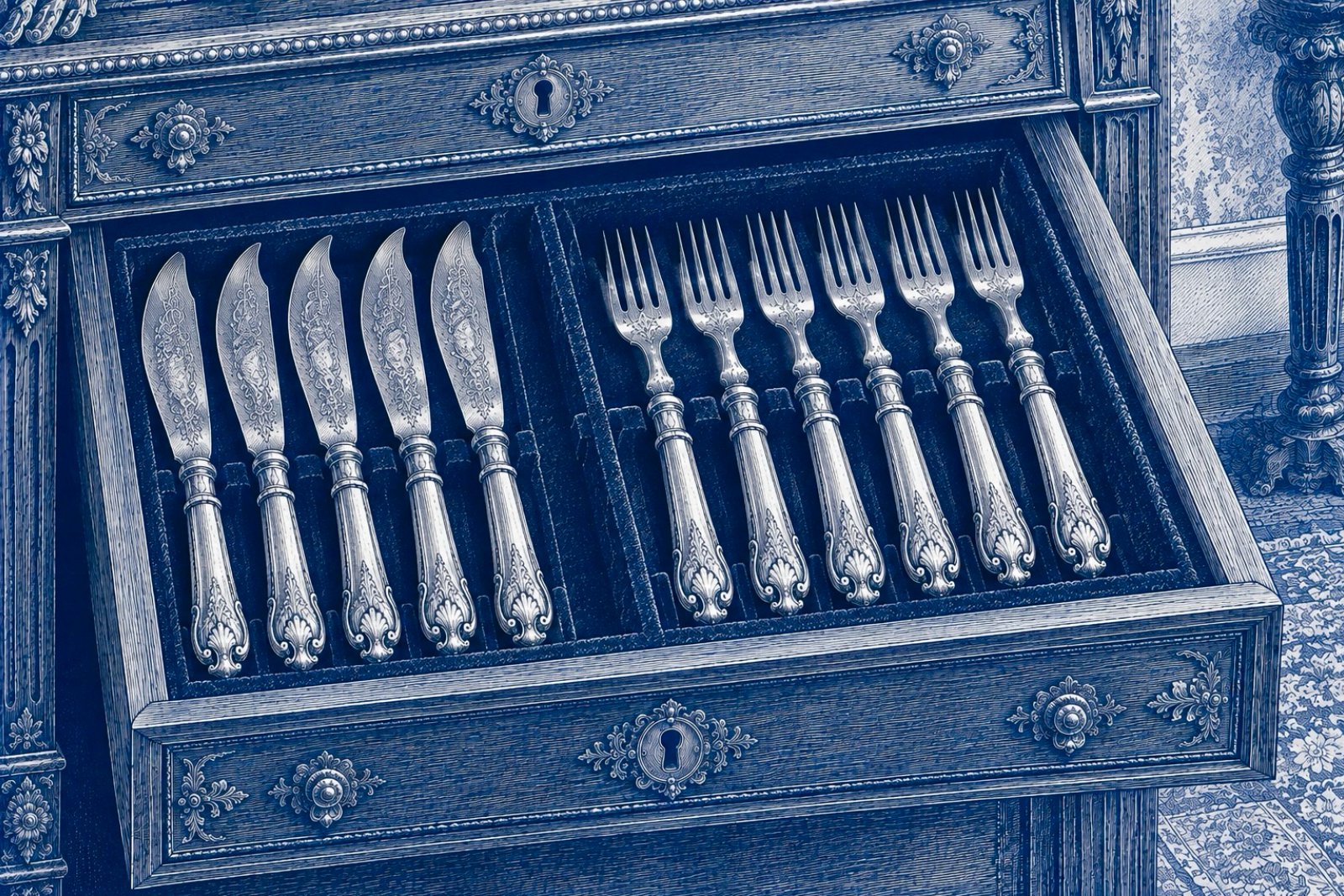
Betjeman wrote into a particular moment, Britain in the early 1950s, when industrial and commercial fortunes made across two generations of war and reconstruction were bringing genuinely new money into rooms that had never before had to admit it. The comedy had a real edge to it. A family doing well for the first time in its history, invited somewhere smarter than its own dining room, had every reason to panic about precisely this sort of detail, because the detail was, for a few more decades yet, taken extremely seriously by the people doing the inviting.
The implement itself was a Victorian invention, part of a broader Victorian enthusiasm for specialised silverware that gave the dinner table a separate tool for nearly every task: a knife for fruit, a spoon for grapefruit, a fork for oysters, and eventually a knife for fish. Fish, oily and prone to flaking, was awkward with an ordinary blade, so silversmiths designed a broad, blunt, often decoratively pierced implement meant for nothing else. It sold well. Within a generation or two it had become the expected thing to own, a small fixture of a properly equipped table, listed as a matter of course in any department store’s wedding catalogue.
Not every household bothered. Families whose silver had been assembled before the fashion arrived simply carried on managing fish with two ordinary forks, one held in the left hand to steady the flesh and the other used to flake it apart, a method that worked perfectly well and gave no outward sign of strain to anyone practised in it. These were often the oldest and best-established families in the room. They had never had reason to buy a fish knife, because their cutlery predated the problem the fish knife was invented to solve, and nobody in the family had thought to catch up since.
Pierre Bourdieu, writing in 1979, gave this kind of knowledge a name: cultural capital, the inherited stock of taste, reference and bearing that a child absorbs largely without being taught it as a formal lesson, and that functions, later in life, as a kind of currency. Knowing which fork to lift, and knowing it without needing to glance sideways at anyone else’s hand first, counts among its smallest coins. It opens doors, lowers suspicion, and shortens the distance a stranger must travel before being trusted. None of it appears on any ledger. Nobody writes a cheque for it, and nobody could.
Comparable unspoken rules governed a hundred adjacent details that had nothing to do with silver: which glass takes the red wine, how long to wait before starting a course, how to decline a dish without comment. A person raised inside the system performs all of it by reflex, the way a native speaker drops into the right grammar without consulting a rule. A person raised outside it can learn the individual facts well enough, sometimes better than well enough, but the learning itself tends to show, in a fractional pause before the correct fork is lifted, in an answer arriving a half-second after it should have been instinctive.
Etiquette manuals of the period did brisk business addressing exactly this anxiety, with chapters devoted to table settings, the correct wine glass, the order of cutlery from the outside in. They taught the individual rules capably enough, order of forks and all. A diligent reader could master every line in such a chapter and still arrive at the table audibly consulting it in their own head, in a way that nobody raised at that particular table had ever needed to.
Saleroom convention, oddly, runs the other way. An auction house cataloguing a canteen of silver treats completeness purely as a virtue to be rewarded: a full set in its original fitted case, every piece matching, commands a premium over an equivalent weight of mismatched spoons and forks gathered from several sources. Among dealers, wholeness raises the price. Among the families who actually own the stuff, it tends to do the opposite, which is one reason a complete Victorian canteen so often reaches the saleroom in the first place, sold by an heir who never much liked eating off it.
Money, nonetheless, is not powerless in the drawing room either, and this is where the fish knife becomes genuinely instructive, well beyond its purely decorative function. A newcomer with sufficient funds can walk into a good shop and order a complete canteen: every course accounted for, every pattern matched, soup spoon to fish knife to fruit knife, delivered the following week in a fitted case. There is nothing illegal or even especially vulgar about this transaction. It proceeds exactly the way any other purchase proceeds, by paying the asking price for the full catalogue.
A complete, matching canteen bought whole like this demonstrates, with some precision, the kind of household that had no canteen to begin with. Cutlery that has been in a family for three or four generations rarely looks like this. It arrives piecemeal: a dozen teaspoons from a grandmother, fish knives added once they became fashionable and never quite completed to a full setting, odd replacements bought after a house fire or a move, a pattern altered once in the 1920s and never fully corrected afterward. Such a canteen is a record of accumulation, not a single act of acquisition, and it shows in every uneven drawer.
Old money, as a consequence, often owns less complete sets than new money does, and feels no embarrassment about it whatsoever. A grand house will happily seat guests with three different fish-knife patterns at one table, confident that nobody there reads mismatched cutlery as a confession of anything. New money reads it that way, which is precisely why new money tends not to risk it, buying the full matching set as a kind of insurance, and in doing so handing over the one piece of information it most wanted to withhold.
Something similar happens whenever a buyer tries to purchase completeness in markets on demand. A portfolio built entirely at once, every asset class represented, every fashionable instrument included from day one, often marks out a buyer who arrived with a cheque long before he arrived with a history, much as a drinks cabinet stocked floor to ceiling in a single afternoon marks out a household that did not inherit its taste for wine.
Family shareholdings built over decades tend to look odd in places by contrast, the way an old canteen does. A manufacturing dynasty’s descendants might still hold a parcel of shares in a local brewery nobody quite remembers why their great-grandfather bought, alongside a conspicuous gap in whichever sector happens to be fashionable this decade, and a position in the family’s own firm kept at a size that stopped making strict diversification sense years before anyone alive today could explain the original reasoning. These irregularities function closer to a fingerprint than to an inefficiency waiting to be tidied away, and smoothing them into a neat, modern, fully diversified model portfolio is its own kind of disclosure.
None of this registers, inside the family, as a gap at all. A dinner service missing its fish course for four place settings, a canteen with one of its original knives replaced by a slightly wrong substitute decades ago, reads to the people who grew up eating from it as simply how the cutlery has always been. An outsider’s eye finds the gap first. A family’s eye, trained from childhood on exactly this set, generally does not find it at all.
Judged purely as equipment, the fish knife was never a sound purchase. It did one job, flaking fish apart, that two forks already did adequately, and it required a household to store, polish and insure an object used perhaps a dozen times a year. Judged as a signal, matters were worse still, since the people most eager to own one were exactly the people least served by being seen to.
Fashion, inevitably, moved on. Later generations of the very families who had bought complete canteens in the 1880s found themselves, by the 1950s, in Betjeman’s position: holding a full, correct, matching set, and discovering that fullness and correctness had become, in the meantime, faintly embarrassing, the unmistakable mark of a grandparent who had tried too hard at exactly the wrong moment to be trying.
Somewhere, in a drawer fitted decades ago for a canteen that was never quite finished, there sits a velvet-lined slot cut to the shape of an implement the family never thought to buy. It has been empty for longer than anyone living can recall, and nobody now remembers deciding to leave it that way. A visitor glancing in might take it for an oversight, a gap waiting to be filled at the first opportunity. The family that owns it would not dream of filling it.
Leave a thought