


THE HAT THAT GOVERNED NOTHING
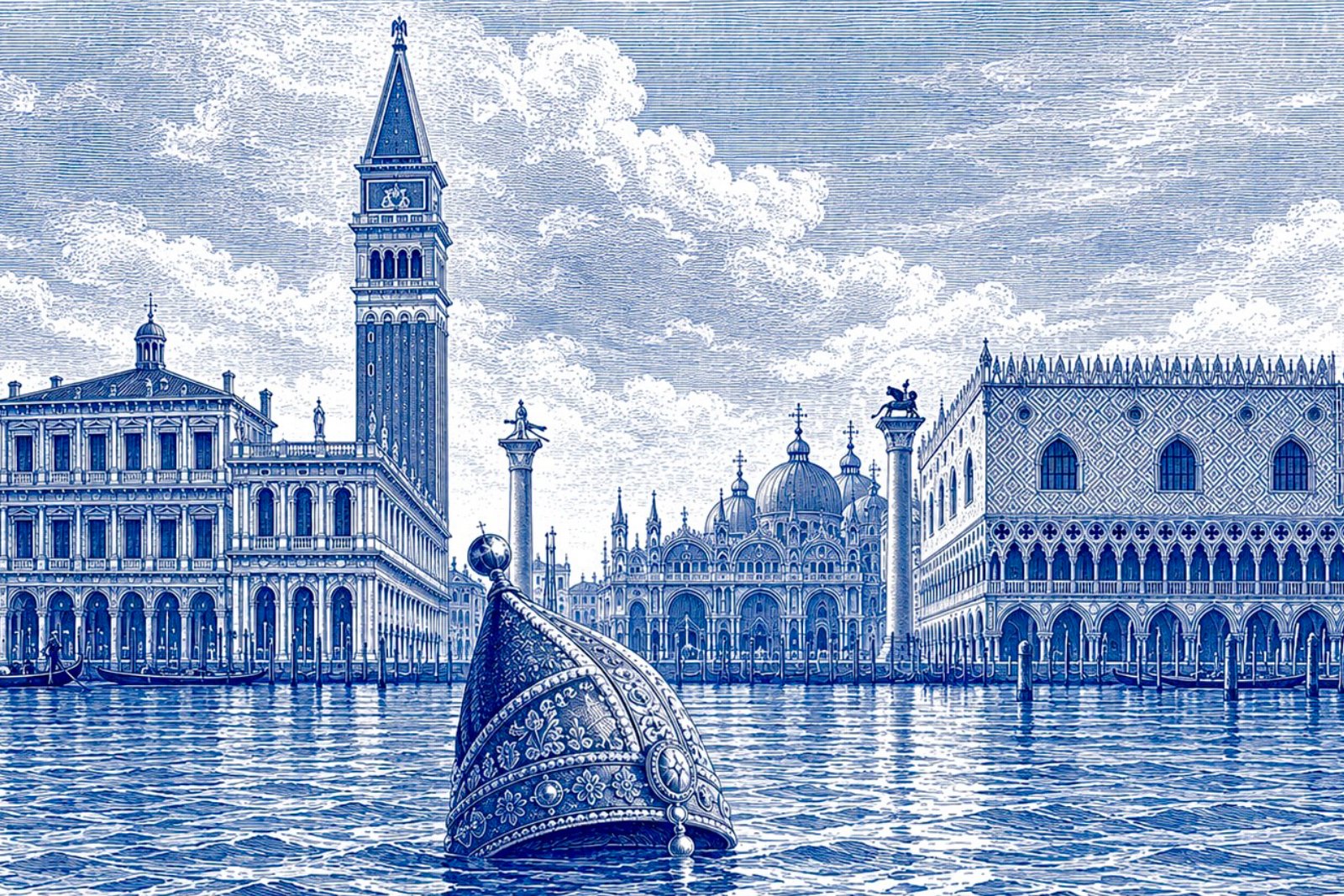
Venice dressed its head of state like no other republic in history. The Doge wore the corno ducale, a tall, horn-shaped cap unlike anything worn by any other ruler in Europe, was addressed with titles usually reserved for princes, and sat enthroned in paintings beside saints and allegorical virtues. His investiture was a full state ceremony, conducted in St Mark’s Basilica before the assembled nobility of the Republic, and he held the office for life once elected, an honour no other servant of the Venetian state ever received. He could not, however, open a letter from a foreign prince without two other officials standing beside him to witness it. The contrast between pomp without much real charge and procedure without mercy ran through the entire system by design.
Even reaching the office was designed to defeat ambition. Venice elected its Doge through a sequence of ballots and lotteries, something like ten stages in all, alternating the drawing of lots with committee votes, each stage narrowing and reshuffling the body of electors until a final college of forty one men chose the winner. No faction could reliably pack every stage of a process built, on purpose, to be nearly impossible to engineer. A man might spend a lifetime cultivating influence and still lose the office to the lottery before his allies ever got to vote.
The restrictions did not end once a Doge was safely elected, and they accumulated with every reign. Before each new election, a committee reviewed the ducal oath, the promissione ducale, and appended one more clause for every failure the previous Doge’s own conduct had just revealed. He could not receive foreign envoys in private. After 1268 he could not open diplomatic dispatches without other officials present. He could not leave Venice without the Great Council’s permission, and he could not own property in foreign territory. Each Doge, in effect, swore to a slightly longer list of things his predecessor had gotten away with.
His relatives drew the Republic’s suspicion too. After 1473, even a Doge’s own sons and grandsons were quietly fenced out of every council that actually mattered, the Great Council’s crowded, ceremonial benches excepted, as if ambition itself might be hereditary and had to be bred out across generations. Three years later the same relatives were forbidden from joining the boards of savii, the officials who actually ran the daily business of government. The restrictions held, with only minor exceptions granted from 1763 onward, for close to three centuries.
Nor was the Doge’s wife left outside the oath’s reach. The promissione ducale specified what the Dogaressa could wear and which ceremonial duties fell to her, extending the Republic’s appetite for control to the one household role that was not, strictly speaking, an office at all. If Venice was willing to legislate a woman’s wardrobe to prevent a family from quietly accumulating informal standing, it is a reasonable guess that very little about the Doge’s own position was ever left to custom or goodwill.
Sentiment had nothing to do with it. Venice’s patrician families had watched other Italian cities slide from republic into hereditary lordship, a single family’s temporary pre-eminence hardening, over two or three generations, into a permanent dynasty answering to no one. The Great Council had no intention of producing its own prince. Stripping the office of real power while loading it with ceremony solved the problem neatly: ambition could be rewarded without ever being allowed to accumulate into anything resembling a crown.
Accountability followed a Doge past his own death. A commission of inquisitors examined the record of his entire reign once he was no longer alive to argue his own case, and his estate could be fined for any breach of the oath that was only now being discovered. Venice gave a Doge the honours while he lived, and kept the liability for afterward, collecting it from whoever had inherited his house.
Profit was not guaranteed either, even for the man who held the office. By most accounts a Doge was expected to fund a share of the ceremonial life of the Republic from his own pocket, entertaining visiting dignitaries and maintaining a household scaled to his supposed dignity, and more than one Doge is said to have left his heirs poorer than his own inheritance had found him. Prestige, in this arrangement, operated as a tax payable partly in cash.
Centuries before any court of chancery existed, Venice had already arrived at a distinction that company law would eventually rediscover from first principles: the economic interest in an enterprise and the right to direct it are two separate goods, and they can be held by two different people without either arrangement being fraudulent. Wearing the horned cap entitled a man to magnificent treatment and a permanent place in the historical record. War, peace, taxation and appointment were made by councils that had outlasted every Doge before him and would go on making them after he was gone.
A minority shareholder in a modern company inherits a version of the same arrangement, without the cap. He is entitled to his proportional share of whatever the company earns. He can attend the annual meeting, ask questions, and cast a vote that will almost certainly be outvoted. He typically learns of the real decisions only afterward, in a filing or a press release: whether to expand, whether to borrow, whether to sell the whole enterprise to a competitor, each one made by somebody else first. The register decides, not the argument made in the room, and the register is held by whoever has control.
This is why control of a company is sold separately from the company it controls, and it never sells cheap. Control buys the future of the thing: who runs it, whether profits are paid out or reinvested, whether the whole business is ever sold and to whom. Two shareholders can own an identical fraction of the same company and live, in every practical sense, in different economies. One of them decides. The other is informed, politely and after the fact, and no amount of shareholder activism entirely closes that gap, since activism can only borrow influence that control already owns outright.
Silicon Valley reinvented a version of the arrangement as a share class, in dual-class structures now common among technology companies. Founders keep a class of shares carrying ten or twenty votes apiece, while the public buys a separate class carrying one vote or sometimes none, and pays, in effect, for economic participation in a business whose direction it will never influence. The structure is disclosed, legal, and priced accordingly: shares with inferior voting rights typically trade at a discount to otherwise identical shares carrying full votes, a gap investors have measured for decades without ever quite agreeing on how large it ought to be.
Index funds have created an even larger population of owners without control, though by choice of mandate rather than by any cap of fabric. A fund tracking a broad market index may hold a meaningful stake in thousands of companies simultaneously, entitled to vote at every one of them, yet built, by design, to vote predictably and rarely to initiate anything. Its managers collect the dividends, the capital gains and the proxy statements on behalf of millions of savers who hired the fund purely to hold the shares on their behalf.
Modern law softens the extremes without removing the underlying arrangement. Minority shareholders do have real protections: the right to sue over clear abuse, block related-party transactions, demand audited accounts. They restrain misconduct without granting direction. A well-treated minority holder still cannot decide to expand into a new market, still cannot remove the chief executive, and still cannot block a sale he considers unwise, provided the majority has followed the proper procedure. The remedy for mistreatment is legal and can be pursued in court. The remedy for simply losing an argument about strategy, which is a different grievance entirely, does not exist.
That bargain ran, in one form or another, for roughly a thousand years, long enough to suggest that most of the patricians subject to it were genuinely satisfied by the arrangement. Patricians who would never have accepted a Doge with real power lined up eagerly for the privilege of being one without it. Men will accept a remarkable quantity of honour in exchange for a modest amount of authority, provided the honour is dressed well enough and the title lasts for life. Venice finally fell in 1797, from outside, to Napoleon and an army the Republic’s elaborate constitutional safeguards had never been designed to resist. No Doge ever grew powerful enough, inside the system, to threaten the Republic himself; the danger that ended it had nothing to do with the office the corno ducale represented.
Leave a thought