


NOBODY KNOWS WHO CARVED UTA
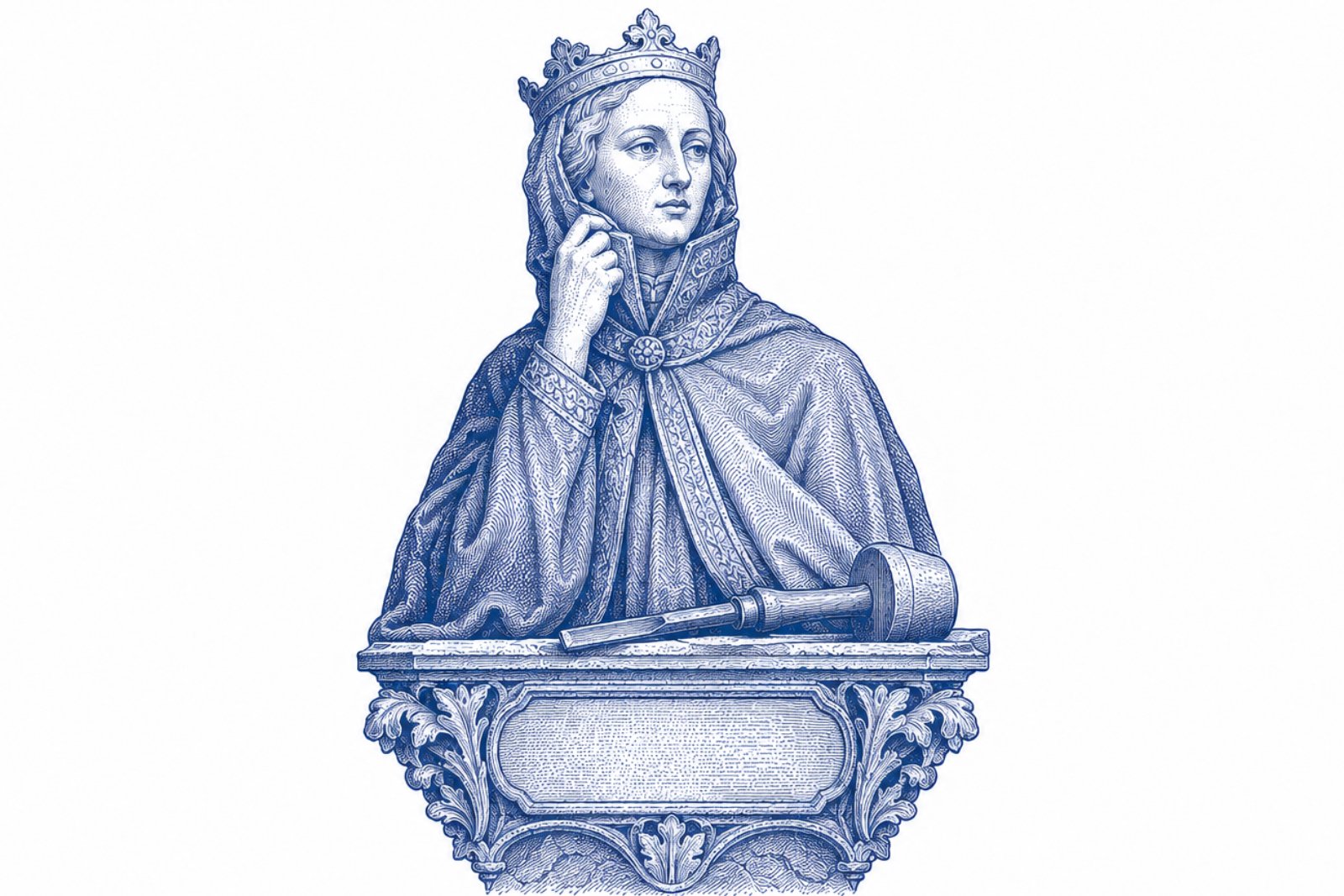
Uta of Ballenstedt died around 1046 and left almost nothing behind her except a dowry. She had married Ekkehard II, the margrave of Meissen, around 1026, and the couple had no children, so that the line of margraves ended with her husband. Naumburg remembered her as a benefactor of its cathedral, which in the eleventh century meant that somebody had been generous in her name. Of her looks, her temper or her opinions the record says nothing at all.
Some two hundred years later a sculptor was asked to give her a face. In the 1240s he began filling the west choir of the cathedral with twelve life-size figures of the founders, eight men and four women, carved in sandstone, painted and set in a half circle around the altar. He gave the margrave a double chin, a firm grip on his sword and a gaze on the altar, as if checking what his money had bought. He gave Count Syzzo a beard and a mouth open as if in mid-sentence, and Reglindis, the daughter of a Polish king, a smile rare enough in medieval stone to be remarked on. Uta he gave a heavy cloak, red, with a golden hem and a trim of green fur, which she draws up to her cheek with one hand, as if the choir were draughty, and a face so composed that the draught seems to be somebody else’s affair. A crown of lilies sits on her gilded hood, and her other hand wears a wedding ring. Of the twelve, I should want Reglindis on my right at dinner, and I suspect that I would spend the soup looking across the table at the lady in the cloak.
All twelve are in that choir because of money. They are the people who endowed the church, or were remembered as having done so, and the arrangement amounts to a receipt in stone: the donors are given faces, ranks and a place of honour beside the altar for ever. The cathedral’s own guide explains that the sculptor made Uta beautiful because she was noble, pious and a generous benefactress, which is a way of reading a face off the dowry. The craftsman who produced the receipt was presumably paid for it, and appears nowhere.
Nobody has found out who he was.
He goes in the literature as the Naumburg Master, after the town where his finest work stands. Scholars follow his hand by style. It leads from northern France, where he very probably trained and was at work around 1225 at Noyon, Amiens and Reims, to Mainz, and then to Naumburg, with a share of the founders at Meissen. The rood screen at Naumburg is attributed to him as well. Second from the left on its frieze, Judas receives his thirty pieces of silver, and the man who carved that transaction left no record of his own. No contract names him, no guild book lists him, and no document says what he was paid. The west choir was finished in the middle of the thirteenth century, and in the seven centuries and more since, no archive has surrendered his name.
Fame came late. A local newspaper reports that Goethe, Schiller and Nietzsche all visited the cathedral and saw nothing in the figures worth a remark. Three men with an opinion on everything went through the choir and kept it to themselves. The change came with the camera in the 1920s, when the photographer Walter Hege lit and posed Uta, in the cathedral’s own phrase, like a film star of the Ufa studios. The cathedral adds that one of the prints reached Walt Disney in 1935 and left a trace in the Evil Queen of Snow White. No document is offered for the claim, and it belongs with the legends. It would be a strange afterlife for a woman who drew her cloak against the draught.
The following decade was less amusing. The regime adopted her as an ideal of German womanhood, and a prominent art historian set her against her neighbour Reglindis, whose smile he found flighty and traced to her Polish blood. The smile survived the lecture, as stone smiles do. A photograph of Uta was set beside the exhibition of degenerate art in 1937, and Uta became a popular name for girls. A woman whose biography fits on a postcard had been conscripted into a cause, and the sculptor, who was dead and anonymous, could not be summoned to object.
She did not object either.
East Germany later used the same figures as models for socialist realist sculpture, and they stood through all of it with the same expression. Naumburg now holds an Uta meeting every two years, and the eighth, in 2022, drew 241 people over three days, 133 of them named Uta, a good turnout for an acquaintance of almost a thousand years who has never said a word.
Nothing the Naumburg Master made can come to market. The founders are part of the choir wall, the rood screen is part of the church, and a cathedral is not offered in lots. The most admired medieval sculptor in Germany therefore has no sale record, no provenance file and no price, since price needs a thing that can change hands and a name to attach to it. Scholars gave him a large exhibition in 2011 under the title The Naumburg Master, which is as close as the catalogue could come: a title standing where a signature should be. The show brought together more than three hundred works from Europe and the United States, and it came with a garden of the plants he carved on the capitals of the rood screen. Specialists can describe his style in great detail. They cannot write the line at the top of the catalogue entry.
A panel from Buckland Abbey in Devon was a Rembrandt, then was not, then was again. A property developer, Harold Samuel, owned a self-portrait of 1635 that had been accepted as a Rembrandt. In the late 1960s Horst Gerson suggested that a pupil had painted it, and in 1989 the Rembrandt Research Project placed it among the paintings whose authorship by Rembrandt cannot be accepted. By 2005 the project’s own corpus had softened the label to a studio piece with a question mark attached, and the panel went to the National Trust in 2010 and into storage. Then Ernst van de Wetering, who had once led the project, looked at it in person and thought it genuine. Eight months of testing at the Hamilton Kerr Institute removed the old varnish and showed that the signature had been put on when the picture was painted, and the National Trust announced a Rembrandt, valued by 2014 at about thirty million pounds. One historian reports that the family who once owned it had been told it was worth about twenty thousand. Between twenty thousand and thirty million lay one visit and one cleaning.
Another panel, better known, makes the same point at higher volume. In 2005 two dealers bought a darkened and heavily overpainted Christ at an estate sale in New Orleans, for less than ten thousand dollars by one report.
After years of restoration it was shown in 2011 at the National Gallery as a Leonardo. On 15 November 2017 it sold at Christie’s in New York for 450.3 million dollars, then the highest price ever paid at auction for a work of art. Specialists still disagree about how much of the Salvator Mundi is Leonardo’s own, and the price has not noticed. I would give a good deal to have been in the room in New Orleans.
Finance does the same with letters. A name is the cheapest guarantee a market can ask for, and a borrower without a rating from an agency may be better managed than one with three and still pays more for the missing letters. A fund manager with a short record stands where the Naumburg Master stands: the work may be superb, and the market has nothing to put in the box marked name.
Visitors to Naumburg, a regional paper noticed, find Uta high in the choir, at a distance, with her collar raised. Umberto Eco said that of all the women in European art she was the one he would most like to spend an evening with. The invitation, as reported, did not extend to the man who carved her. The man has no name to send it to.
Leave a thought